How Much Does a Boat Dock Really Cost
How Much Does Building a Dock Actually Cost?
How much does a boat dock cost in Charleston, SC? For most Lowcountry waterfront properties, a private dock runs about $25–$65 per square foot installed — roughly $25–$45/sq ft for a fixed piling dock and $35–$65/sq ft for a floating dock (per ProMatcher’s Charleston pricing data), putting a typical permitted residential dock between $15,000 and $45,000 depending on walkway length, pierhead size, materials, and OCRM permitting. BluTide Marine Construction prices and builds to those local realities — long tidal-creek walkways, 6–7 ft tides, OCRM size limits, and saltwater-grade materials.
A dock cost calculator helps you estimate the total investment for your waterfront project before a single pile hits the water. Here’s a quick snapshot of what to expect in 2025:
| Dock Type | Cost Per Sq Ft | Typical Total Range |
|---|---|---|
| Floating | $15 – $35 | $3,000 – $17,500 |
| Piling (stationary) | $20 – $40 | $4,000 – $20,000 |
| Aluminum pipe / roll-in | $15 – $35 | $3,000 – $15,000 |
| Crib | $50 – $100 | $10,000 – $50,000 |
| Suspension / cantilevered | $50 – $100 | $15,000 – $65,000 |
| Double-decker / boathouse | varies | $15,000 – $50,000+ |
National average: roughly $15,000, with most homeowners spending somewhere between $7,000 and $25,000 depending on size, materials, and site conditions.
If you own waterfront property in coastal South Carolina, you already know the stakes are high. The Lowcountry’s tidal creeks, marsh edges, and saltwater exposure don’t forgive cheap materials or sloppy planning. A dock here isn’t just a nice-to-have — it’s a structural investment that needs to survive hurricanes, shifting tides, and strict OCRM permitting requirements.
The problem? Nobody wants to give you a straight number.
Builders dodge quotes. Suppliers say “call for pricing.” And online resources give ranges so wide they’re almost useless. The goal of this guide is to change that — giving you real numbers, a clear formula, and the context you need to budget your dock project with confidence.
Breaking Down the Average Cost to Build a Dock
When we sit down with a homeowner in Johns Island or Charleston, the first question is always about the bottom line. While every shoreline is unique, we can look at 2026 Cost To Build A Dock — Prices By Type & Size to see that most projects fall into predictable buckets.
The average cost to build a dock typically ranges from $20 to $50 per square foot, with $40 being a very common “middle-of-the-road” rate for a professionally installed, high-quality structure. If you are looking at a standard 400-square-foot dock, you should expect a budget between $8,000 and $20,000, depending heavily on whether you choose basic pressure-treated lumber or high-end composite materials.
Cost Per Square Foot Benchmarks
Think of your dock like a house on stilts. The “foundation” (the pilings or floats) and the “flooring” (the decking) represent the bulk of your material rates. In the Lowcountry, labor often accounts for about $30 per square foot or roughly 50% of the total project cost. This is because marine construction requires specialized equipment, like barges and pile drivers, that you just don’t need for a backyard deck.
Regional labor rates in South Carolina generally fall between $40 and $110 per hour for skilled marine contractors. While it might be tempting to look for the lowest hourly rate, a dock in saltwater environments faces much more stress than one on a calm freshwater pond.
How to Estimate Square Footage for a Dock Cost Calculator
To use a dock cost calculator effectively, you need to know your numbers. We break a dock down into three main parts:
- The Walkway (Pier): This is the long stretch from your high-ground to the water. In South Carolina, these can be quite long to reach navigable water at low tide. (Length x Width = Sq Ft).
- The Pierhead: This is the “main stage” where you hang out, fish, or prep the boat. (Length x Width = Sq Ft).
- The Float: If you have a floating section for easy boat access, calculate that separately as it often uses different materials.
Add these together to get your total square footage. For example, a 40-foot walkway (4′ wide) and a 10’x12′ pierhead equals 280 square feet. At an average of $40/sq ft, your baseline estimate would be $11,200.
How to Use a Dock Cost Calculator for Your Project
Using a Dock Cost Calculator – Calculator Academy is a great way to play with “what-if” scenarios. What if I use Ipe hardwood instead of pine? What if I add a boat lift?
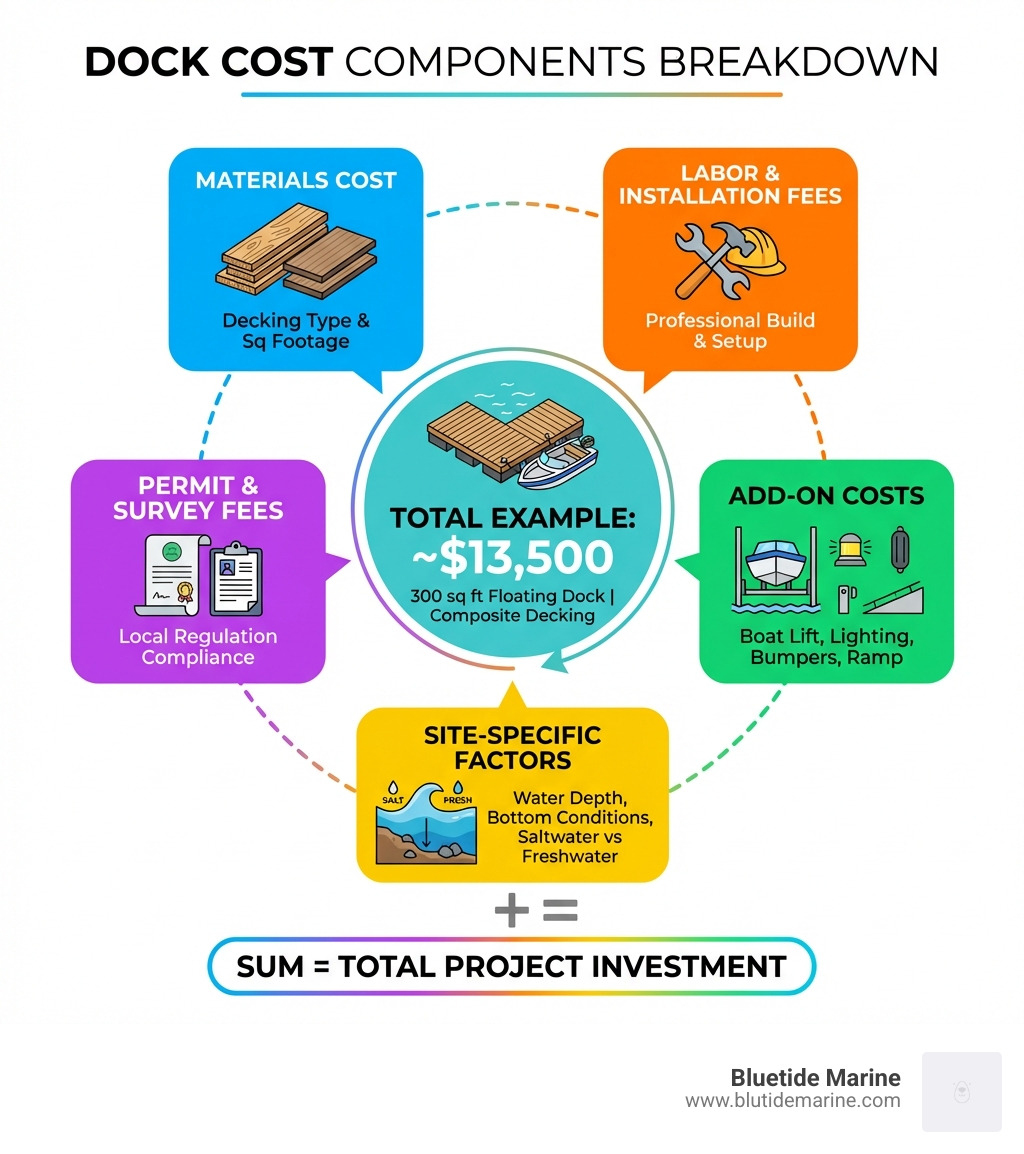
The basic formula we use is: Total Cost = (Square Footage x Material Rate) + Labor + Permits + Accessories.
Essential Inputs for Your Dock Cost Calculator
To get an accurate estimate, you can’t just guess. You need to know:
- Water Depth and Bottom Conditions: Are we driving pilings into soft pluff mud or hitting hard rock? Soft mud might require longer pilings (more expensive), while rocky bottoms might require specialized drilling.
- Material Choice: This is your biggest lever. Pressure-treated wood is the budget-friendly choice, but composite or PVC will last decades longer in the Charleston sun.
- Permit Fees: Don’t forget the paperwork! In our area, you’ll likely need an OCRM permit and potentially a joint permit with the Army Corps of Engineers.
Factoring in Add-ons with a Dock Cost Calculator
A “naked” dock is rarely the end of the story. Most of our clients want the bells and whistles that make waterfront living enjoyable.
- Boat Lifts: These range from $1,000 for a simple PWC lift to $12,000+ for a heavy-duty 12,000-lb lift capable of holding a large center console.
- Lighting: Solar piling caps are affordable, but wired-in LED systems with power pedestals provide better safety and ambiance.
- Bumpers and Cleats: Quality foam bumpers (like Hercules brand) are worth the investment to protect your hull from barnacle-encrusted pilings.
Comparing Dock Types and Material Costs
Not all docks are created equal. The type of structure you choose depends entirely on your specific slice of the Lowcountry.
Floating vs. Piling Docks
In areas with significant water fluctuation — like our 6-to-7-foot tides — floating docks are almost a necessity for boaters. They stay at the same level as your vessel, making boarding easy regardless of the tide. However, they require a stationary pier to attach to.
Stationary piling docks are the “gold standard” for stability. We drive heavy timber or concrete piles deep into the sub-surface. While they don’t move with the water, they are incredibly durable and can handle the “choppy” water of the harbor or larger rivers. According to DNR Permit Requirements (which vary by state but share common environmental goals), floating docks often have a lighter “footprint” on the underwater ecosystem because they don’t require as many permanent pilings.
For those looking for low maintenance, Aluminum Docks are an excellent freshwater choice, though in our saltwater environment, we have to be very careful about the grade of aluminum used to prevent corrosion.
Decking Material Price Points
The “skin” of your dock is what you’ll see and walk on every day.
- Pressure-Treated Wood: $5 – $8 per sq ft. It’s the classic choice, but it requires annual sealing to prevent rot and splinters.
- Composite Docks: $16 – $32 per sq ft. These offer the look of wood without the maintenance. They don’t rot, warp, or splinter, making them a favorite for families.
- Plastic Docks: $25 – $80 per sq ft. Often used in modular floating systems, these are incredibly durable and easy to clean.
- Concrete: $220 – $600 per sq ft. Usually reserved for commercial marinas or ultra-high-end residential projects, concrete is essentially permanent but very expensive.
Specialized Structures
If you want to go big, you might consider a double-decker dock or a boathouse. A double-decker dock can cost anywhere from $15,000 to $50,000. They are great for deep-water lots where you want a “jump-off” platform or a shaded upper deck for entertaining.
Crib docks, which use rock-filled wooden crates, are rare in the Lowcountry because they can interfere with tidal flow and are often restricted by environmental agencies. Suspension docks, which look like miniature bridges, are sometimes used to cross sensitive marsh areas without driving dozens of pilings.
Hidden Factors: Labor, Permits, and Site Conditions
The “sticker price” of materials is only half the battle. There are several “hidden” costs that can make a dock cost calculator jump if you aren’t prepared.
Professional Labor and Installation
Marine construction is a heavy-lift industry. We don’t just show up with a truck and a hammer. Most projects require a barge equipped with a crane and a pile driver. Mobilization fees — the cost to get that barge to your property — can be a significant part of the bill.
If you are interested in seeing how these professional crews operate, you can find more info about residential marine services on our site. Hiring a licensed marine contractor isn’t just a good idea; in South Carolina, it’s a legal requirement for any project over $5,000.
Environmental and Permitting Costs
In Charleston and the surrounding Lowcountry, the South Carolina Department of Health and Environmental Control (DHEC) and the Office of Ocean and Coastal Resource Management (OCRM) hold the keys to your dock.
Getting a permit for a private residential dock can take approximately 120 days. This process involves:
- A Certified Survey: A licensed surveyor must map your shoreline and property lines.
- Public Notice: Neighbors and the public often have a chance to comment on the project.
- Agency Review: OCRM ensures your dock doesn’t exceed size limits (usually based on the width of the creek) or harm the marsh.
Expect to spend anywhere from $500 to $3,000+ just on the permitting and surveying phase. Additionally, you must consider Hurricane Preparation for Vessel and Boat Lift to ensure your new investment is built to withstand the high winds and storm surges common to our coast.
Maintenance, Repairs, and Budgeting Mistakes
We’ve seen it all—from “DIY disasters” that wash away in the first Nor’easter to docks that rot from the inside out because the builder used the wrong fasteners.
Common Budgeting Pitfalls
- Using Untreated Wood: Never, ever use untreated or standard “ground contact” lumber for a dock. In saltwater, you need marine-grade pressure-treated wood (rated at .60 pcf or higher). Using the wrong wood is a “savings” that will cost you a full replacement in three years.
- Ignoring Tides: If your walkway is too low, a king tide will lift your deck boards right off the frame. If it’s too high, you’ll need a ladder just to get into your boat.
- Brand Lock-In: Some modular dock companies use proprietary parts. If a piece breaks five years from now and that company is out of business, you might have to replace the whole system. We prefer modular systems with universal fittings.
Replacement and Repair Estimates
If you already have a dock that’s seen better days, you might not need a total rebuild.
- Board Replacement: Replacing just the “skin” of your dock typically costs $5 to $15 per square foot for labor and materials.
- Piling Repair: If your pilings are solid but “necked down” at the waterline due to marine borers, we can sometimes install piling wraps or concrete jackets to extend their life.
For larger scale needs, you can find more info about commercial marine services which often involve heavy-duty structural reinforcement.
Frequently Asked Questions about Dock Costs
Does a boat dock increase home value?
Absolutely. In waterfront markets like Johns Island and Mount Pleasant, a permitted dock is one of the highest ROI (Return on Investment) projects you can undertake. It’s often compared to adding a swimming pool, but with a much broader appeal to buyers. A well-built dock can increase property value by $20,000 to $100,000+, often exceeding the cost of the build itself.
How long does it take to build a dock?
The actual construction usually takes 4 to 8 weeks once the barge arrives. However, the “pre-game” (permitting and surveying) takes much longer—usually 3 to 5 months. Total timeline from “I want a dock” to “Let’s go fishing” is typically 6 to 9 months.
Can you insure a boat dock?
Yes. Most homeowners’ insurance policies cover docks under “Other Structures” (Coverage B). However, in coastal South Carolina, you should verify if your policy covers “wind and hail” for marine structures, as some standard policies exclude them or require a separate endorsement.
How much does it cost to build a dock in Charleston, SC?
In Charleston and the surrounding Lowcountry, expect roughly $25–$65 per square foot installed — about $25–$45/sq ft for fixed piling docks and $35–$65/sq ft for floating docks. A typical permitted residential dock lands between $15,000 and $45,000, with longer tidal-creek walkways and add-ons like boat lifts pushing the total higher. Budget another $500–$3,000+ for permitting and surveying.
Do you need a permit to build a dock in Charleston?
Yes. Private docks in the Charleston area need a critical-area permit through SC DHEC’s Office of Ocean and Coastal Resource Management (OCRM), and many also require a joint permit with the US Army Corps of Engineers. The process includes a certified survey, a public-comment window, and agency review of size limits based on creek width — typically about 120 days start to finish.
Conclusion
Building a dock in the Lowcountry is a journey, not a weekend project. From navigating the complexities of OCRM permits to choosing materials that can stand up to the relentless Charleston sun and salt, there is a lot to consider.
While a dock cost calculator provides a great starting point, nothing beats a site visit from a team that knows the local pluff mud and tidal currents. At BluTide Marine, we specialize in tailored building adapted to the unique challenges of the Charleston waterfront. Whether you are looking for a simple fishing pier or a complex double-decker boathouse, we are here to help you build smart, budget right, and enjoy the water for years to come.
Ready to turn your waterfront vision into reality? Contact BluTide Marine for a Custom Quote and let’s start planning your project today.