How to Measure Your Way to the Perfect Boat Dock
Why Getting Your Boat Dock Size Right Matters From the Start
Average boat dock size varies by use, but here are the most common dimensions to know:
| Use Case | Typical Dock Size |
|---|---|
| Basic boat mooring | 8 ft x 20 ft |
| Single boat + lounging | 16 ft x 16 ft |
| Multi-use / entertaining | 18 ft x 20 ft or 20 ft x 20 ft |
| Party / large group | 24 ft wide platform |
| General rule of thumb | ~2/3 of your boat’s length |
Quick reference by boat length:
- 30-foot boat → ~20-foot dock
- 40-foot boat → ~27-foot dock
- 50-foot boat → ~33-foot dock
You’ve got a beautiful stretch of Lowcountry waterfront. Now you need a dock that actually fits — your boat, your lifestyle, and South Carolina’s strict permitting rules.
The problem? Most people start with the wrong question. They ask “how long should my dock be?” when they should be asking “what do I actually need this dock to do?”
Dock size isn’t just about your boat’s length. It’s shaped by your shoreline, water depth, tidal swing, how you plan to use the space, and what OCRM will actually allow. Get it wrong and you’re either rebuilding too soon or stuck with a permit violation.
This guide walks you through every dimension that matters — from the basic 2/3 length rule to South Carolina’s creek-width calculations — so you can build once and build right.
Understanding the Average Boat Dock Size and Dimensions
When we talk about the average boat dock size, we aren’t just picking a number out of a hat. In the Lowcountry, the “average” is a balance between the physical needs of your vessel and the environmental realities of the Charleston harbor and its surrounding creeks.
To find your ideal size, you have to look at three primary numbers: the Length Overall (LOA) of your boat, the beam (its width at the widest point), and the draft (how deep it sits in the water).
| Boat Length | Recommended Dock Length | Recommended Slip Width |
|---|---|---|
| 20 ft | 14 ft | 12-13 ft |
| 30 ft | 20 ft | 14-15 ft |
| 40 ft | 27 ft | 17-18 ft |
| 50 ft | 33 ft | 20-22 ft |
Calculating the Average Boat Dock Size for Your Vessel
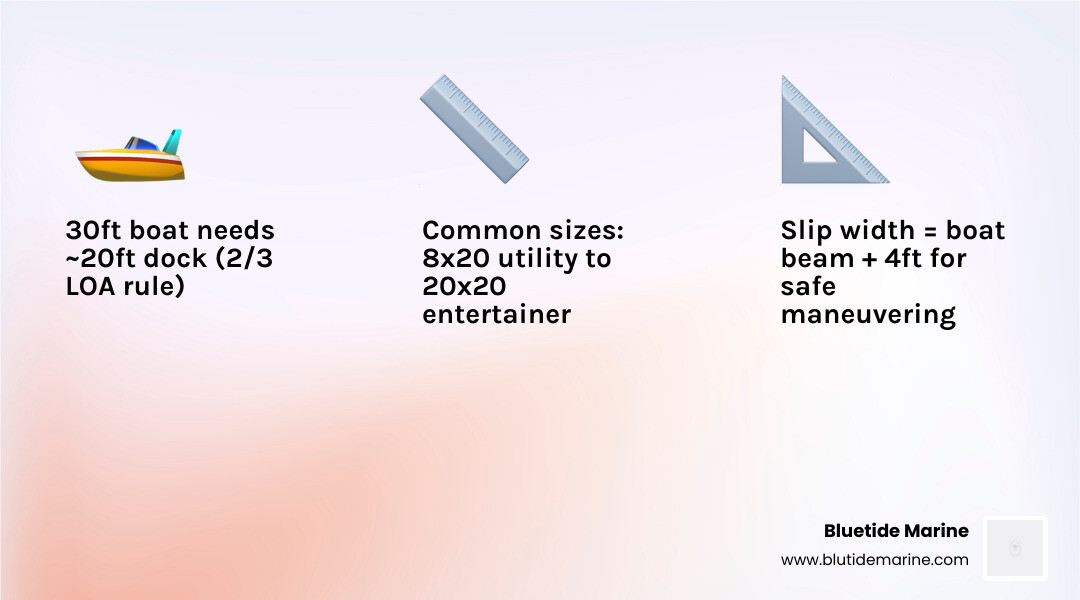
The golden rule in the marine industry is the 2/3 rule. This means your dock length should be approximately two-thirds the length of your boat. For example, if you own a 30-foot center console, a 20-foot dock is generally sufficient to secure the bow, stern, and spring lines safely. If you’ve upgraded to a 50-foot yacht, you’re looking at a dock length of roughly 33 feet.
However, length is only half the battle. Maneuvering space is where many new dock owners get caught off guard. We always recommend adding at least 2 feet of extra space on either side of your boat’s beam for a slip. If your boat is 10 feet wide, your slip should be at least 14 feet wide. This “buffer zone” prevents the “parking garage” anxiety that comes with trying to dock in a tight space during a heavy Charleston afternoon current.
For more detailed insights on matching dimensions to specific boat types, check out this What Size Boat Dock Do I Need? Boat Dock Size and Dimensions Guide.
Minimum Width and Stability Requirements
While the length is determined by your boat, the width of the dock is often determined by human comfort and physics.
- The 3-Foot Rule: This is the absolute practical minimum width for any dock or walkway. Anything narrower feels like a balance beam, especially when you’re carrying a heavy cooler or fishing gear.
- The Platform Standard: Most residential docks in our area feature platforms (or “pier heads”) ranging from 8 feet to 24 feet wide. An 8-foot width is great for utility, but if you want two people to pass each other comfortably, 10 to 12 feet is much better.
- Floating Dock Stability: If you are opting for a floating dock, size equals stability. A tiny floating dock will tip and bob like a cork. The industry consensus for a stable floating dock is a minimum footprint of 6′ x 20′ with a total weight of at least 1,000 lbs. To keep it from tipping when you step on the edge, we install floats toward the perimeter to distribute the load effectively.
Key Factors Influencing Your Ideal Dock Size
In Charleston and Johns Island, the “perfect” size is often dictated by Mother Nature. Unlike a calm inland lake, our coastal waters are dynamic.
- Water Depth and Tides: We have a significant tidal range in the Lowcountry. Your dock needs to reach water that is deep enough to keep your boat afloat even at “King Tide” lows. If your shoreline is shallow, your walkway might need to be longer to reach that sweet spot.
- Shoreline Type: Is your property on a high bluff or a low-lying marsh? This determines the “walkway” portion of your dock.
- Boat Weight: Heavier boats exert more stress on the dock structure. If you have a massive sportfish, your dock won’t just need to be longer; it will need larger pilings and reinforced framing to handle the load.
Before you start digging, it is vital to understand Advanced considerations for dock permitting to ensure your dream dock doesn’t run afoul of federal guidelines.
How Usage Impacts the Average Boat Dock Size
How do you spend your Saturdays? Your lifestyle is a huge factor in determining the average boat dock size for your specific lot.
- Mooring Only: If the dock is strictly a place to park the boat, a simple straight dock following the 2/3 rule is perfect.
- The “Entertainer”: A 16×16 foot pier head is the “sweet spot” for many Charleston families. It provides enough room for a few chairs, a small table, and space to walk around the boat.
- The Party Dock: If you envision sunset cocktails with ten friends, you’ll want a 24-foot wide platform. This allows for “Aunt Mabel” to have her favorite deck chair in the corner without being in the way of the grill or the kids jumping into the water.
- Fishing and Gear Storage: If you need space for fish cleaning tables, storage lockers, and multiple rod holders, you’ll need to add square footage beyond the basic mooring requirements.
Environmental Constraints and Water Conditions
The Lowcountry’s “Pluff Mud” is legendary, but it’s a challenge for dock builders.
- Mud Bottoms: Because our bottom is often soft, pilings must be driven deep—sometimes 20 to 30 feet—to find stable ground. This can sometimes limit how large of a fixed structure you can build without exponentially increasing costs.
- Currents and Waves: If you are on the Wando or Cooper River, you’re dealing with heavy currents. Larger docks offer more “surface area” for water to push against, so they must be engineered with stronger hardware.
- Saltwater Corrosion: Everything in Charleston wants to rust or rot. We use marine-grade pressure-treated lumber or composite decking to ensure that no matter the size, your dock stands the test of time.
Popular Dock Configurations and Recommended Sizes
The shape of your dock is just as important as its size. The right configuration makes docking easier and maximizes your usable square footage.
Straight and L-Shaped Layouts
- Straight Docks: These are the most common and cost-effective. An 8×20 utility dock is a standard starting point for many. It’s simple, efficient, and fits well on narrow lots.
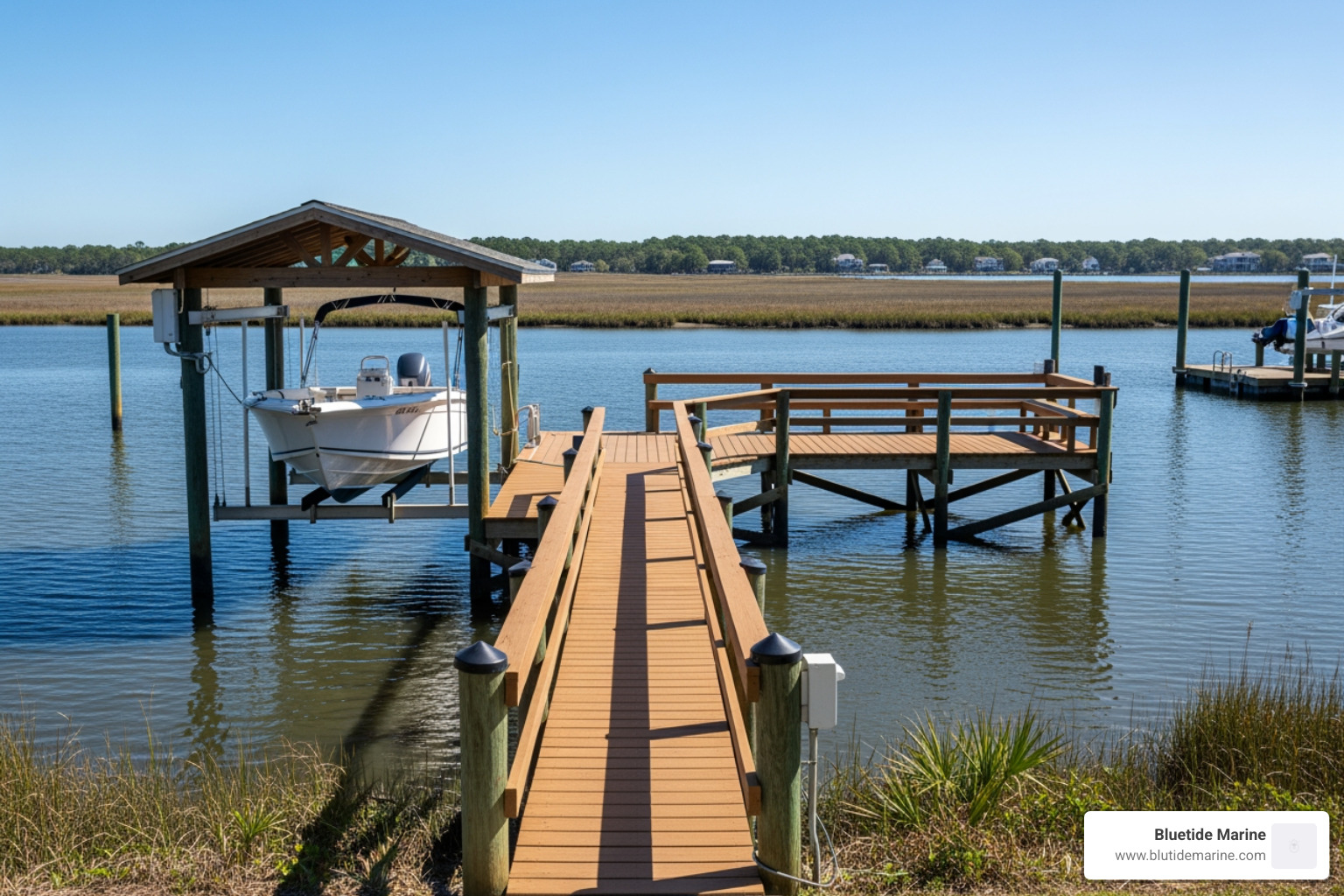
- L-Shaped Docks: By adding a “wing” to the end of a straight dock, you create a protected corner for your boat while leaving the main platform open for lounging. This is a favorite for shallow water access, as it allows the boat to sit further out in the channel while the “L” provides a stable area for swimming or fishing. An 18×20 long ramp configuration is often used here to bridge the gap between the shore and deep water.
U-Shape and Custom Configurations
- U-Shaped Docks: If you want maximum protection for your vessel, the U-shape is king. It surrounds the boat on three sides, making it incredibly easy to step on and off from any angle. It’s essentially a “parking space” for your boat.
- The Entertainer (20×20): This is the ultimate “Lowcountry Lifestyle” dock. It’s large enough for a covered roof (if permitted), a boat lift, and a dedicated seating area.
- Modular Add-ons: Many modern docks now integrate “Waveports” or jet ski ports. These modular additions allow you to expand your average boat dock size as your fleet grows.
For a look at how these shapes are managed across state lines, see the Private Recreational Dock Management in Georgia and South Carolina comparison.
Navigating Regulations and Permitting in the Lowcountry
In Charleston, you can’t just build whatever you want. We work closely with OCRM (Ocean & Coastal Resource Management) and SC DHEC to ensure every dock meets strict environmental standards.
South Carolina Specific Size Limits
South Carolina has very specific rules designed to protect our marshes and “Critical Areas.”
- Riparian Frontage: Generally, you need at least 75 feet of shoreline frontage for a single-family dock (50 feet for a shared dock).
- Walkway Dimensions: Walkways are typically limited to 4 feet in width. This minimizes the “shading” effect on the marsh grass below.
- The 1,000-Foot Rule: The maximum length for a dock walkway is 1,000 feet. While most of us don’t need that much, it’s the legal ceiling.
- Pier Head Size: This is often determined by the width of the creek.
- Creeks 20-50 feet wide: Max 120 sq ft pier head.
- Creeks 51-150 feet wide: Max 160 sq ft pier head.
- Creeks >150 feet wide: Max 600 sq ft pier head.
- Boat Lifts: A standard boat lift is typically permitted at 160 square feet.
Future-Proofing and Modular Growth
We always tell our clients: build for the boat you want, not just the boat you have. If you think you might upgrade from a 22-foot skiff to a 30-foot center console in three years, size your dock for the 30-footer now.
- Modular Floating Docks: These are a game-changer for future-proofing. You can start with a basic 10×20 platform and add expansion kits later as your needs change.
- Resale Value: A well-built, appropriately sized dock is one of the best investments you can make. It typically adds between 8% and 15% to your property’s ROI. In a boating-heavy market like Charleston, a dock is often the deciding factor for a buyer.
Frequently Asked Questions about Boat Dock Sizing
What is the minimum size for a stable floating dock?
For a floating dock to feel safe and stable underfoot, we recommend a minimum size of 6′ x 20′. It should weigh at least 1,000 lbs to prevent excessive tossing in the water. For the best results, floats should be placed at the outer perimeter to maximize stability, and the “freeboard” (the distance from the water to the dock surface) should be adjusted based on your boat’s height.
How much extra space is needed in a boat slip?
Safe maneuvering requires a buffer. You should aim for at least 2 feet of clearance on each side of your boat’s beam. This 4-foot total extra width allows for bumper clearance and gives you room to breathe if the wind or tide catches your hull during docking.
Does water depth limit my dock size or type?
Absolutely.
- Pipe Docks: Generally limited to water depths of 7 feet or less.
- Crib Docks: Usually capped at 8 feet of depth.
- Piling Docks: These are the standard for Charleston because they can be driven deep into the mud to reach stable strata, allowing them to work in much deeper water and handle our significant tidal swings.
Conclusion
Finding the perfect average boat dock size isn’t about following a generic template; it’s about tailoring a solution to your specific slice of the Lowcountry. Whether you’re on a narrow creek in Southeast South Carolina or facing the open waters of the Charleston harbor, your dock should be a seamless extension of your home.
At Bluetide Marine, we specialize in navigating the unique challenges of Charleston’s waterfront—from OCRM permits to deep-water pile driving. We don’t just build docks; we build the foundation for your best days on the water.
Ready to start planning? More info about residential dock services is just a click away. Let’s build something that lasts.