Your Step-by-Step Guide to Becoming a Marine Contractor
What It Really Takes to Become a Marine Contractor
How to become a marine contractor is a question more people are asking — and for good reason. It’s a skilled trade with strong pay, real job security, and work that genuinely matters to coastal communities.
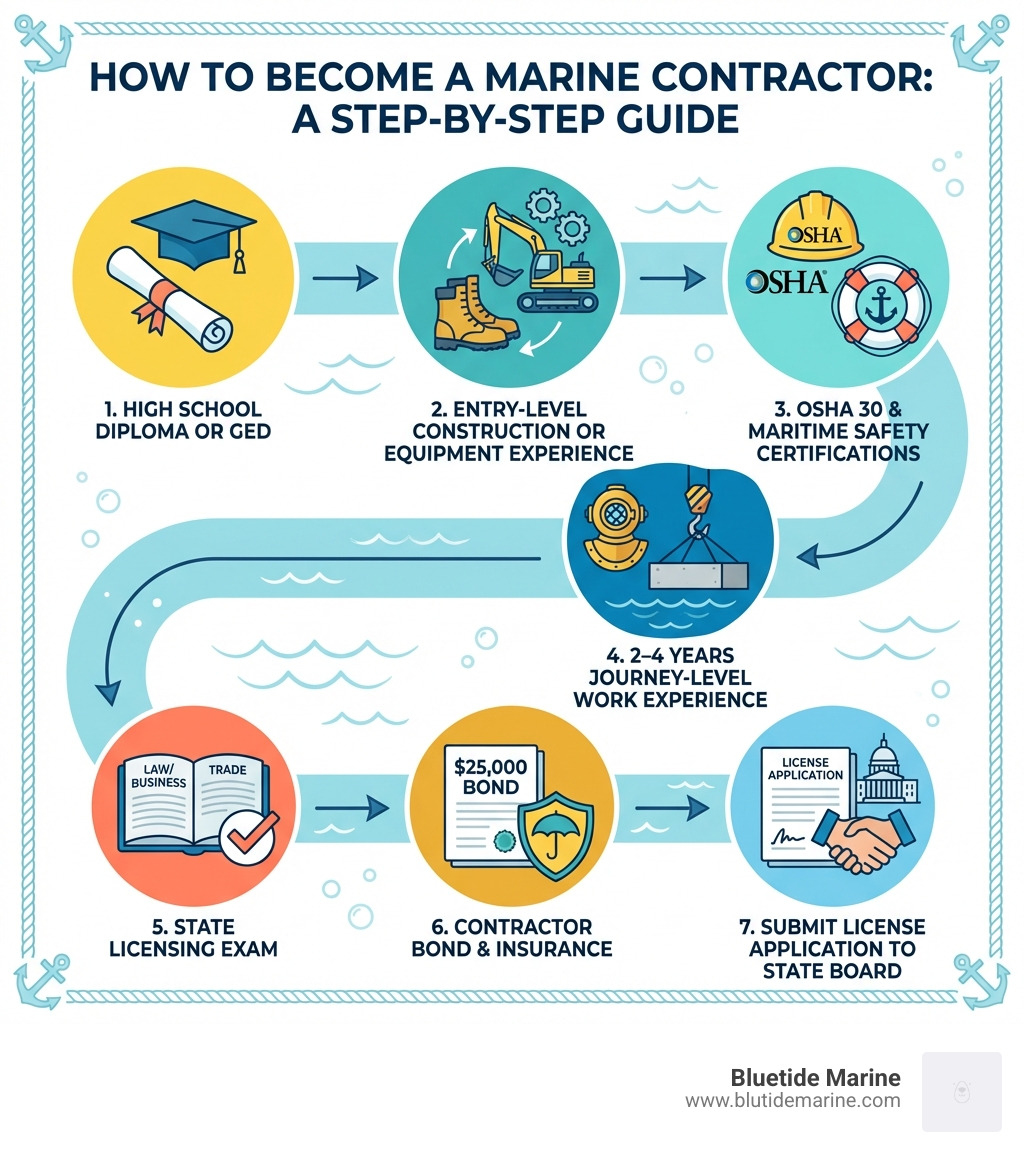
Here’s the short answer:
- Get a high school diploma or GED
- Build hands-on experience in construction, heavy equipment, or a related trade
- Complete safety training (OSHA 30, US Coast Guard requirements, maritime certifications)
- Gain journey-level work experience — most states require 2–4 years before you can apply for a license
- Pass your state licensing exams (law/business and trade-specific tests)
- Secure your bond and insurance — typically a $25,000 contractor bond plus general liability and workers’ comp
- Apply for your contractor license through your state licensing board
The path isn’t short — but it’s very achievable without a four-year degree.
Marine construction is one of the most specialized corners of the trades. You’re not just building — you’re building on water, against tides, currents, and weather that never stops moving. Every project adds complexity that simply doesn’t exist on dry land.
For waterfront property owners in places like coastal South Carolina, the stakes are high. A poorly built bulkhead or dock doesn’t just fail — it can accelerate erosion, damage neighboring properties, and cost far more to fix than it did to build wrong the first time. That’s why understanding who a marine contractor is, and what it takes to become one, matters whether you’re entering the trade or hiring someone for your waterfront.
Understanding the Role: What Does a Marine Contractor Do?
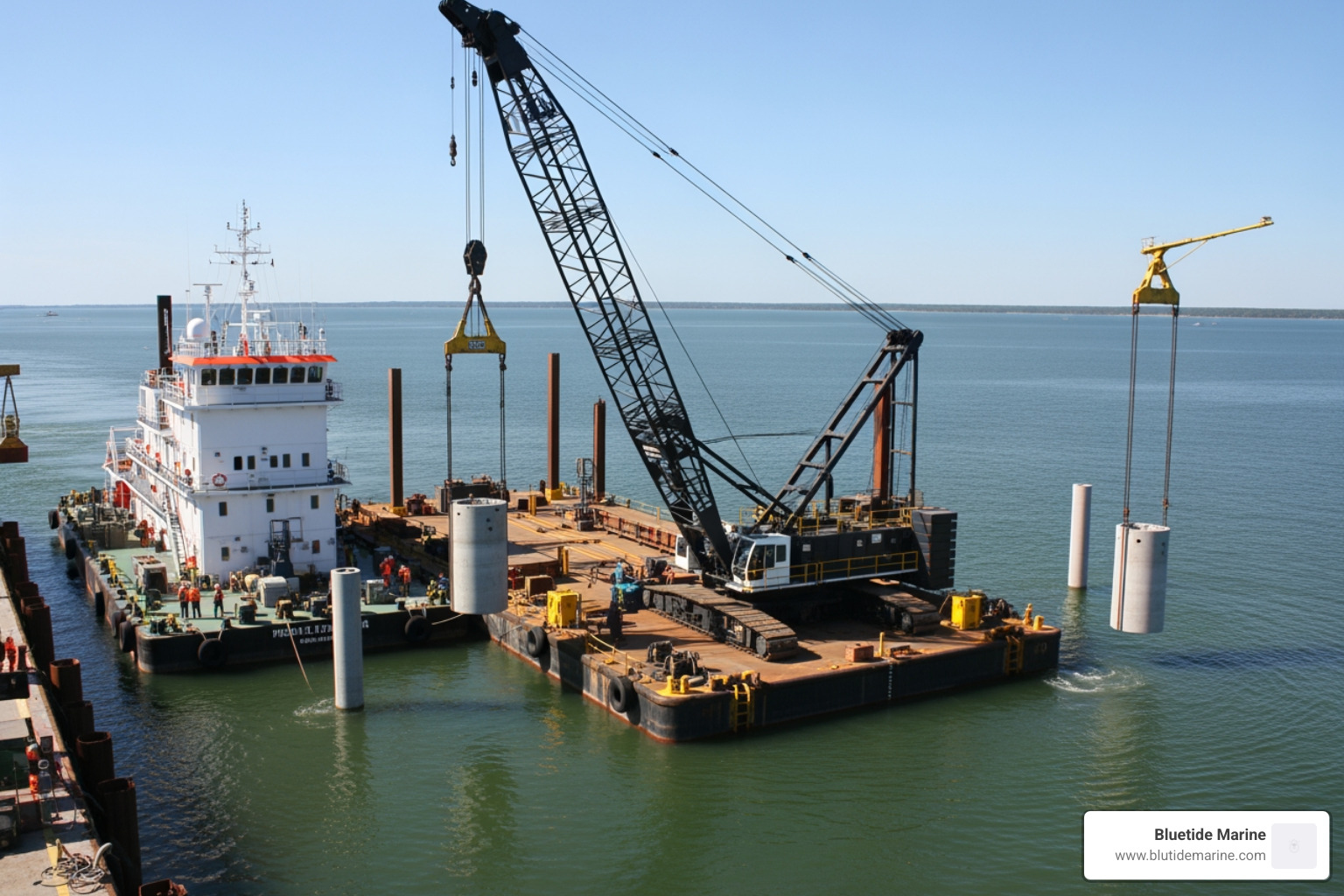
At its core, marine construction involves the building, maintenance, and repair of structures that sit in or around the water. Unlike a standard home builder, we have to account for the constant movement of the environment. Whether it’s the salt air of the Lowcountry or the shifting sands of a riverbed, every material and every nail has to be chosen for its ability to withstand the elements.
According to the UBC Pile Drivers Marine Construction Guide, staying competitive in this industry requires a constant focus on safety and precision. We aren’t just “carpenters on boats.” We are specialists who understand coastal processes, sediment transport, and the engineering required to keep a structure standing when a hurricane rolls through Charleston.
Types of Marine Construction Projects
The scope of work for a marine contractor is incredibly diverse. On any given day in the Southeast, we might be working on:
- Residential Docks and Piers: Creating access to the water for homeowners.
- Bulkheads and Seawalls: Essential for shoreline stabilization and preventing erosion.
- Boat Lifts and Boathouses: Protecting valuable vessels from the tides.
- Bridges and Marinas: Large-scale infrastructure that supports local travel and tourism.
- Dredging: Clearing out sediment to maintain navigable waterways.
- Mooring Systems and Fender Systems: Ensuring ships and boats can dock safely without damaging the structure.
Unique Challenges of Working on Water
Working on the water adds roughly 8 to 10 layers of complexity compared to land-based construction. On land, if you forget a tool, you walk to the truck. In marine construction, if you forget a specialized piece of equipment, it might take a four-hour tugboat trip to retrieve it, costing the project thousands in idle crane time.
We also have to deal with:
- Tides and Currents: In the Lowcountry, tides can swing significantly throughout the day, changing the water depth and the pressure on our structures.
- Dynamic Environments: Nothing stops moving. We have to perform buoyancy and weight calculations for every single lift to prevent barge rollovers.
- Logistics: Planning must happen weeks or months in advance. Materials must be loaded onto barges in a specific reverse order to maintain balance and stability.
Essential Skills and Education for Aspiring Marine Contractors
You don’t need a fancy degree to start your journey toward how to become a marine contractor, but you do need a solid foundation. Most entry-level roles require a high school diploma or GED. Beyond that, the most successful contractors are those who can read blueprints, understand basic marine engineering, and have the physical fitness to handle long hours in varying weather conditions.
| Role | Typical Pay | Key Skills Needed |
|---|---|---|
| Entry-Level Labor | $18–$25 / hour | Physical stamina, basic tool use, safety awareness |
| Skilled Trades (Welder/Carpenter) | $30–$45 / hour | Specialized certifications, blueprint reading, precision |
| Specialized Roles (Diver/Crane Op) | $45+ / hour | Commercial diving certs, heavy equipment licenses |
| Project Superintendent | $90,000+ / year | Management, logistics, advanced safety knowledge |
Gaining Experience: How to Become a Marine Contractor through Apprenticeships
One of the best ways to enter the field is through a registered apprenticeship. Organizations like the UBC Pile Drivers offer federally registered programs in the U.S. and Canada. These programs combine classroom learning with paid, on-the-job training.
By working as an apprentice, you gain “journey-level” experience. This is critical because most licensing boards, including those in the Southeast, require you to prove you have worked in the trade for several years before you can even sit for a contractor’s exam.
Specialized Training and Trade Schools
If you want to fast-track your career, consider specializing in a high-demand niche.
- Welding: Underwater welding is one of the most challenging and highest-paying roles in the industry.
- Commercial Diving: Many marine projects require underwater inspections and repairs.
- Marine Carpentry: Understanding how pressure-treated wood and composite materials react to saltwater is a science in itself.
- Rigging and Signaling: Safety is paramount when moving heavy piles. Programs like the UBC Certified Rigger and Signaler Program are accredited and highly valued by employers.
How to Become a Marine Contractor: The Licensing and Certification Path
Once you have the skills, you need the legal authority to operate. In many states, any project valued over a certain amount (often $1,000 to $5,000) must be performed by a licensed contractor.
To become a “qualifier” for a license, you typically need at least four years of journey-level experience within the last ten years. At least one of those years usually needs to be in a supervisory or foreman role. This ensures that the person holding the license actually knows how to manage a crew and a job site safely.
State-Specific Requirements: How to Become a Marine Contractor in Your Region
Since we focus on the Lowcountry and Charleston, SC, it is vital to look at the South Carolina Contractor’s Licensing Board. South Carolina offers a specific “Marine Contractor” classification.
To get licensed here, you must:
- Demonstrate Experience: Show a history of working on fixed and floating marine structures.
- Financial Statements: Provide proof of financial stability, which determines your “bid limit” (the maximum size of a project you can legally take on).
- Submit Fees: Expect to pay several hundred dollars in application and initial license fees.
For those looking to prepare, there are Marine Contractor License – In-Person Classes in South Carolina that help you navigate the specific technical and legal questions you’ll face on the exam.
Preparing for and Passing Licensing Exams
The licensing exam isn’t just about how to drive a pile. It’s split into two main parts:
- Business and Law: This covers contracts, lien laws, payroll taxes, and safety regulations.
- Trade Exam: This tests your technical knowledge of marine construction, from concrete mixtures for saltwater environments to the proper use of filter cloth in bulkheads.
Many contractors use study guides and continuing education modules to stay sharp. The goal of these exams is consumer protection — ensuring that every licensed contractor has the baseline knowledge to build structures that won’t fall into the harbor.
Navigating Safety Regulations and Financial Requirements
Safety isn’t just a suggestion in marine construction; it’s a “top-priority business deliverable.” Because we work on floating vessels, we have to follow both OSHA regulations and U.S. Coast Guard (USCG) rules. This includes regular man-overboard drills, fire safety training on tugboats, and specialized safety standards for diving crews.
Mandatory Credentials and Identification
To work on most commercial waterfronts or ports, you will need specific federal credentials:
- TWIC (Transportation Worker Identification Credential): Issued by the TSA, this is mandatory for anyone requiring unescorted access to secure areas of port facilities and vessels.
- MMC (Merchant Mariner Credential): If your role involves operating vessels or working as part of a professional crew, the USCG issues this credential. You can find more details on the National Maritime Center (NMC) website.
Bonds, Insurance, and Business Setup
Starting your own marine contracting business requires more than just a boat and some tools. You’ll need:
- Contractor Bonds: Often a $25,000 bond is required to protect the public and the state.
- General Liability Insurance: Essential for protecting your business against accidents.
- Workers’ Compensation: Mandatory in South Carolina for most businesses with employees, especially in a high-risk field like ours.
- Federal Tax ID (EIN): For tax and hiring purposes.
- Vehicle and Equipment Markings: In many jurisdictions, you are required to display your license number in 3-inch block lettering on your trucks and heavy equipment at every job site.
Career Outlook: Salaries and Finding Your First Job
The demand for skilled marine contractors is higher than ever. Coastal erosion, rising sea levels, and the need for updated infrastructure mean there is no shortage of work.
As mentioned earlier, entry-level workers can expect to start around $18–$25 per hour. However, once you specialize—becoming a certified diver, a friction crane operator, or a project superintendent—your earning potential jumps significantly, with many experienced pros making $90,000 or more annually.
Where to Find Marine Construction Opportunities
If you’re ready to dive in, there are several paths to your first job:
- Staffing Agencies: Firms like Gillmann Services or NCW often have openings for tradespeople in marine environments.
- Unions: Joining a union like the UBC Pile Drivers provides a clear path for training and job placement.
- Military-to-Mariner Programs: If you are a veteran with Navy or Coast Guard experience, there are fast-track programs designed to help you transition your skills into the Merchant Marine or marine construction.
- Local Networking: In the Lowcountry, the marine community is tight-knit. Visiting local boatyards or reaching out to established contractors in Charleston can often lead to entry-level labor opportunities where you can prove your worth.
Frequently Asked Questions about Marine Contracting
How long does it take to become a licensed marine contractor?
Generally, it takes 4 to 5 years. You need time to gain the hands-on journey-level experience required by state licensing boards. Once you have the experience, the application and exam process usually takes 3 to 6 months.
Do I need a college degree for marine construction?
No. While a degree in civil engineering or marine biology can be helpful for project management roles, the vast majority of marine contractors build their careers through trade schools, apprenticeships, and on-the-job experience.
What is the difference between a marine contractor and a general contractor?
A general contractor typically handles land-based residential or commercial building. A marine contractor is a specialty contractor with the equipment (barges, pile drivers) and the expertise (tides, coastal engineering, underwater materials) required to build safely in a water environment. Land-based building principles often do not apply to the dynamic forces of the ocean.
Conclusion
Becoming a marine contractor is a journey of grit, precision, and a deep respect for the water. It’s a career that allows you to see the tangible results of your hard work every time a boat ties up to a dock you built or a shoreline remains stable during a storm.
At Bluetide Marine, we live and breathe these challenges every day. We specialize in marine construction for the Lowcountry waterfront in Charleston, SC. Our USP is tailored building adapted to the unique waterfront challenges of our region—from the pluff mud of Johns Island to the historic tides of the Charleston Harbor.
Whether you are looking to start your career in the trades or you need a team that understands the complexities of South Carolina’s coast, we are here to help. Building on the water is a science and an art, and we take pride in doing it right the first time.
Ready to start your project or learn more about the industry? Contact Blutide Marine today.