Top Docks Charleston SC Guide 2026
What You Need to Know About Docks in Charleston, SC
Docks Charleston SC are a cornerstone of waterfront living in the Lowcountry — and choosing the right one makes all the difference.
Here’s a quick overview of what you’ll find in Charleston’s dock scene:
| Category | Key Details |
|---|---|
| Dock Types | Fixed piers, floating docks, community docks, commercial terminals |
| Common Materials | Composite (Trex), hardwood (Ipe, Garapa), aluminum, vinyl |
| Permitting Bodies | SC OCRM, U.S. Army Corps of Engineers |
| Top Uses | Residential access, boat lifts, marinas, commercial cargo |
| Key Challenge | Tidal range, erosion, environmental compliance |
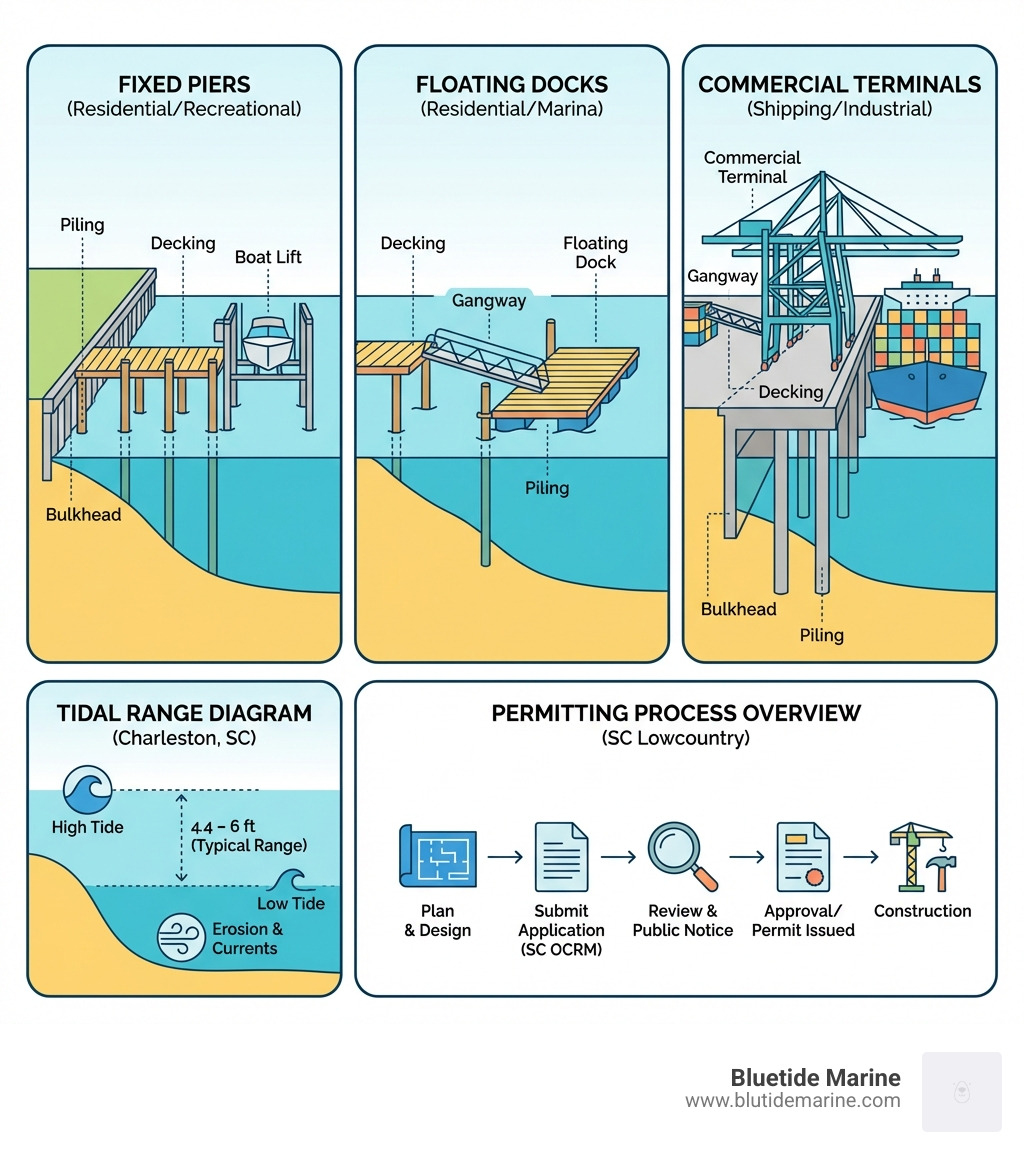
Charleston sits on one of the most dynamic coastlines in the Southeast. Its tidal range swings between 4.4 and 6 feet, and its waterways are shaped by shifting marsh, soft sediment, and strong currents. That’s a tough environment for any structure built over water.
Whether you’re a homeowner wanting simple creek access, or a property owner needing a fully permitted dock with a boat lift and seawall, the Lowcountry has its own rules — literally and practically.
The good news? Charleston has a deep tradition of marine construction. Local contractors have been building docks here for decades, learning exactly how to design structures that hold up against the salt, tides, and storms this region throws at them.
This guide covers everything: dock types, materials, permits, costs, marinas, and the contractors who know this waterfront best.
Essential Materials and Design for Docks Charleston SC
When we talk about building docks charleston sc, we aren’t just talking about hammering some boards together. The Lowcountry is a “harsh coastal environment.” Between the high salinity of the Atlantic water and the intense South Carolina sun, your materials have to be tough enough to survive.
Hardwood and Composite Decking
For those who want the gold standard in durability, exotic hardwoods are the way to go. Materials like Ipe and Garapa are imported primarily from Brazil and are famous for being incredibly dense. In fact, these woods are so heavy they often sink in water!
- Ipe Wood: Often called “ironwood,” it is naturally resistant to rot, insects, and decay. It can easily last over 30 years with basic maintenance.
- Garapa: A slightly more affordable but still high-performing hardwood that offers a beautiful golden hue.
- Composite Decking: Brands like Trex have become staples for docks charleston sc because they don’t splinter or warp. They are low-maintenance and come in various colors to match your home’s aesthetic.

The Role of High-Quality Supplies
Finding the right Deck and Marine Construction Supplies is critical for longevity. We focus on using marine-grade pressure-treated lumber for the understructure and stainless steel or hot-dipped galvanized hardware to prevent the “rust-bleed” that ruins many coastal structures.
Boat Lifts and Advanced Technology
A dock in Charleston isn’t complete without a way to get your boat out of the water. Saltwater is a slow-motion wrecking ball for boat hulls and engines. Modern boat lifts now feature advanced technology like double planetary gearing systems. These systems provide smoother, faster lifting and are often paired with auto-stop limit switches to ensure your boat stops exactly where it needs to every time. In the Charleston Harbor Marina area, it’s common to see lifts with capacities ranging from standard 12,000-pound units up to massive 180,000-pound commercial-grade lifts.
Essential Dock Accessories
To make your dock truly functional, consider adding these “bells and whistles”:
- Aluminum Ramps and Gangways: Lightweight and rust-proof.
- Fish Cleaning Stations: A must-have for Lowcountry anglers.
- Benches and Tables: For those sunset happy hours.
- Power Pedestals: Providing shore power and fresh water to your vessel.
Customizing Residential Docks Charleston SC
Residential waterfronts in the Lowcountry vary wildly. You might have a deep-water lot on the Stono River or a tidal creek lot on Johns Island that goes dry at low tide. We believe your dock should be an extension of your home—a “room” over the water.
- Fixed Piers: These are the long walkways that get you from your high ground across the marsh to the water.
- Floating Docks: Because our tides move so much (up to 6 feet!), a floating section is essential. It ensures your boat stays level with the dock whether the tide is in or out.
- Crabbing Docks: Sometimes you just want a small, simple platform for the kids to drop a chicken neck on a string. These smaller structures are staples of the Lowcountry lifestyle.
- Gangways: These are the “bridges” that connect your fixed pier to your floating dock. Aluminum is the preferred material here because it flexes with the tide without the weight of wood.
For more information on how we tailor these structures to your specific backyard, check out our residential services.
Maintaining Commercial Docks Charleston SC
Commercial marine construction requires a different level of engineering. Whether it’s a community dock for a new subdivision or a heavy-duty pier for a local business, the focus is on load-bearing capacity and erosion control.
- Heavy-Duty Piles: Commercial docks often require larger diameter pilings driven deeper into the Cooper or Ashley River beds to handle the weight of larger vessels and higher foot traffic.
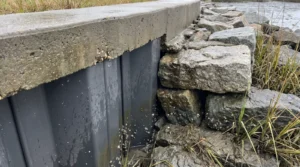
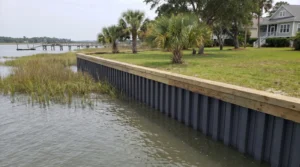
- Bulkheads and Seawalls: The loss of “high ground” is a major concern in Charleston. We implement vinyl seawalls and timber bulkheads to protect the shoreline from constant wake and tidal erosion.
- Erosion Control: Beyond just the dock, we look at the whole waterfront. This includes retaining walls and rip-rap (stone) placement to ensure your land stays where it belongs.
Learn more about our high-capacity builds on our commercial services page.
Table: Material Durability Comparison
| Material | Estimated Lifespan | Maintenance Level | Best Use Case |
|---|---|---|---|
| Pressure Treated Pine | 10-15 Years | High (Staining/Sealing) | Budget-friendly residential |
| Composite (Trex/Azek) | 25+ Years | Low (Cleaning) | Family docks, bare feet |
| Ipe / Garapa Hardwood | 30-50 Years | Medium (Oiling for color) | Luxury residential / High-traffic |
| Vinyl (Seawalls) | 50+ Years | Very Low | Erosion control / Bulkheads |
Navigating Permitting and Environmental Regulations
If there is one thing that surprises new waterfront homeowners, it’s the paperwork. Building docks charleston sc involves navigating a complex web of state and federal agencies.
The Regulatory Players
In the Lowcountry, you’ll primarily deal with the South Carolina Department of Health and Environmental Control’s Office of Ocean and Coastal Resource Management (OCRM). For larger projects or those affecting navigable waterways, the U.S. Army Corps of Engineers also gets involved.
Types of Permits
- New Construction Permits: Required for any new structure over the marsh or water. This involves a “Master Planning” phase where the length and square footage of your dock are scrutinized to ensure they don’t interfere with navigation or sensitive ecosystems.
- Maintenance-and-Repair Permits: If you have an existing dock that is falling apart, you may be eligible for a repair permit. This is often faster than a new permit, but there are strict rules—you generally cannot expand the footprint of the dock under a repair permit.
- Rebuilds: If a dock is completely gone (perhaps after a major storm), the permitting process has become more complex in recent years. New rules may dictate that you can’t rebuild exactly what was there before if it doesn’t meet current environmental standards.
Environmental Impact
We live here because the Lowcountry is beautiful, and we want to keep it that way. Permitting ensures that dock construction doesn’t shade out too much marsh grass (Spartina) or disrupt the local oyster beds. Using the right equipment and methods allows us to build with minimal impact on the very ecosystems we enjoy. For more administrative resources, you can check the Port Directory Content for maritime domain awareness.
Premier Marinas and the Port of Charleston
Charleston isn’t just a place for small private docks; it is one of the most significant maritime hubs on the planet. The infrastructure here is world-class.
The Port of Charleston
The Port of Charleston is the heartbeat of our local economy. Owned and operated by the South Carolina Ports Authority, it handled a staggering 2.85 million TEUs (twenty-foot equivalent units) in Fiscal Year 2022.
What makes our port so special?
- Deepest Harbor: Following a massive harbor-deepening project, Charleston now boasts the deepest harbor on the U.S. East Coast at 52 feet (and 54 feet at the entrance channel).
- Big Ship Ready: This depth allows the “Mega-Ships” (up to 20,000 TEUs) to call on our terminals, like the Hugh K. Leatherman Terminal which opened in 2021.
- Strategic Access: The harbor offers less than one hour of transit time from the open sea, with no air draft restrictions (meaning no low bridges) for the main terminals.
Iconic Marinas and the “MegaDock”
For recreational and luxury boaters, Safe Harbor Charleston City is a landmark. Known for the “MegaDock,” this facility can accommodate vessels up to 455 feet long! It’s a common sight to see some of the world’s most prestigious yachts docked here, enjoying 18.5 feet of draft and unrestricted height access.
Another key facility is the Charleston Maritime Center. Located near the South Carolina Aquarium, it was completed in 1997 as part of a plan to revitalize the historic waterfront. It serves as a “Tall Ship Port,” hosting famous vessels like the Spirit of South Carolina and The HM Bark Endeavour. Because there are no bridges between the harbor mouth and these docks, it offers direct and immediate sea access.
Frequently Asked Questions about Charleston Waterfronts
How long does it take to get a dock permit in Charleston?
The timeline can vary significantly. A simple maintenance-and-repair permit might take a few weeks to a couple of months. However, a new residential dock permit typically takes 6 to 12 months, as it requires public notice periods and reviews by OCRM. Commercial permits or those involving the Army Corps of Engineers can take even longer. We always recommend starting the permitting process as early as possible.
What is the best material for a Lowcountry dock?
For the decking, composite (like Trex) or hardwoods (like Ipe) are the best for longevity. If you want a “set it and forget it” dock, composite is the winner because it doesn’t require oiling or staining. For the pilings, marine-grade pressure-treated timber is the standard, but ensure they are treated to the proper “retention level” (usually 2.5 pcf for saltwater) to prevent marine borers from eating the wood.
How much weight can a standard boat lift handle?
Residential boat lifts typically start at 4,000 to 7,000 lbs for small skiffs and center consoles. The most common size for Charleston boaters is the 12,000 lb to 16,000 lb lift, which handles most 25–30 foot offshore boats. However, technology like the Hi-Tide systems can go up to 180,000 lbs for massive yachts. Always choose a lift capacity that is at least 20% higher than your boat’s “wet weight” (including fuel, water, and gear).
Conclusion
Building on the water in the Lowcountry is a rewarding investment, but it requires a partner who understands the unique challenges of our environment. From the shifting tides of Johns Island to the deep-water demands of the Charleston Harbor, every project requires a tailored approach.
At Bluetide Marine, we specialize in exactly that: tailored building adapted to the specific challenges of your waterfront. Whether you are dreaming of a quiet crabbing dock for the family or a high-capacity commercial pier, we bring the expertise and local knowledge needed to turn that vision into a reality.
Ready to start your next waterfront project? Contact Bluetide Marine today, and let’s get to work on your piece of the Charleston shoreline.