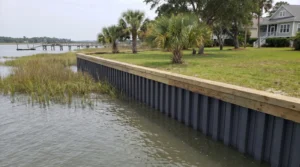
On the South Carolina coast, hurricane season is part of the calendar, and the waterfront takes the brunt of it. Knowing how to protect a dock from a hurricane — and what makes a seawall hold when the surge comes — is something every Lowcountry owner should think about before a storm is on the radar, not after. Some of it is simple preparation you can do in an afternoon. The rest is built into the structure long before the season starts. This guide covers both: the prep checklist and the construction choices that decide whether your waterfront survives.
Before the season: prepare early
The best time to get ready is now, while skies are clear. Walk your dock and seawall and look honestly at their condition. A piling that’s already loose, a board that’s lifting, or a seawall showing cracks or soil washing out behind it is a weak point a storm will find. Address those before peak season — it’s far easier to fix a small problem in calm weather than to lose a whole structure in a storm. The NOAA National Hurricane Center is the authoritative place to track conditions as the season develops.
When a storm is coming: the dock checklist
Once a storm is in the forecast, a focused checklist protects your dock and reduces the chance it becomes debris:
Remove everything that can move — furniture, grills, planters, ladders, and gear should come off the dock and into secure storage. Take valuables and electronics off any lift or dock box. For floating docks, double up and check your lines, allowing enough slack for the surge to lift the float without snapping the lines or tearing the cleats — the same scope logic that governs a sound mooring system applies here. If you have a boat lift, lower or secure the boat per the manufacturer’s storm guidance, or better, move the boat to safer water. Anything left loose becomes a projectile that can damage your dock and your neighbors’.
What makes a dock survive a hurricane
Preparation helps, but survival is mostly decided by how the dock was built. Pilings driven deep enough to resist scour and surge are the foundation of a storm-resilient dock; this is exactly why sound pilings matter so much. Floating docks need mooring — guide pilings tall enough to stay engaged through surge, or anchors with real holding power — designed for the extreme, not the average day. Strong connections, marine-grade hardware, and adequate freeboard all add margin. A dock built to ride a storm gives the water room to do its work and comes back afterward; one built only for fair weather often doesn’t.
Seawalls, bulkheads, and surge
A seawall or bulkhead faces a different test: holding the land in place while storm surge and wave energy try to pull it out. The most common storm failure isn’t the wall face cracking — it’s scour and erosion behind and beneath the wall, where surge washes soil away and the structure loses its backing. Proper drainage, sound tiebacks, adequate depth, and rip rap where appropriate are what let a seawall take a storm and keep the property behind it intact. These are design decisions made at construction, which is why the resilience of a seawall is largely set before its first season.
After the storm: assess before you use
When it’s safe to return, don’t assume an intact-looking dock is sound. Storm damage often hides below the waterline — a piling can be undermined or a connection compromised without any obvious sign on deck. Inspect at low tide, watch for new movement or lean, and have anything questionable looked at before you put weight on it. Catching storm damage early prevents a compromised structure from failing later.
Build resilience in, for home and commercial alike
The same principles protect a family dock and a marina or municipal structure — the scale differs, the engineering doesn’t. Our residential and commercial work is built for Lowcountry storm and corrosion exposure from the start, because the most reliable storm protection is a structure that was designed for the conditions before it was ever needed.
Frequently asked questions
How do I protect my dock from a hurricane?
Before the season, fix loose pilings, boards, or seawall weaknesses. When a storm threatens, remove all loose items, double and slacken floating-dock lines for surge, and secure or relocate any boat. Long term, the biggest factor is how well the dock was built.
Should I remove my floating dock before a hurricane?
Usually you can’t remove it, so the priority is a mooring designed for surge plus doubled, properly slackened lines. A float moored only for calm conditions is the most at-risk. A storm-rated mooring is the real protection.
What makes a seawall survive storm surge?
Resistance to scour and erosion behind and beneath the wall — through proper drainage, sound tiebacks, adequate depth, and rip rap where appropriate. Most storm failures come from undermining, not the wall face itself.
How do I check my dock for storm damage afterward?
Inspect at low tide, look for new lean or movement, soft or shifted pilings, and loose connections. Because damage often hides below the waterline, have anything questionable assessed before using the dock.
When should I prepare my waterfront for hurricane season?
Early — before peak season and well before any named storm. Repairs and structural improvements are far easier in calm weather than during a warning.
Get your waterfront storm-ready
If you’d like a clear-eyed look at how your dock and seawall would handle a storm, we’re glad to help. Contact BluTide for a pre-season inspection and a straight assessment of what, if anything, to shore up before the next system forms.