5 Ultimate Floating Dock Mooring Systems
Why Floating Dock Mooring Systems Are the Foundation of Every Safe Waterfront
Floating dock mooring systems are the anchors, lines, and connection hardware that keep a floating dock securely in place — without them, your dock drifts, rotates, or worse, disappears entirely with the tide.
Here’s a quick overview of the main mooring system types:
| Mooring Method | Best For | Key Feature |
|---|---|---|
| Pile restraint | Most conditions, high stability | Fixed piles with sliding rings |
| Chain and anchor | Deep water, permanent installs | Heavy-duty holding power |
| Cable and winch | Variable water levels | Adjustable tension |
| Elastic mooring | Storm-prone or high-fluctuation areas | Shock-absorbing stretch |
| Stand-alone pole/sleeve | Shallow, calm water | Simple DIY install |
If you own waterfront property in coastal South Carolina, you already know the Lowcountry doesn’t go easy on structures. Strong tidal swings, soft mud bottoms, hurricane-force winds, and relentless saltwater corrosion all work against you. A floating dock without the right mooring system isn’t just inconvenient — it’s a liability.
The good news? There’s a mooring solution for almost every site condition. Whether you’re dealing with a sandy river bottom on the Stono, a muddy tidal flat near the ACE Basin, or a deep-water slip at a busy marina, the right system can keep your dock exactly where you need it — through tide cycles, storm surges, and decades of daily use.
This guide breaks down every major mooring option, how they work, what conditions they suit, and how to avoid the mistakes that cause docks to fail.
Understanding Floating Dock Mooring Systems
At its core, a mooring system is what tethers your floating structure to the earth. While a fixed dock is hammered into the substrate and stays at a constant elevation, a floating dock is designed to move. This creates a unique engineering challenge: how do you keep a platform from floating away while allowing it to travel vertically with six-foot Charleston tides?
Vertical Movement and Tide Management
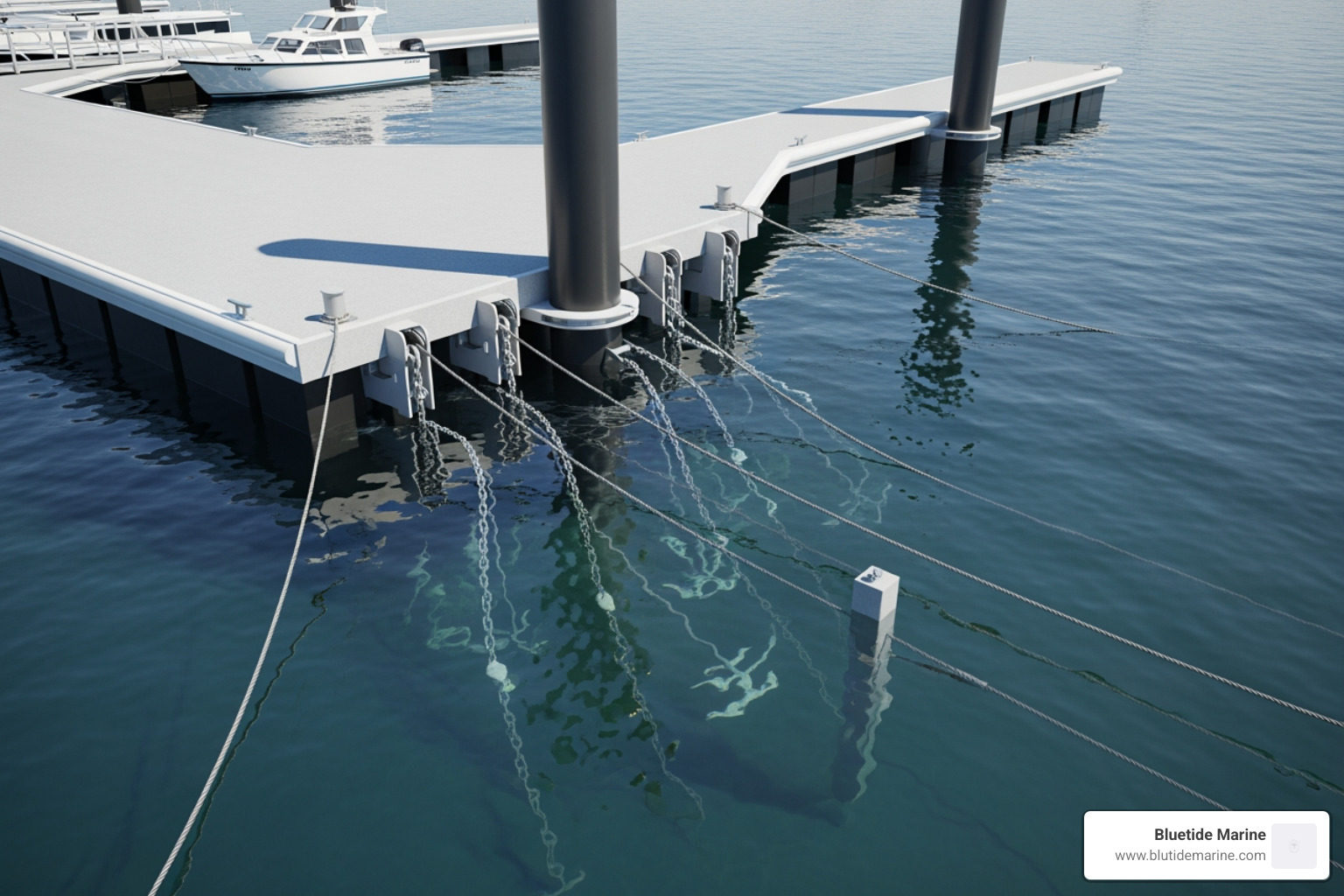
The primary differentiator for floating dock mooring systems is their ability to manage vertical travel. In the Lowcountry, hydrostatic pressure and buoyancy work together to lift the dock as the tide comes in. If your mooring is too rigid, the dock will submerge or break its hardware. If it’s too loose, the dock will bash against the shore or other structures.
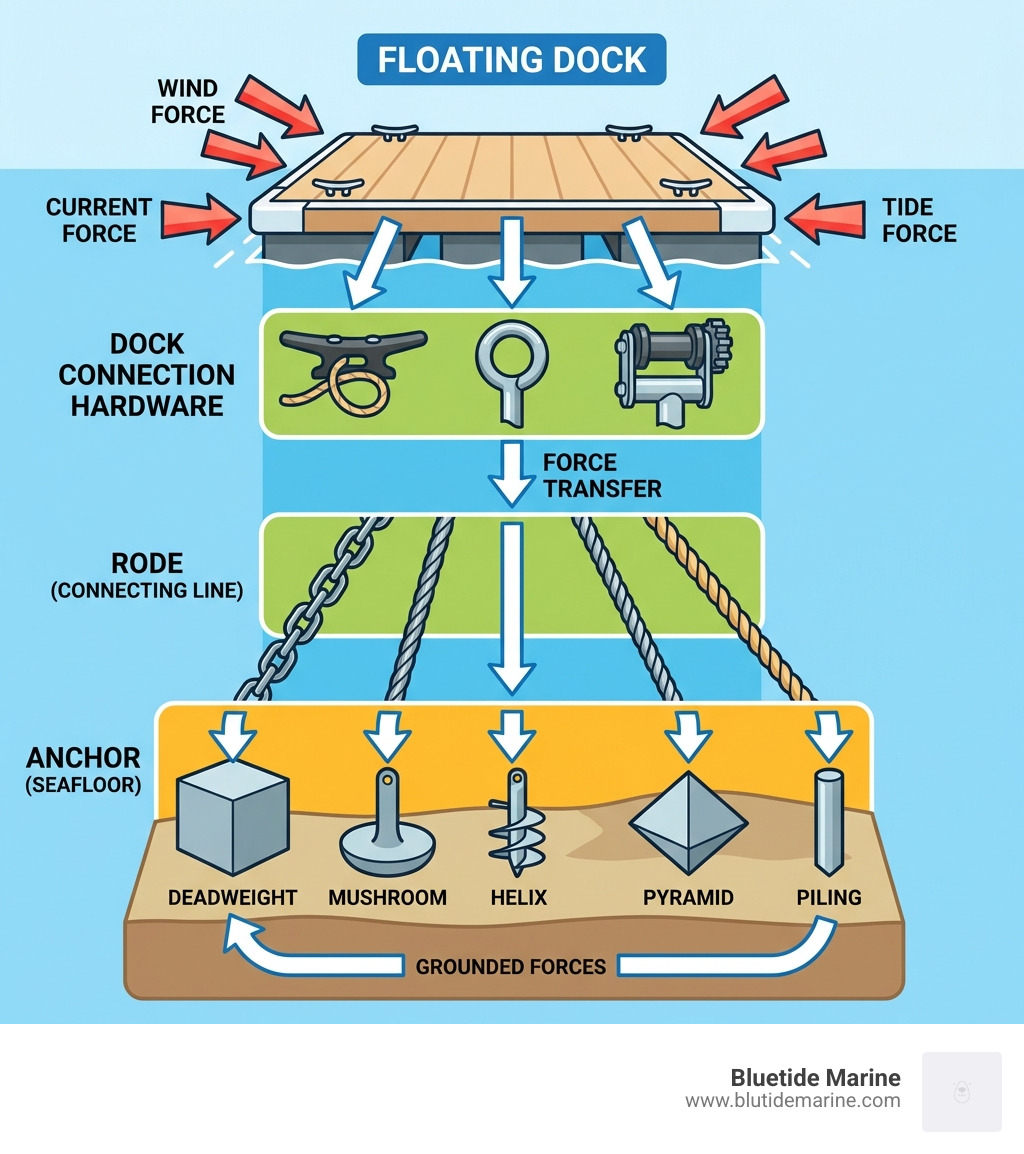
According to FLOATING DOCK ANCHORAGE – Marine Construction Magazine, these systems consist of three main parts: the anchor (seafloor connection), the rode (the chain, cable, or rope), and the dock attachment. These can be shore-based fixtures, like a bulkhead connection, or offshore fixtures that rely entirely on seafloor anchors.
Selecting the Right Floating Dock Mooring Systems for Your Site
Choosing a system isn’t just about what looks good; it’s about physics. We have to look at several environmental stressors before we drive a single pile or drop an anchor:
- Water Depth: Deep water often requires chain and anchor systems, while shallow water (less than 40 inches) might only need simple poles.
- Current Velocity: If you’re on the Ashley River during an outgoing tide, the current is a major factor.
- Tidal Range: Charleston frequently sees fluctuations that require systems capable of 6-8 feet of vertical travel.
- Fetch and Wind: Fetch is the distance wind blows over open water. More fetch means bigger waves and more stress on your mooring.
- Seafloor Composition: Is it “pluff mud,” sand, or rock? This determines which anchor will actually bite.
The Role of Modular Stability
Modern floating docks often utilize modular HDPE (High-Density Polyethylene) cubes. These systems are popular in South Carolina because they are UV resistant and don’t rot like traditional wood.
The stability of these docks depends heavily on their connection points. High-quality modular docks use integrated connection pins and strengthening bars to reduce “flex and bounce.” This rigidity is vital because a dock that flexes too much puts uneven stress on the mooring lines, potentially snapping hardware during a storm. Because they are reconfigurable, you can adapt the mooring points if you decide to add a jet ski lift or expand your dock later.
Five Essential Anchor Types for Marine Stability
When we talk about “anchoring” a dock, we aren’t talking about the little fluke anchor you use for your skiff. We’re talking about heavy-duty seafloor connections designed to stay put for decades.
1. Deadweight Anchors
These are the simplest form of mooring. Usually consisting of massive concrete blocks or stone, they rely on pure mass and the suction force of the mud to stay in place. Because they require a barge and crane for installation, they are typically used for larger commercial setups or permanent residential moorings.
2. Mushroom Anchors
Named for their shape, these are cast-iron anchors that work best in soft, silty bottoms—perfect for many Lowcountry creeks. Once they “set” and bury themselves, a mushroom anchor can hold up to 10 times its own weight. However, if they aren’t set properly, they can “spin out” or cause the chain to wrap around the shaft, shortening your lead.
3. Pyramid Anchors
A more modern take on the mushroom, pyramid anchors have a large surface area and a point that penetrates the seafloor quickly. Their shorter shaft reduces the risk of chain wrap, making them an excellent choice for shallow water or harder sandy bottoms.
4. Helix (Screw-In) Anchors
Helix anchors are essentially giant screws. Usually made of high-tensile steel with 8-foot shafts, they are screwed into the seafloor using hydraulic equipment. These offer incredible holding power and are considered very “eco-friendly” because they have a small footprint on the bottom. In waters up to 60 feet, helix anchors are often the gold standard for stability.
5. Piling Anchors
In Charleston, this is what you’ll see most often. Piling anchors involve driving timber, steel, or composite poles deep into the substrate. The dock is then attached to these piles using hoops or rollers. This is arguably the most secure method, providing a “fixed-dock” feel with all the benefits of a floating system.
Soil Suitability and Holding Power
The “bite” of your anchor depends entirely on the dirt beneath the water.
- Soft Mud (Pluff Mud): Mushroom and deadweight anchors excel here because they can sink deep and create suction.
- Sandy Bottoms: Helix and pyramid anchors provide the best grip.
- Rocky Substrate: You may be limited to heavy deadweights or specialized rock-bolt anchors.
A critical rule of thumb we follow is the anchor rode ratio. For most permanent moorings, your line should be at least three times the length of the water’s depth (a 3:1 ratio). This ensures the pull on the anchor remains horizontal, which is where it has the most holding power.
Piling Restraint and Tide Slides
For those using pilings, the connection hardware is where the magic happens.
- Pile Loops: Simple metal or plastic hoops that go around the pile.
- Roller Assemblies: These use heavy-duty rollers to allow the dock to glide up and down the pile without friction or “hanging up.”
- Tide Slides: A specialized track system that allows for smooth vertical travel even in rough water, preventing the dock from jarring against the piles.
Primary Methods for Securing Your Floating Dock
Beyond the anchor itself, we have to choose how the dock connects to that anchor.
Chain and Anchor
This is the traditional “catenary” system. Heavy galvanized chain runs from the dock to the anchor. The weight of the chain itself acts as a spring, absorbing the energy of waves before they hit the dock. In some cases, we use “clump weights”—extra weights mid-way down the chain—to keep the dock centered during low tide.
Cable and Winch
Common in areas with massive water level fluctuations (like some inland reservoirs that can drop 60 feet), this system uses steel cables and winches. As the water level changes, the owner can manually or automatically adjust the tension to keep the dock in the right position.
Elastic Mooring
Elastic systems, like Seaflex, use high-strength stretchy cables instead of chains. These stay under constant tension, meaning the dock doesn’t “walk” around as much. They are incredibly resilient during hurricanes because they can stretch to accommodate storm surges and then pull the dock back into place once the water recedes. According to the Mooring & Boat Lift Installation Guide, these are excellent for maintaining a steady platform for boarding.
Managing Extreme Water Level Fluctuations
While Charleston’s tides are predictable, some areas face extreme challenges. Marinas on reservoirs can experience fluctuations of over 60 feet. In these cases, we use telescoping poles or long-travel winch configurations. For most Lowcountry residents, a standard piling or helix system with sufficient “freeboard” on the piles is enough to handle our 8-10 foot storm surges.
Environmental Impact and Regulatory Guidelines
We don’t just build; we protect. The Piers, Docks and Overwater Structures Guidelines and local Shoreline Master Programs (SMP) dictate how we can moor docks.
- Light Penetration: Docks can shade out eelgrass, which is vital for local fish. We often use grated decking to let light through.
- Salmon and Migration: While more of a West Coast issue, similar local regulations protect the migration patterns of our indigenous species.
- No-Net-Loss: Regulations often require that any habitat lost to a dock must be mitigated elsewhere. Using helix anchors instead of large concrete blocks is one way we minimize the “footprint” on the seafloor.
Installation and Maintenance Best Practices
A floating dock mooring system is only as good as its installation.
Site Assessment and Tools
Before we start, we perform a bathymetry study—measuring the depths and contours of the underwater landscape. For a “stand-alone” system (where the dock isn’t attached to a pier), you generally need:
- Heavy-duty drill for pilot holes.
- PVC casings to protect steel poles from corrosion.
- A crew of at least two people.
- Standard marine-grade hardware (316 stainless or hot-dipped galvanized).
For pole-based systems, we ensure a minimum of 36-inch penetration into the seafloor to prevent the poles from leaning over time.
Maintenance for Long-Lasting Floating Dock Mooring Systems
A high-quality system can last 20 years, but only with a bit of love. We recommend:
- Bi-annual Inspections: Check your shackles, pins, and cables every six months.
- Hardware Tightening: Saltwater vibrations can loosen even the best-set bolts.
- Barnacle Removal: In Charleston, barnacles are a fact of life. Clean them off your sliding hardware and piles to prevent “sticking” during tide changes.
- Chain Monitoring: Replace chains if they show significant rust or thinning. A good rule is to use a mooring line a quarter-inch thicker than your service chain for extra safety.
Common Mooring Mistakes to Avoid
- Underestimating Tides: Not leaving enough “tail” on your piles. If the storm surge is 9 feet and your piles only stick up 8 feet, your dock will float right off the top.
- Inadequate Anchor Weight: Using a “skiff anchor” for a 20-foot dock. Your mooring anchor should be at least three times the weight of a standard boat anchor.
- Ignoring Littoral Drift: Water doesn’t just go up and down; it moves sideways. If you don’t account for the constant “push” of the current, your dock will eventually sit crooked.
- Using Non-Marine Hardware: Hardware store “zinc-plated” bolts will dissolve in Charleston saltwater in months. Always insist on 316 Stainless or Hot-Dipped Galvanized steel.
Frequently Asked Questions about Floating Dock Mooring Systems
What is the best mooring system for high-traffic marinas?
For high-traffic areas, pile restraint with roller assemblies is usually best. It offers the most “fixed” feel, which is safer for people boarding and unloading gear while other boats create wakes.
How do I prevent my mooring lines from chafing?
Use mooring line supports and “thimbles” at connection points. Chafing is the #1 cause of line failure. Adding a PVC sleeve over the line where it rubs against the dock can also extend its life significantly.
Can I install a stand-alone mooring system in deep water?
It’s possible, but once you get past 40 feet of depth, piles become impractical and expensive. In deep water, a chain-and-anchor or elastic mooring system is much more cost-effective and reliable.
Conclusion
At Blutide Marine, we’ve seen what happens when a dock isn’t properly tethered to the Lowcountry. We specialize in tailored marine construction that respects the unique challenges of the Charleston, SC waterfront. Whether you are on Johns Island, the Wando, or the Stono, we build systems designed to stay put.
Don’t let your investment drift away. If you’re ready for a dock that stands its ground (or its water), check out our guide on Marine construction in Charleston SC: Building for the Lowcountry waterfront or contact us for a site assessment. We’ll make sure your dock is still there to greet you, tide after tide.