The Ultimate Guide to Pathway Construction for Beginners
What Is Pathway Construction (and Why Does It Matter)?
Pathway construction is the process of mapping and building the step-by-step connections between components in a system — whether that’s a biological signaling network inside a cell or a physical walkway in an infrastructure project.
Here’s a quick overview of the core steps:
- Gather information — identify the key components and how they relate
- Assemble a prototype — connect the components into a working map or structure
- Refine with context — add specific details and annotations relevant to your goal
- Verify with experts — confirm accuracy before finalizing
These steps apply whether you’re building a pedestrian bridge path or reconstructing a molecular signaling network from protein interaction data.
Pathway construction shows up in two major worlds:
- Biological systems — researchers map how proteins and genes communicate inside cells, using databases like NetPath and KEGG alongside tools like Cytoscape and CellDesigner
- Physical infrastructure — contractors build walkways, bridges, and multi-use paths using materials like prestressed concrete piling and architectural railings
Both fields share something important: a systematic, step-by-step process is what separates a reliable result from a costly mistake.
The challenge? Both types of pathway construction are more complex than they first appear. Biological pathways are incomplete even after years of manual curation. Physical pathways must meet strict engineering and safety standards. And in both cases, the margin for error is low.
This guide breaks it all down — clearly, step by step — so you can understand how pathway construction works from start to finish.
The Essential Workflow of Pathway Construction
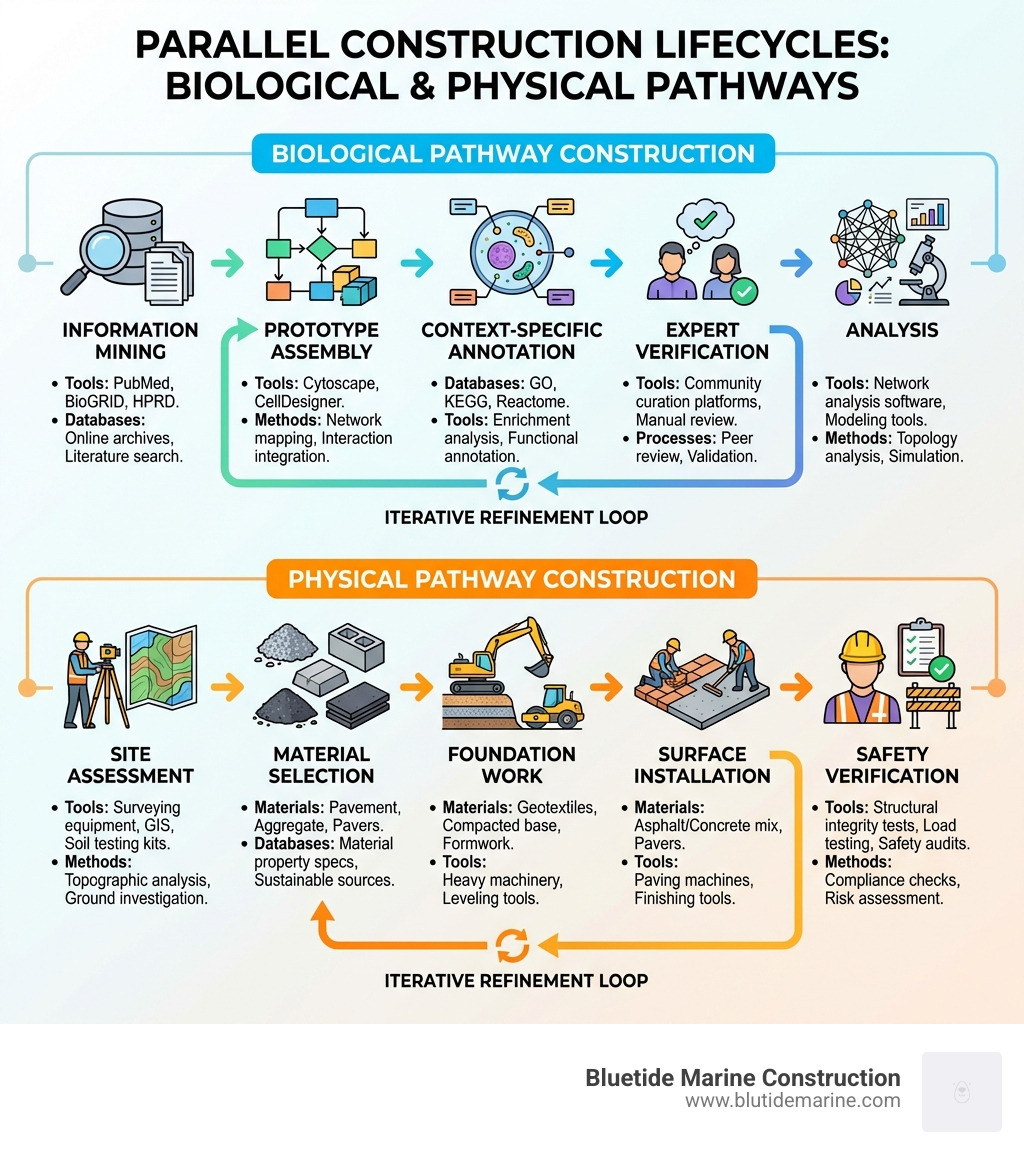
When we talk about building a pathway, we aren’t just throwing components together and hoping they stick. Whether we are dealing with proteins or pavement, the process requires a rigorous, four-step workflow.
Step 1: Information Mining
The first step is always gathering the “raw materials.” In biological pathway construction, this means digging through public and private databases to find every known interaction between genes and proteins.
Think of this like a treasure hunt. We look for:
- Entities: The “nodes” or “points” in our path (like proteins).
- Interactions: The “edges” or “lines” that connect them.
- Evidence: The proof that these connections actually exist.
Researchers often use keywords to mine literature or tap into resources like Pathguide, which catalogs over 200 pathway resources. It’s a lot of work, but you can’t build a path if you don’t know where the stones are!
Step 2: Prototype Assembly
Once we have our list of components, we start the assembly. This is where we create a “rough draft” of the pathway. In the digital world, this involves using software to draw the connections. In the physical world, this might be a site plan or a blueprint. The goal here is connectivity—making sure there is a clear route from the “start” (a receptor on a cell) to the “finish” (a transcription factor in the nucleus).
Step 3: Context-Specific Annotation
A path through a swamp in the Lowcountry is different than a path through a suburban park. Context matters! In biological terms, we refine the prototype by adding “metadata.” We ask: In which cell type does this happen? Under what conditions (like infection or stress)? We add annotations—links to the primary literature—to ensure every part of the path is backed by science.
Step 4: Expert Verification
No matter how smart our algorithms are, they can’t replace human expertise. We take our refined map to domain experts who have spent their lives studying these specific systems. They check for errors, identify missing links, and ensure the pathway makes biological sense.
For a deeper dive into these methods, check out this Scientific research on biological pathway construction and analysis.
Manual Curation vs. Automated Curation
There are two ways to handle this workflow: by hand or by machine.
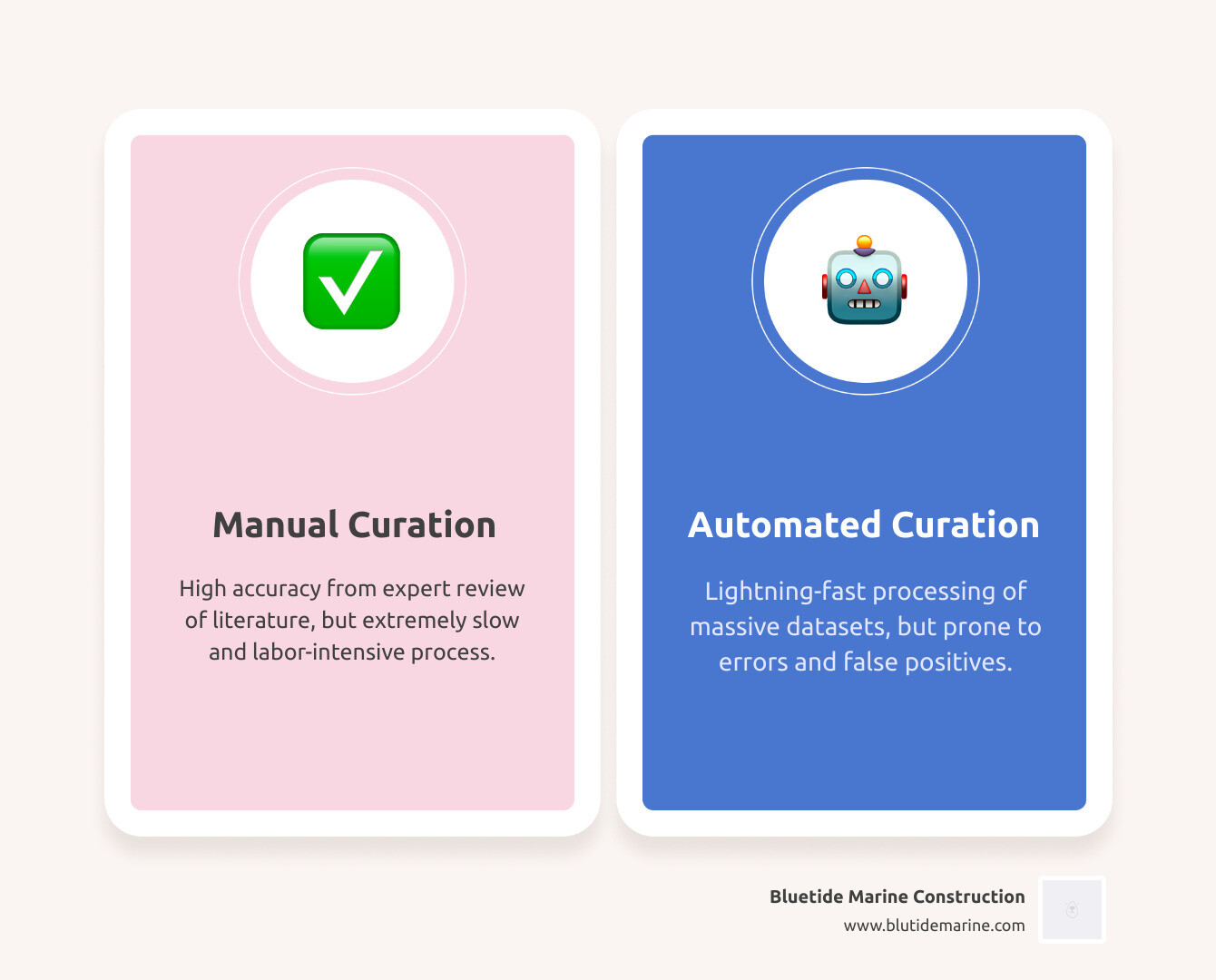
- Manual Curation: This is the gold standard for accuracy. Humans read papers and manually enter data. It’s incredibly reliable but slow. As the volume of biological data explodes, keeping these pathways updated manually is a massive challenge.
- Automated Curation: This uses text-mining tools and algorithms to build pathways at lightning speed. While it can handle vast amounts of data, it often struggles with accuracy and “noise” (false positives).
The modern approach is a hybrid: use machines to do the heavy lifting and humans to verify the results.
Data-Driven vs. Knowledge-Driven Objectives
Why are we building the path in the first place? Your objective changes your construction strategy.
Data-Driven Objectives (DDO)
DDO starts with a specific experiment. For example, you might have a list of genes that changed after a drug treatment (from microarray or mass spectrometry data). Your goal is to build a pathway that explains how those specific genes are connected. It’s like building a custom driveway for a specific house.
Knowledge-Driven Objectives (KDO)
KDO is broader. Here, we want to build a comprehensive “map” of a specific domain—like the Toll-like receptor signaling network. We aren’t looking at one experiment; we are trying to represent everything known about that system. It’s like building a city-wide highway system.
Essential Tools and Standard Formats
In pathway construction, having the right tools is just as important as having a good plan. You wouldn’t use a garden trowel to build a bridge, and you wouldn’t use a simple drawing program to map the human interactome.
Standard Formats for Pathway Construction
To make sure different software systems can talk to each other, we use standard formats. Think of these as the “language” of pathways.
- SBML (Systems Biology Markup Language): The most popular format, supported by over 100 software systems. It’s great for mathematical modeling.
- BioPAX (Biological Pathways Exchange): A very rich format that can handle complex information, though it can be a bit tricky to implement.
- PSI-MI: Specifically designed for molecular interaction data.
Using these standards ensures that a pathway built in one tool can be analyzed in another. For those looking at physical construction standards, you can find More info about commercial infrastructure services.
Recommended Software for Assembly and Analysis
If you’re ready to start building, these are the tools we recommend:
- Cytoscape: An open-source powerhouse for visualizing complex networks.
- CellDesigner: Perfect for drawing highly detailed, structured pathway diagrams.
- Reactome: Both a database and a tool, it’s a massive consortium effort to map human biological pathways.
- JDesigner & PATIKA: Useful for specialized modeling and pathway assembly.
- Ingenuity Pathway Analysis (IPA) & UniHI: Commercial and public tools that help you make sense of large-scale data.
Computational Algorithms and Performance Metrics
Sometimes, the biological “forest” is too thick to map by hand. That’s where computational algorithms come in. These are like high-tech GPS systems that can find the most likely paths through a massive web of protein interactions.
Optimizing Algorithms in Pathway Construction
Two of the most powerful tools in this space are PATHLINKER and GrowDAGs. They use “cost functions” to determine which paths are the most biologically relevant.
- minedgecost: This looks for the path with the “cheapest” edges (highest evidence).
- minpathscost: This prioritizes paths that don’t overlap too much, helping to capture a wider variety of biological processes.
One big challenge? Feedback loops. Biology is full of them, but most algorithms prefer Directed Acyclic Graphs (DAGs)—structures that don’t have cycles—because they are much easier to calculate. For a technical deep dive, see this Scientific research on automated reconstruction of human signaling networks.
Measuring Success with Precision and Recall
How do we know if our reconstructed pathway is any good? We use three main metrics:
- Precision: Of the connections we predicted, how many are actually in the “gold standard” database (like NetPath or KEGG)?
- Recall: Of all the connections that should be there, how many did we actually find?
- AUPRC (Area Under the Precision-Recall Curve): A single number that summarizes how well the algorithm balances these two goals.
Stats You Should Know:
- PATHLINKER is a beast—it recovered 90% of transcriptional regulators in the first 1,000 interactions for 15 NetPath pathways.
- GrowDAGs performed even better in terms of AUPRC in 11 out of 12 test cases.
- In the Wnt signaling pathway, these algorithms correctly identified the Ryk-CFTR-Dab2 path, which was later proven in a lab!
Applying Systematic Processes to Physical Infrastructure
Now, let’s bring it back down to earth—literally. The same logic we use for biological pathway construction applies to the physical paths we walk on every day in places like Charleston and Johns Island.
In the Lowcountry, building a path isn’t just about pouring concrete. It’s about engineering a system that can handle our unique environment.
Systematic Processes in Pavement and Bridges
When we build a multi-use path or a pedestrian bridge, we follow a systematic process that mirrors the biological workflow:
- Mining (Site Assessment): We look at soil conditions, water levels, and existing infrastructure. In North Charleston, projects like the Cosgrove Extension Bridge required deep foundations because of our coastal soil.
- Assembly (Structural Work): We use prestressed concrete piling (sometimes 60 to 108 feet deep!) to ensure the path stays put.
- Refinement (Architectural Details): We add “annotations” like architectural railings, salt-finish concrete decks, and decorative saw-cut diamonds to make the path functional and beautiful.
- Verification (Safety Standards): Every bridge and path must meet strict engineering codes to ensure public safety.
Real-World Examples in South Carolina
We see these systematic pathways all over the Southeast:
- Cosgrove Extension Bridge: This 1,032-foot-long bridge includes a dedicated 12-foot wide multi-use path for pedestrians, connecting the community to the Navy Base Intermodal Facility.
- Battery Park Pedestrian Bridge: An 800-foot path over Noisette Creek that uses structural steel arches and uplighting to create a safe, scenic route.
Whether it’s a signaling pathway or a sidewalk, the goal is the same: creating a reliable connection between point A and point B. For more on how we handle these projects, explore More info about residential construction projects.
Frequently Asked Questions about Pathway Construction
What is the difference between topological and dynamical analysis?
Topological analysis is like looking at a static map. It tells you who is connected to whom and identifies “hubs” (nodes with lots of connections). Dynamical analysis is like watching a video of traffic on that map. It uses math to predict how the system changes over time—for example, how a signal “flows” through a cell after a receptor is activated.
How do PATHLINKER and GrowDAGs improve upon manual curation?
Manual curation is slow and can’t keep up with the thousands of new papers published every year. Algorithms like PATHLINKER can scan the entire “interactome” (all known protein connections) in seconds. They can find “hidden” paths that a human might miss. For instance, PATHLINKER identified CFTR as a key player in Wnt signaling, a discovery that was later validated in the lab. They don’t replace humans; they tell us where to look first.
What are the main limitations of current reconstruction methods?
The biggest headache is feedback loops and cycles. Most efficient algorithms require a Directed Acyclic Graph (DAG), which means no “circles” in the path. But biology is full of feedback loops! Also, computational efficiency becomes an issue when you try to calculate millions of possible paths. Finally, we still struggle with “noise”—sometimes the data says two proteins interact, but they never actually meet in a real cell.
Conclusion
At Bluetide Marine Construction, we understand that every project—from a simple garden path to a complex marine bridge—requires a systematic approach. Just as researchers use pathway construction to unlock the secrets of the cell, we use these same principles of information mining, prototype assembly, and expert verification to build the infrastructure that connects our communities in Charleston and beyond.
Success in any type of construction comes down to knowledge integration and rigorous project verification. When you build with a plan, you build for the future.
For more information on our approach to infrastructure, visit our pages on More info about marine and commercial construction.