What Do Marine Dock Contractors Actually Do?
Core Services Offered by Marine Dock Contractors
#
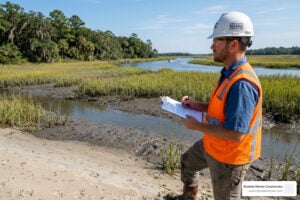
When you search for marine dock contractors, you’re looking for specialists who build, fix, and maintain structures on or near water. These experts handle everything needed to create a safe, durable waterfront property. They turn your waterfront visions into reality.
Here’s a quick look at what they do:
- Design & Build Docks: From simple residential docks to large commercial marinas.
- Install Boat Lifts: To protect your vessel from water damage and wear.
- Control Erosion: Using bulkheads, seawalls, or natural solutions to protect your shoreline.
- Repair & Restore: Fix damaged docks, pilings, and other marine structures.
- Manage Permits: Navigate complex regulations and secure necessary approvals for your project.
- Handle Challenging Sites: Work in remote locations, rough waters, and sensitive environments.
Owning waterfront property in places like coastal South Carolina comes with unique perks – and unique challenges. You need a trusted partner who understands the local environment, from harsh tides to potential storm impacts. marine dock contractors are those specialized professionals. They ensure your property is not just beautiful but also resilient and compliant with local rules.
If you’ve ever stood on a sturdy pier in the Lowcountry, watching the tide roll in, you’ve seen the handiwork of marine dock contractors. But their job goes far beyond just hammering nails into wood. We provide a comprehensive suite of services designed to bridge the gap between land and sea.
At the heart of our work is dock construction. This isn’t your average backyard deck project; it involves driving pilings deep into the riverbed or seabed to create a foundation that can withstand the constant push and pull of the ocean. Whether it’s a small crabbing dock for a weekend home or a massive commercial marina, the engineering must be spot-on.

Beyond the walkway itself, we offer several critical services:
- Boat Lifts: We install mechanical and drive-on lifts. In our region, keeping your boat out of the salt water when not in use is the best way to prevent hull damage and barnacle growth. High-quality lifts can handle anything from a jet ski to a 180,000-pound commercial vessel.
- Erosion Control: The Lowcountry is beautiful, but our shorelines are constantly under threat. We build bulkheads and seawalls to act as solid barriers against the water. If a hard structure isn’t necessary, we might use “rip rap”—a specific mixture of rocks—to stabilize the bank.
- Marine Fabrication: Sometimes, “off-the-shelf” parts won’t cut it. We specialize in custom metalwork, creating aluminum ramps, specialized brackets, and dock hardware that can survive the corrosive salt air.
- Emergency Storm Response: When a hurricane or major storm hits Charleston, the damage can be devastating. We provide disaster relief services, including debris removal and emergency repairs to restore access to your property.
Specialized Solutions for Waterfront Properties
Every shoreline is different. Some clients require floating platforms that rise and fall with our dramatic 6-to-9-foot tides, while others need fixed pierheads for deeper water access. We also design and install wave attenuators (breakwaters) to protect your dock from heavy wake or rough chop.
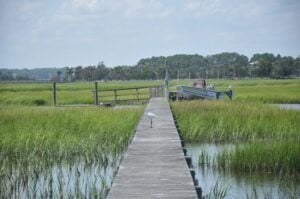
If you have a vision for a unique waterfront experience, the first step is to request a quotation. We can help you determine if your site is better suited for a long gangway or a series of elevated walkways to navigate the marsh.
Maintenance and Restoration Services
The marine environment is relentless. Salt, sun, and marine borers (tiny organisms that eat through wood) are always at work. We don’t just build and walk away; we offer full-service maintenance. This includes:
- Component Replacement: Swapping out rusted bolts for stainless steel or replacing a single warped board.
- Re-decking: Giving an old dock a “facelift” by replacing the top surface with modern composite materials.
- Piling Encasement: Protecting your wooden foundations from “shipworms” and other wood-boring pests.
- Structural Inspections: Checking the integrity of your underwater supports to ensure they are still safe for your family or customers.
The Marine Construction Process: From Permit to Completion
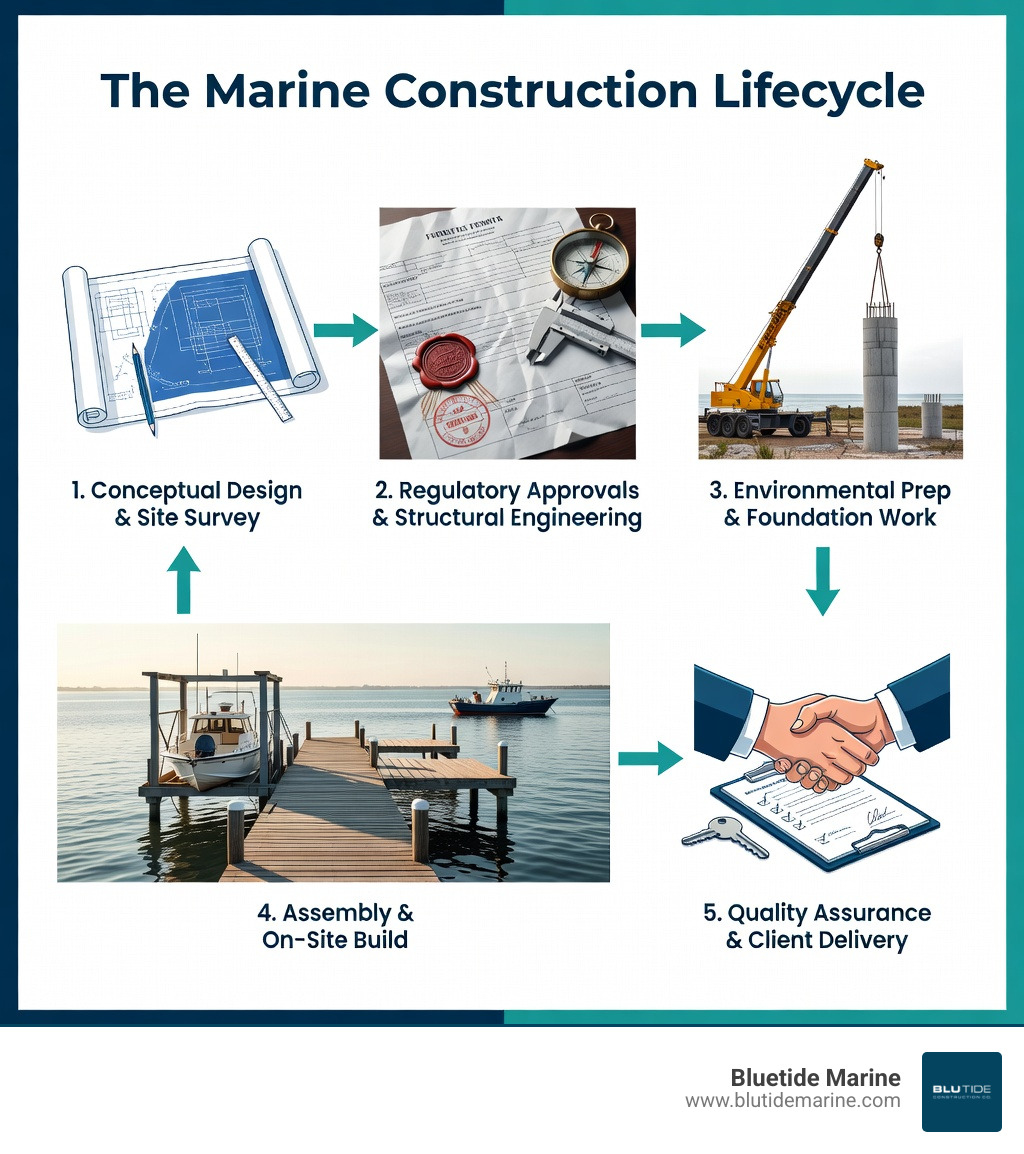
One of the biggest surprises for new waterfront homeowners is that the actual “building” part is often the shortest phase of the project. The real magic happens in the planning. As marine dock contractors, we guide you through a multi-step journey to ensure your dock is legal, safe, and built to last.
How Marine Dock Contractors Handle Permitting
In the Lowcountry, you can’t just stick a pole in the water and call it a day. We have to answer to several “bosses,” including the South Carolina Department of Health and Environmental Control (DHEC) and the U.S. Army Corps of Engineers.
Navigating regulatory compliance is where we provide some of our greatest value. We handle the environmental assessments to ensure your dock won’t harm local marsh grass or protected habitats. We coordinate with zoning boards and ensure every design meets local building codes. In many cases, we can get these permits in place within about 90 days, handling all the drawings and surveys so you don’t have to.
Turnkey Installation and Final Inspection
Once the paperwork is signed and the permits are in hand, the heavy lifting begins. A true “turnkey” solution means we handle everything from the first site evaluation to the final walkthrough.
- Site Evaluation: We study the water depth, the soil quality of the riverbed, and the “fetch” (the distance wind travels over water) to understand what kind of wave force the dock will face.
- 3D Design & Engineering: Before a single piling is driven, we often use 3D model renderings. This helps you visualize the final product and ensures our engineers have accounted for every stress point.
- On-Site Assembly: Our crews arrive with barges and specialized equipment. We don’t just build on your land; we build from the water.
- Integration: This includes anchoring services for floating sections and electrical integration for boat lifts and dock lighting.
- Quality Assurance: We perform safety testing and a final walkthrough with you to ensure every handrail is sturdy and every bolt is tight.
Essential Materials and Equipment for Durable Docks
If you use the wrong materials in a marine environment, you might as well be throwing your money into the Ashley River. We select materials based on their ability to resist rot, corrosion, and UV damage.
| Material | Best Use Case | Pros | Cons |
|---|---|---|---|
| Pressure-Treated Timber | Pilings and Framing | Cost-effective, traditional look | Requires maintenance, vulnerable to borers |
| Marine-Grade Aluminum | Ramps and Gangways | Lightweight, rust-proof | Higher initial cost |
| Concrete | Commercial Docks | Extremely durable, heavy | Difficult to install, expensive |
| Composite (MoistureShield) | Decking Surfaces | No splinters, low maintenance | Can get hot in the sun |
| HDPE (Polyethylene) | Float Frames | Won’t crack or leak | Needs proper anchoring |
Heavy Machinery Used by Marine Dock Contractors
You can’t build a dock with a pickup truck and a ladder. Top-tier marine dock contractors maintain an expansive fleet of specialized equipment. We use crane barges to move heavy materials across the water and vibratory hammers or pile drivers to sink timber or steel supports into the ground.
For dredging projects—where we need to remove sediment to make the water deep enough for your boat—we use specialized excavators and high-speed transport barges. This equipment allows us to work efficiently without damaging your upland property, as most of our heavy machinery stays on the water.
Innovation in Marine Fabrication
We’ve moved past the era of “just wood.” Modern docks are symphonies of engineering. We use custom metalwork to create “artisanal” touches that are also functional. This might include:
- Aluminum Ramps: Stronger and lighter than wood, making them easier to move during storms.
- Specialized Brackets: Custom-fabricated to hold floating docks in place during extreme tidal swings.
- Intake Structures: For properties that need to draw water for irrigation or specialized resort needs.
Navigating Environmental and Regional Challenges
In Charleston and the surrounding Lowcountry, the environment is our biggest partner and our toughest opponent. We don’t just build for a sunny Tuesday; we build for the worst-case scenario.
Addressing Remote and High-Exposure Sites
The Lowcountry is full of rugged terrain and remote islands that aren’t accessible by road. This is where our logistical planning shines. We use barges to transport entire crews, equipment, and materials to sites that others might find “impossible.”
One of our primary focuses is shoreline stabilization. We use a combination of bulkheads, seawalls, and sustainable building practices to protect the high ground from erosion. We also ensure that our construction methods preserve the local habitat. We live here too, and we want to keep the Lowcountry beautiful for the next generation of boaters.
Dealing with “The Big Three”: Tides, Borers, and Storms
- Tidal Ranges: With some of the largest tidal swings on the East Coast, our docks must be designed to stay functional whether the water is 2 feet deep or 10 feet deep.
- Marine Borers: We use marine-grade treated wood (specifically 2.5 CCA) to repel “shipworms” and “gribbles” that can turn a piling into Swiss cheese in just a few years.
- Storm Surge: After Hurricane Hugo, the industry learned a lot. We now use specific techniques, like “three and four pile bent designs,” to provide extra support against storm surges and ice (on the rare occasion we get a freeze!).
Frequently Asked Questions about Marine Dock Contractors
What is the typical lifespan of a professionally built dock?
A well-maintained wooden dock in the Lowcountry typically lasts 15 to 25 years. However, if you use high-end materials like vinyl sheet pilings or composite decking, you can see a lifespan of 40 to 50 years. Regular inspections are the key to longevity.
How do contractors ensure a dock survives a hurricane or major storm?
We use “over-engineering” techniques. This includes using stainless steel fasteners at a 4:1 ratio for decking and driving pilings much deeper than the minimum requirement. We also design “breakaway” sections for some walkways so that the main pierhead remains standing even if the ramp is displaced.
Do I need a permit for minor dock repairs?
In South Carolina, “like-for-like” repairs (replacing a few boards or a handrail) often don’t require a full new permit, but it’s always best to check. Major structural work, like replacing pilings or extending the dock, always requires a permit. We can help you determine exactly what’s needed.
Conclusion
At the end of the day, marine dock contractors are the experts who ensure you can actually enjoy the water you live next to. Whether it’s a place to park your boat, a spot to catch some blue crabs, or a commercial hub for a marina business, the structural integrity of your dock is paramount.
At Bluetide Marine, we pride ourselves on our Lowcountry expertise. We don’t just build docks; we build tailored solutions adapted to the unique challenges of the Charleston waterfront. From the initial permit to the final sunset on your new pierhead, we are committed to unmatched craftsmanship.
Ready to turn your waterfront vision into a reality? Let’s start building for the Lowcountry waterfront together. Give us a call, and let’s get your project off the ground—and into the water!