Sullivan’s Island is a different kind of waterfront. The Intracoastal Waterway runs along its back side, the Charleston Harbor opens off its south end, and the historic-district zoning means every structure on the island — including waterfront structures — gets a layer of architectural review you won’t find on younger Lowcountry developments. As a Sullivan’s Island dock builder, BluTide approaches each project as a balance of three things: the deep-water buoyancy of the Intracoastal, the architectural restraint that the town and the historic-district overlay require, and the long-term durability of a structure that’s going to live in salt water for decades.
What Sets Sullivan’s Island Apart
Sullivan’s is a historic barrier island with deep-water Intracoastal frontage on its inland side and Cove Inlet between it and Isle of Palms to the north. The combination of factors that make it distinctive for marine construction:
- The Intracoastal frontage is genuinely deep — you can build a fixed dock with floating slip and dock a 40-foot boat at low tide without dredging. This is rare in the Charleston area.
- Strong tidal currents on the Intracoastal mean piling design has to account for serious lateral load — much more than a sheltered marsh creek dock would require.
- The historic district overlay applies to most of the island and adds an additional layer of architectural review for any structure visible from a public way.
- The town and the OCRM critical line are both involved in waterfront permitting; the town has its own design standards on top of SCDES requirements.
- Storm exposure — Sullivan’s is a true barrier island with documented Atlantic storm surge history. Design loads for waterfront structures need to account for the full storm spectrum.
What We Build on Sullivan’s
- Fixed deep-water docks with floating slips — the dominant new-build type for the Intracoastal frontage. Pile spacing and depth handle the lateral current load.
- T-docks and L-docks for properties with shorter setbacks where a long marsh dock walk isn’t required.
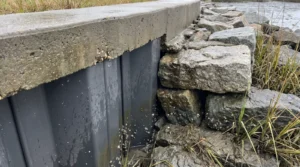
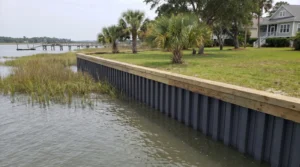
- Bulkheads, retaining walls, and shoreline armoring — particularly on the back side of the island where storm surge and tidal current both erode the shoreline.
- Boat lifts sized to the Intracoastal Waterway — 16,000-lb to 24,000-lb single-piling and two-piling lifts are the common configuration.
- Boathouses where the town and OCRM permit them.
- Maintenance, repair, and storm recovery — refastening, deck replacement, piling repair, gangway replacement.
Sullivan’s-Specific Permitting
A Sullivan’s Island waterfront project goes through:
- SCDES (OCRM) coastal permit — joint application with US Army Corps of Engineers Charleston District. Same fundamental pathway as elsewhere on the Charleston coast (see our OCRM/SCDES permitting guide for the full process).
- Town of Sullivan’s Island review — zoning, setbacks, design review for any historic-district property. The town’s review process is well-organized but requires complete and properly formatted submittals.
- Historic district overlay — for properties within the overlay, materials, scale, and visual impact get additional scrutiny. Even waterfront structures (which face away from the street) are reviewed for visibility from public ways and from neighboring properties.
The town of Sullivan’s Island is small enough that we know the staff and the review schedule. Submittals that hit the right month run smoothly; submittals that miss meeting windows can lose 30–60 days. We schedule client submittals to align with the town’s review calendar.
Materials & Construction Details
- Pilings: treated timber for most residential work; steel H-piles where the design load demands them (some Intracoastal deep-water docks fall into this category). Helical piles for retrofit or tight-access situations.
- Decking: ipe, cumaru, or premium composite are the common upper-tier choices. Pressure-treated yellow pine is still common on Sullivan’s where the historic context favors traditional materials.
- Railing: mixture of traditional wood balustrades (for historic-district properties) and stainless cable rail (for properties not under historic-district restrictions).
- Hardware: 316 stainless steel throughout — the salt environment is aggressive and lower grades fail fast.
Working Around the Tides & Currents
The Intracoastal current at Sullivan’s runs strong, especially on the spring tides. Pile design accounts for lateral loads from the current; floating slip and gangway design accounts for the rate of rise and fall through the tide cycle (six-foot tidal range, twice a day). Boat lifts have to be sized for the boat AND the current it sits in. Storm surge — including from hurricanes far enough offshore that they don’t make landfall — is a real design consideration. Our piling and bulkhead engineering reflects all of this. The technical background is in our marine pile driving overview.
Frequently Asked Questions
Can I get a permit for a new dock on Sullivan’s Island?
In most cases, yes. SCDES and the Town of Sullivan’s Island both permit new docks on appropriate frontage; the process generally takes 4–8 months. Some marsh-only properties or those at the very narrow end of the island may have constraints — we can assess feasibility on a site-specific basis.
How does the historic district overlay affect my dock?
The overlay primarily affects visible elements — railing style, decking material, pilings exposed above water, light fixtures. Underwater and infrastructure elements (pile depth, structural framing) aren’t reviewed for visual impact, but anything visible from a public way or a neighboring property is.
Do I need a boat lift on the Intracoastal?
If you’re keeping the boat in the water, the lift extends its life dramatically by removing it from constant salt immersion and from the wear of tidal current. For boats over $50K in value, a lift typically pays back in 3–5 years through reduced bottom paint, reduced corrosion, and extended useful life.
How much does a Sullivan’s Island dock cost?
A new fixed-deep-water dock with floating slip and boat lift on an Intracoastal Sullivan’s lot typically runs $180,000–$450,000 depending on pile count, lift size, decking material, and any architectural features like covered seating or a boathouse.
Can BluTide handle bulkhead and dock together as one project?
Yes, and we typically recommend bundling them. The pile-driving rig and crew can do both, the permit is one joint application, and the construction sequencing is more efficient.
Get Started
We’d welcome a site walk on your Sullivan’s Island property. The first conversation usually covers the boats you want to accommodate, the architectural language of the house, and any constraints from the historic district or POA. From there we put together a preliminary scope and a budgetary number. Reach out to start the conversation.