Marine pile driving is the process of driving structural piles — timber, steel, prestressed concrete, or helical — down through soft coastal soils into the firmer bearing strata below, so they can carry the load of a dock, pier, seawall, boathouse, boardwalk, or waterfront building. As a marine pile driving contractor in South Carolina, BluTide installs all four pile types for residential, commercial, and municipal projects across the Charleston metro and the broader Lowcountry coast.
Almost every marine structure in the Lowcountry sits on piles. The dock at the end of your dock walk, the bulkhead behind your bulkhead, the pier holding up a public boardwalk, the foundation under a coastal home — they’re all transferring load through soft estuarine soils into the firmer strata below. Getting the pile right is what makes the structure above it last. This guide walks through what marine pile driving actually involves, which pile type fits which job, how the work gets permitted, and what to expect on cost and schedule.
What Marine Pile Driving Actually Is
Pile driving is the process of installing a structural member — a pile — into the ground to support a load. In marine work, the load is some combination of a dock, a pier, a seawall, a boathouse, a boardwalk, or a coastal building. The pile transfers that load down through the loose marine sediment near the surface into the denser sand or clay layers below, where the soil can carry the weight. In the Charleston area you’re typically driving through 8–20 feet of soft Cooper Marl or estuarine mud before you hit the bearing stratum.
The “driving” part of pile driving means physically pushing the pile into the ground using one of three mechanisms: impact driving (a hammer falls on the pile head, pushing it down with each blow), vibratory driving (the pile is shaken at high frequency, liquefying the surrounding soil so the pile sinks under its own weight), or screwing (in the case of helical piles, the pile is rotated like a screw into the ground). The choice between them depends on pile type, soil conditions, structure being built, and noise/vibration tolerances of nearby property.
Pile Types We Drive
The pile market is more diverse than people realize. The four families we work with most often in the Charleston area — and how they compare on load, service life, install method, and installed cost — are summarized below.
| Pile type | Typical load & use | Service life (salt water) | Install method | Installed cost (Charleston, 2026) |
|---|---|---|---|---|
| Timber (treated southern yellow pine) | Residential docks, light piers, boardwalks | 25–40 years with proper treatment | Vibratory hammer | $400–$800 per pile |
| Steel H-pile / pipe pile | Commercial piers, marinas, vehicle-load structures | 40–75 years with coatings + anodes | Impact hammer, verified with a pile-driving analyzer | $1,800–$3,500 per pile |
| Prestressed concrete | Major bulkheads, bridges, port & Navy infrastructure | 50–75+ years | Impact hammer, typically barge-mounted | $3,500–$6,500 per pile |
| Helical (screw pile) | Retrofits, tight-access & vibration-sensitive sites | 40–75 years (galvanized) | Hydraulic torque motor; capacity verified by install torque | $1,500–$2,800 per pile |
Timber piles
Pressure-treated southern yellow pine, typically 8–14 inches in diameter and 25–50 feet long. Timber is the historic workhorse of residential dock construction in the Lowcountry — relatively low cost, fast install with a vibratory hammer, and proven decades-long service life in salt water with the right preservative treatment. Most residential docks, light commercial piers, and boardwalks are still timber-piled.
Steel H-piles and pipe piles
Used where load demands or driving depths exceed what timber can handle — commercial piers, marina infrastructure, heavy boardwalks, and any structure that has to carry vehicle traffic. Steel piles are typically driven with an impact hammer to refusal and then verified with a pile-driving analyzer to confirm bearing capacity. Coatings (epoxy or galvanizing) and sacrificial anodes manage corrosion in salt water.
Concrete piles
Prestressed concrete piles are the standard for large commercial marine work — major bulkheads, large bridges, port and Navy infrastructure. They’re heavier, require larger driving rigs, and are typically delivered to the site on a barge. Concrete piles are common in our commercial marina construction projects.
Helical piles
The newest family on this list and one of the most useful for tight-access or vibration-sensitive sites. Helical piles are steel shafts with welded helical plates that get torqued (screwed) into the ground using a hydraulic motor; the load capacity is verified by the torque needed to install. They’re particularly useful for retrofit work — adding piles under an existing dock, supporting a new boathouse next to a structure you don’t want to vibrate, or working in confined access where a pile-driving rig won’t fit. We covered the technology in detail in our blog post on marine helical pile foundation technology.
Equipment & Methods
The equipment package depends on the pile type, the site access, and the depth of water. For most of our work in the Charleston area we run one of three configurations:
- Land-based crane with vibratory hammer. Used for residential dock work and any pile driving accessible from the bank. Fast, relatively quiet, minimal mobilization cost.
- Barge-mounted impact hammer. Used for commercial pier and marina work, larger steel piles, and any site without bank access. Mobilization is a multi-day operation — the barge has to be towed in, anchored on spuds, and stabilized before driving starts.
- Hydraulic torque motor on a track-mounted carrier. Used for helical pile work, often in residential settings where vibration to nearby structures would be a problem.
Selection of impact vs. vibratory driving also depends on the regulatory context. Some OCRM permits limit vibratory driving in proximity to wildlife habitat during nesting or spawning windows; we manage those constraints during pre-construction submittals.
When You Need Marine Piles
Almost any marine structure rests on piles, but a few project types where pile selection is the most consequential design decision:
- New residential docks and walkways. Timber piles are the default; helical piles are an upgrade option for higher load capacity or tight access. Many of these docks also carry a boat lift, whose added load has to be planned into the pile design from the start.
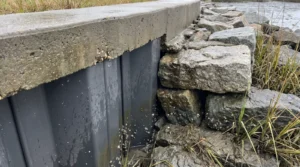
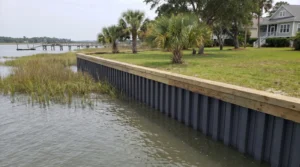
- Seawall and bulkhead construction. Steel sheet piles or king-pile-and-panel systems form the wall; tie-back piles anchor the wall against earth pressure.
- Marina and commercial pier construction. Mix of steel H-piles, concrete piles, and (for some floating dock systems) timber piles for breasting and mooring.
- Boardwalk and public access. Higher-head boardwalks for parks and resorts; typically timber or concrete piles to the design loads from ADA, pedestrian, and emergency-vehicle access.
- Existing structure retrofit or repair. Helical piles excel here — when you need to add load capacity to an existing dock without vibrating the structure apart. See our complete walkthrough of boat dock piling repair for the residential angle, and marine piling repair for the broader engineering context.
Permitting and Regulatory Path
Marine pile driving in South Carolina is regulated by three agencies whose jurisdictions overlap in coastal waters:
- SC Department of Environmental Services (SCDES, formerly DHEC) — coastal critical area jurisdiction, water quality, and the state permit pathway under the SC Coastal Zone Management Act.
- US Army Corps of Engineers Charleston District — federal jurisdiction over navigable waters (Section 10 of the Rivers and Harbors Act) and dredge-and-fill activities (Section 404 of the Clean Water Act).
- Local municipality — zoning, setbacks, stormwater, and (for piers extending onto public marsh) sometimes a separate town-level approval.
For most pile driving work the permit pathway is the same as the broader marine construction permit — pile driving is rarely a standalone permit. The major exception is vibratory driving in proximity to protected species habitat (sea turtle, manatee, sturgeon, shortnose), which can trigger time-of-year restrictions or specific monitoring requirements during driving. We cover the full process in our OCRM and SCDES permitting guide.
One pre-construction submittal that catches a lot of contractors out: the Army Corps Charleston District typically requires a pile driving plan with hammer specifications, sequencing, and noise/vibration mitigation 30 days before mobilization on permits with environmental conditions. We submit those proactively rather than wait for the Corps to request them.
Costs & Project Timeline
Pile driving cost is dominated by three variables: pile type, pile count, and mobilization. Order-of-magnitude per-pile installed cost in the Charleston area (2026 dollars, subject to material market):
- Treated timber pile, residential dock (10″ diameter, 30′ length): $400–$800 installed depending on count and access.
- Steel H-pile, commercial pier (HP 12×53, 40′ length): $1,800–$3,500 installed.
- Helical pile, residential retrofit (3″ shaft, single helix, 30′ depth): $1,500–$2,800 installed.
- Prestressed concrete pile, commercial marine (16″ square, 50′ length): $3,500–$6,500 installed.
Mobilization is the meaningful step in any project. For a residential dock with bank access we can typically be on site driving piles within 1–2 weeks of permit issuance. For a commercial pier requiring a barge-mounted impact hammer, mobilization is a multi-day operation and we schedule 3–6 weeks out from notice to proceed. For very large municipal or port projects, the barge and rig package is sometimes a long-lead item — we recommend booking the equipment slot at the same time you submit your permit application.
Frequently Asked Questions
How deep do marine piles go in Charleston-area soils?
Depends on load and the bearing stratum, but typical residential dock piles go 18–25 feet below the mudline; commercial pier piles go 35–60 feet; and Navy or port piles can go 75 feet or more. The geotechnical investigation tells us how deep the bearing layer is; the structural engineer’s design tells us how deep the pile has to go to develop the needed capacity.
Can helical piles replace timber piles for a residential dock?
Yes, and they often should — particularly on tight-access sites, when adding piles under an existing structure, or when soft bearing strata would require a timber pile longer than is practical. Helical piles cost more per pile but require less equipment mobilization and have lower vibration during install. We recommend them anytime the access is constrained, the structure is being added to, or the load demands exceed what a single timber pile can carry.
How noisy is pile driving, and how long does it last?
Vibratory driving is quieter — comparable to a large construction excavator running close-by. Impact driving is genuinely loud, comparable to a piledriver at a highway construction site. For a typical residential dock with 12–20 piles, impact driving takes 1–2 days; vibratory driving usually finishes in a single day. For a commercial pier with 100+ piles, plan on 2–4 weeks of intermittent pile driving.
Do you drive piles for seawalls and bulkheads?
Yes. Steel sheet piles, vinyl sheet piles, and king-pile-and-panel systems all involve a pile-driving operation; we install all of them. The wall geometry, soil conditions, and earth pressure (especially the surcharge from upland improvements) drive the pile selection and tie-back design.
Are you a PDCA member?
BluTide tracks Pile Driving Contractors Association (PDCA) standards and best practices, and we follow the PDCA-recommended pre-construction submittal format for commercial work. Formal PDCA membership is on our 2026 roadmap.
Do you work with engineers of record, or design-build?
Both. For commercial and municipal projects we typically work alongside a separate engineer of record selected through procurement; for residential and smaller commercial work we offer integrated design-build with established SC coastal and structural engineering partners.
Request a Pile Driving Quote
If you’re scoping a marine project that needs piles — residential dock, commercial pier, seawall, marina, boardwalk, or any retrofit — we’d welcome the conversation. The first step is usually a site walk where we can look at access, soils, and the surrounding structures, followed by a written budgetary number for the pile work. Get in touch and we’ll set up a call.