A Deep Dive into Marine Helical Pile Foundation Technology
Why Helical Pile Foundation Marine Technology Is the Smart Choice for Coastal Construction
Helical pile foundation marine installations are one of the most effective ways to build durable, low-impact structures in coastal and waterfront environments. Here is a quick overview of how to install helical piles for marine structures:
- Assess the site — Evaluate soil data, water depth, tidal fluctuations, and hydrodynamic forces.
- Select the right pile — Choose round shaft (pipe) piles for lateral loads or square shaft piles for higher compression capacity based on soil conditions.
- Mobilize equipment — Deploy a barge-mounted excavator or crane with a hydraulic torque motor to the installation site.
- Install the lead section — Rotate the helical lead section into the seabed using continuous hydraulic torque.
- Add extensions — Bolt on additional sections and continue rotating until the pile reaches load-bearing strata.
- Monitor torque in real time — Use a calibrated digital torque indicator to verify capacity as the pile advances.
- Terminate and cap — Once target torque is achieved, install the pile cap and connect to the structure.
Marine construction in the Charleston Lowcountry is unforgiving. The tidal creeks of Kiawah Island, the soft marshland soils of Seabrook Island, and the saltwater-saturated ground throughout the South Carolina coast create foundation challenges that traditional concrete or timber piles often struggle to solve.
Helical piles — also called screw piles, helical piers, or helical anchors — were originally developed for England’s silty riverbeds. That heritage makes them a natural fit for the challenging subsea conditions found right here along the Southeast coast.
Unlike driven piles that rely on impact hammers and generate significant noise and vibration, helical piles are screwed into the ground using a hydraulic drive. They transfer structural loads down through weak surface soils to competent load-bearing strata below — with no excavation, no concrete spoils, and minimal disturbance to the surrounding ecosystem.
For a waterfront homeowner protecting a high-value property, or a project manager overseeing a community marina or public boardwalk, this matters enormously. A well-engineered helical pile system delivers immediate load-bearing capacity, resists both compression and tension forces, and can withstand the hurricane-force winds and wave action that define life on the Carolina coast.
Understanding the Mechanics of Helical Pile Foundation Marine Systems
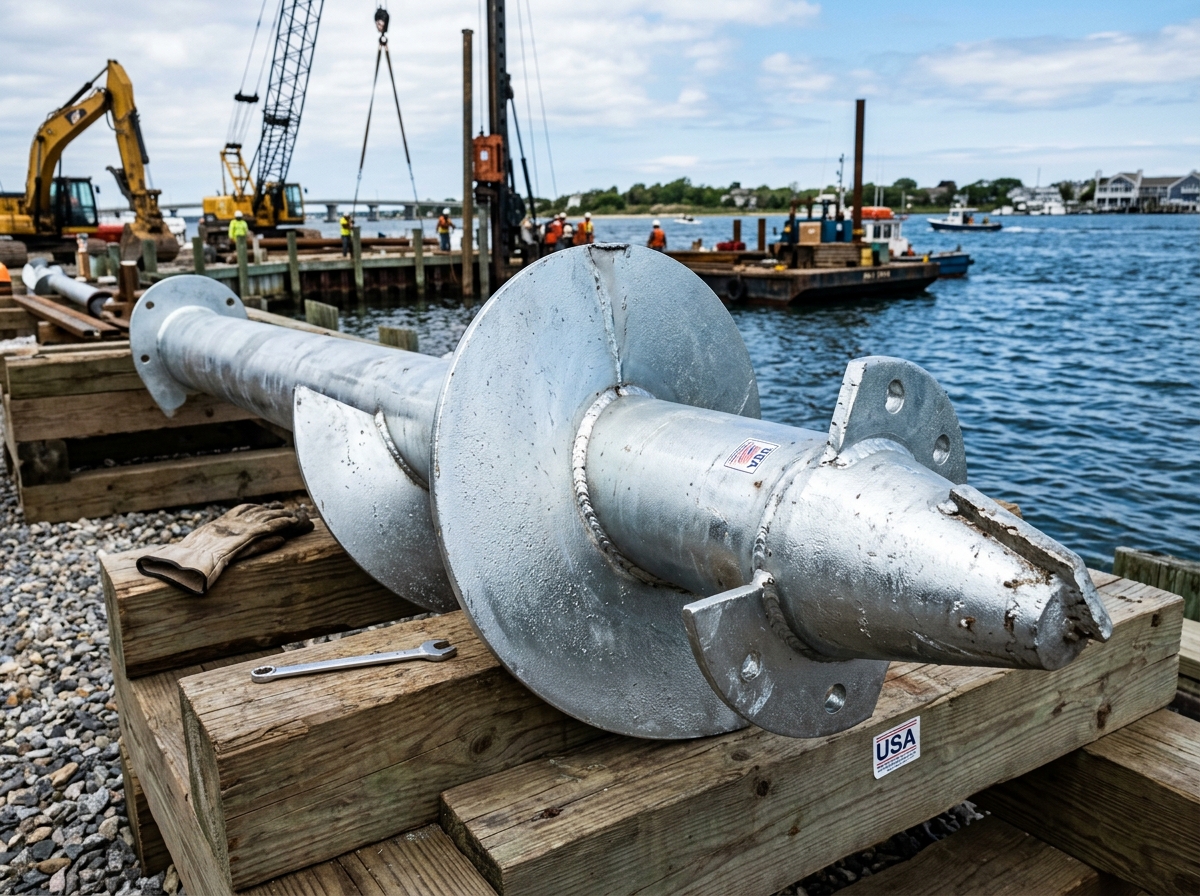
To understand why a helical pile foundation marine system is superior for the Lowcountry, we have to look at the anatomy of the pile itself. A helical pile consists of a central steel shaft with one or more helical plates (helices) welded to the “lead” section. As the pile is rotated into the ground, these plates act like a screw, pulling the shaft deeper into the earth without auguring or removing soil.
According to the Helical Pile Association, helical piles are often preferred over driven piles or drilled shafts for their versatility and immediate load-bearing capabilities. In marine settings, this versatility is a game-changer. While traditional timber piles might rot over decades and concrete piles require heavy equipment and curing time, helical piles are ready for a full load the moment they are installed.
Comparison of Marine Foundation Types
| Feature | Helical Piles | Concrete Piles | Timber Piles |
|---|---|---|---|
| Installation Method | Hydraulic Rotation | Impact/Vibratory Hammer | Impact Hammer |
| Noise/Vibration | Extremely Low | High | High |
| Soil Spoils | None | High (if drilled) | None |
| Load Timing | Immediate | Requires Curing | Immediate |
| Corrosion Resistance | High (Galvanized) | High | Subject to Rot/Borer |
| Tension Resistance | Excellent | Moderate | Low |
The “magic” of the helical pile lies in its ability to bypass weak, silty surface soils and anchor into competent load-bearing strata. This is particularly vital in Charleston, where the “marsh mud” can extend dozens of feet deep before reaching firm ground.
Engineering the Helical Lead and Extensions
The foundation begins with the lead section. This is the first part of the pile to enter the soil, featuring the helical plates that provide the bearing capacity. Depending on the project requirements—such as a residential dock on Johns Island or a commercial bulkhead in Charleston Harbor—we select either a square shaft or a round pipe shaft.
- Square Shafts: These are typically made of solid steel and are excellent for high-tension applications and penetrating harder soil layers like limestone or dense sands.
- Round Pipe Shafts: These offer superior section modulus, making them the preferred choice for resisting lateral loads (side-to-side forces) common in tidal environments.
Once the lead section is driven, extensions are bolted on in sections (often 5, 7, or 10 feet long) until the desired depth and torque are achieved. Every component is protected by hot-dipped galvanization, which creates a metallurgical bond that shields the steel from the corrosive effects of saltwater for decades. More info about choosing the right marine contractor can help you ensure your team understands these material nuances.
The Torque-to-Capacity Relationship
One of the greatest engineering advantages of helical piles is the empirical correlation between installation torque and load capacity. As we rotate the pile into the ground, the hydraulic pressure required to turn the pile increases as the soil becomes denser.
By using digital torque indicators, we can monitor this relationship in real-time. This provides instant feedback and quality control, ensuring that every pile installed meets the specific engineering requirements for the structure it supports. We aren’t just guessing how deep the pile needs to go; the soil tells us exactly when we’ve reached the necessary bearing capacity.
Engineering for the Charleston Lowcountry: Soil and Scour Challenges
Building in the Lowcountry requires an intimate understanding of our local geography. From the sandy shores of Folly Beach to the pluff mud of West Ashley, the soil is rarely consistent. Helical pile foundation marine technology addresses these inconsistencies better than almost any other method.
More info about marine construction in Charleston SC highlights how we must account for high water tables and constant tidal flux. In these conditions, “scour”—the erosion of soil around a foundation caused by moving water—is a major concern. Because helical piles can be driven deep into stable strata far below the “scour zone,” they remain stable even if the surface soil shifts or washes away.
Addressing Soil Instability in Kiawah and Seabrook Islands
On barrier islands like Kiawah and Seabrook, the soil is often composed of alluvial deposits and soft clays. These soils provide very little lateral resistance. When a hurricane brings high winds and surging waves, a shallow foundation can easily fail.
Helical piles provide a “deep foundation” solution that anchors the structure firmly. By spacing the helices appropriately—typically at least three times the diameter of the largest plate—we ensure that each plate carries its share of the load without interfering with the others. This creates a stable “anchor” that resists both the downward pressure of the structure and the upward “buoyancy” or “uplift” forces during a storm.
Corrosion Mitigation and Longevity
Saltwater is the enemy of most construction materials. However, helical piles are engineered for longevity. Beyond hot-dipped galvanization, we can implement sacrificial anodes for subsea structures. These anodes “sacrifice” themselves to corrosion, protecting the structural steel of the pile. This lifecycle advantage makes helical piles a much more cost-effective solution over time, as they require significantly less maintenance than timber or untreated steel.
Step-by-Step Installation of Helical Piles in Marine Environments
Installing a helical pile foundation marine system is a precision operation that requires specialized equipment and expertise. At BluTide Marine Construction, we utilize barge-mounted excavators and high-torque hydraulic motors to ensure every installation is perfect.
Precision Installation of Helical Pile Foundation Marine Units
- Site Assessment and Soil Data: We begin by evaluating the soils data to determine the likely depth required to reach load-bearing strata.
- Barge Mobilization: For waterfront projects, we mobilize our equipment via water to minimize impact on your upland property. More info about professional beach crossover construction shows how we handle sensitive coastal access.
- Lead Section Placement: The helical lead is positioned and the hydraulic drive begins the rotation.
- Continuous Rotation: The pile is screwed into the seabed at a constant rate. It is vital that the pile “threads” into the soil rather than “churning” it, which preserves the soil’s integrity.
- Extension Addition: Sections are bolted together as the pile descends.
- Torque Monitoring: We monitor the digital torque indicator constantly. If we hit a target of, say, 10,000 ft-lbs, we know the pile has the required capacity.
- Final Termination and Capping: The pile is cut to the correct height, and a custom pile cap is integrated to support the dock, seawall, or boardwalk.
Overcoming Subsea and Marshland Obstacles
In many cases, we face “limited access” sites where traditional pile drivers simply cannot go. Our use of twin-drive systems and vessel-mounted cranes allows us to install piles in a “single-approach” from the water. This means we don’t have to tear up your backyard or remove your landscaping to build a new seawall or dock.
Primary Marine Applications: Seawalls, Docks, and Boardwalks
The versatility of helical piles makes them suitable for a wide range of marine projects. More info about Lowcountry marine construction teams will confirm that having the right foundation technology is the difference between a structure that lasts 10 years and one that lasts 50.
Seawall and Bulkhead Stabilization
One of the most common uses for helical technology is in seawall and bulkhead stabilization. If an existing seawall is leaning or showing cracks, it is often because the original “dead-man” anchors have failed. We can install helical tieback anchors through the face of the existing wall into stable soil behind it.
These anchors provide massive lateral support—sometimes up to 200,000 lbs per anchor—and can extend the life of a seawall by 10 to 15 years. This “underpinning” process is far less expensive than a total wall replacement and can be done entirely from the water side.
Environmentally Sensitive Boardwalks and Piers
For projects in federally protected wetlands or dunes, helical piles are often the only approved solution. Because they are installed with small, high-torque equipment, they have a minimal footprint. There are no “spoils” (drilled-out mud) to dispose of, and the lack of heavy vibration protects the delicate root systems of marsh grasses and the nesting habits of local marine life. More info about pier and dock contractors can explain how these “no-vibration” installs are becoming the industry standard for eco-conscious builds.
Sustainability and Environmental Impact of Helical Pile Foundation Marine Technology
In the Lowcountry, we don’t just build on the water; we live in harmony with it. Sustainability isn’t just a buzzword; it’s a requirement for preserving the beauty of places like Kiawah and Wadmalaw Island.
Environmental Benefits of Helical Pile Foundation Marine Solutions
- No Spoils: Traditional drilled shafts create a mess of wet soil that must be hauled away. Helical piles displace no soil.
- Low Noise: Unlike the “bang-bang-bang” of a pile driver that can be heard miles away and disturbs marine mammals, helical drives are relatively quiet.
- Reduced CO2 Footprint: By eliminating the need for massive amounts of concrete and reducing the number of heavy equipment trips, helical foundations significantly lower the carbon footprint of a project.
- Reversibility: If a temporary structure is needed—such as a boat ramp for a construction project—helical piles can be “unscrewed” and removed, leaving the seabed exactly as it was found.
Frequently Asked Questions about Marine Helical Piles
How do helical piles compare to concrete piling in saltwater?
While high-quality concrete is resistant to saltwater, it is heavy, difficult to install in remote areas, and requires a long curing time. Helical piles, especially when hot-dipped galvanized, offer similar longevity with much faster installation and immediate load capacity. Furthermore, helical piles are far superior in “tension” (resisting being pulled out), which is critical during storm surges.
Can helical piles be installed in areas with limited barge access?
Yes! One of the primary advantages of helical technology is that the equipment can be scaled down. Small, portable hydraulic units can be used in tight spaces or marshes where a large barge cannot reach. This makes them ideal for residential repairs on Isle of Palms or Sullivan’s Island.
What is the typical lifespan of a galvanized helical pile in a marine environment?
With proper hot-dipped galvanization and the optional use of sacrificial anodes, a helical pile foundation marine system can easily last 50 to 75 years. Because they do not rot like wood or “spall” (crack) like concrete, they are often considered a “lifetime” foundation solution.
Conclusion
At BluTide Marine Construction, we believe that a waterfront structure is only as good as the foundation it stands on. Whether we are building a custom dock on Seabrook Island or stabilizing a commercial bulkhead in Charleston, we bring a level of engineering precision and master craftsmanship that is unmatched in the Lowcountry.
Helical pile foundation marine technology represents the perfect marriage of raw coastal power and refined engineering. It is fast, clean, environmentally friendly, and—most importantly—built to last.
If you are planning a new marine project or need to save a failing seawall, don’t settle for “standard” solutions. Choose the technology designed for the world’s most challenging soils.
Contact Us to Discuss Your Project Ready to build a foundation that stands the test of time? Schedule a consultation with our expert team today.
BluTide Marine Construction Phone: +1 (843) 557-1595 Email: blutidemarine@outlook.com Schedule a Consultation Online