The Homeowner’s Guide to Boat Dock Piling Repair
Why Boat Dock Piling Repair Is Critical for Your Waterfront Investment
Boat dock piling repair is the process of restoring damaged or deteriorating dock pilings — the vertical structural supports that hold your entire dock above water — to full strength, without necessarily replacing them.
Quick Answer: The most effective methods for repairing boat dock pilings include:
- Pile jacketing (encapsulation) — Encasing the damaged piling in a PVC or composite jacket filled with concrete to restore and exceed original strength
- Epoxy injection — Filling internal voids and cracks in wood or concrete pilings to reinforce from within
- Sister pilings — Installing a new piling alongside a compromised one to share the structural load
- Protective wrapping — Applying PVC wraps with an internal barrier to block marine borers and moisture
- Full replacement — Reserved for pilings with catastrophic damage, shipworm infestation, or total structural failure
Your dock is only as strong as what holds it up. Beneath the waterline, forces you can’t easily see are constantly working against your investment — tidal fluctuations, saltwater corrosion, UV exposure, and destructive marine organisms like Teredo navalis (shipworms) that hollow out wood pilings from the inside.
For waterfront homeowners on Kiawah Island, Seabrook Island, and throughout the Charleston Lowcountry, the stakes are especially high. The tidal range here, combined with hurricane-force surge and the aggressive marine biology of coastal South Carolina, accelerates piling deterioration faster than in most other environments in the country.
The good news: in many cases, your pilings don’t need to come out. Modern repair methods — particularly concrete encapsulation systems — can restore a compromised piling to beyond its original structural integrity, at a fraction of the cost of full replacement.
This guide walks you through everything you need to know: how to identify damage early, which repair method is right for your situation, and how a professional marine contractor executes a lasting restoration.
Identifying the Need for Boat Dock Piling Repair
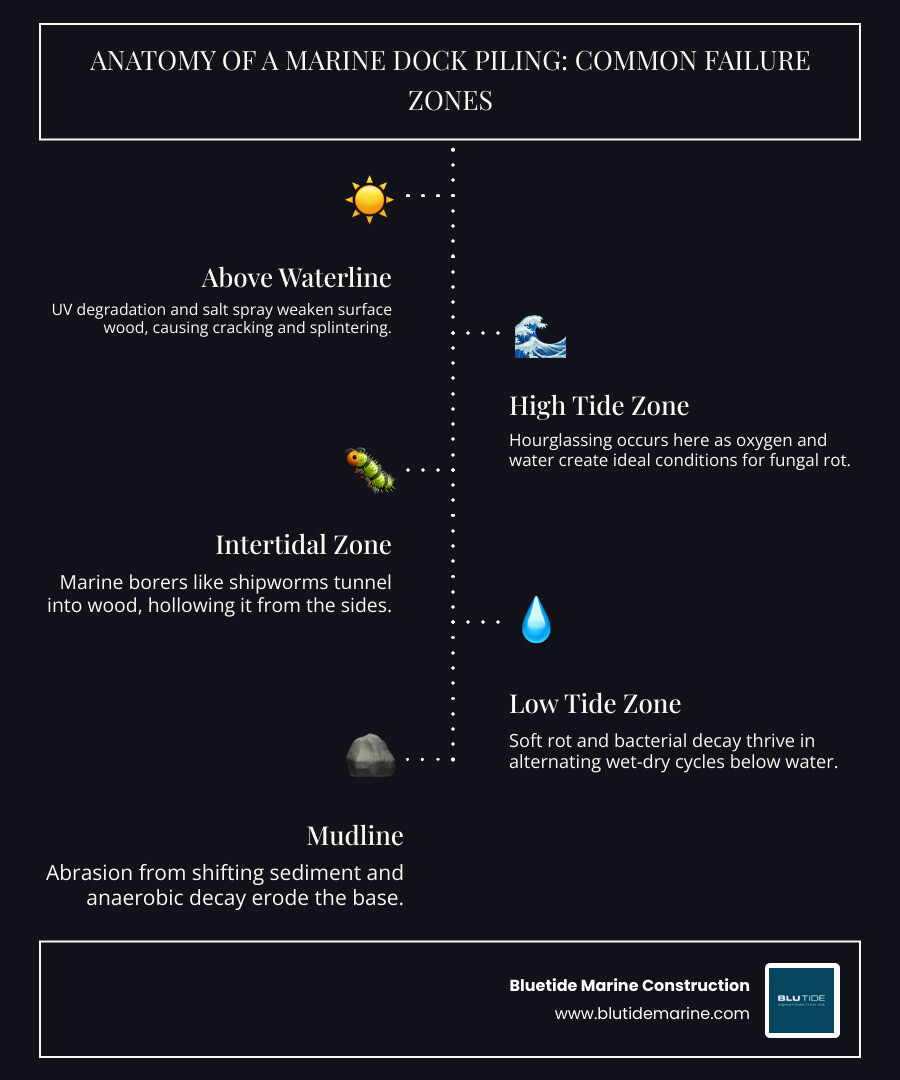
Identifying the need for boat dock piling repair early can be the difference between a straightforward restoration and a catastrophic dock collapse. Because the majority of piling damage occurs between the high-tide mark and the mudline, it often goes unnoticed by the casual observer. However, the structural integrity of your maritime investment depends entirely on these submerged columns.
In the Charleston Lowcountry, we frequently see “hourglassing” in wood pilings. This is a distinct narrowing of the pile, typically occurring in the intertidal zone where oxygen and water meet, creating the perfect environment for decay. If left unaddressed, this narrowing reduces the load-bearing capacity of the pile until it can no longer support the weight of the dock, boat lifts, or the force of incoming tides.
Beyond physical wear, fungal rot and UV degradation also play significant roles. While pressure-treated timber is designed to resist these forces, the treatment eventually leaches out or is bypassed by cracks in the wood. When this happens, the interior of the pile becomes vulnerable. You might notice structural wobbling when walking on the dock or hear ominous creaking joints during high winds—these are clear signals that your foundation is compromised.
Scientific research on marine boring organisms highlights that these pests are not just a nuisance; they are structural terminators. For those looking to understand the broader context of these challenges, you can find more info about marine construction in Charleston to see how we engineer for these specific local threats.
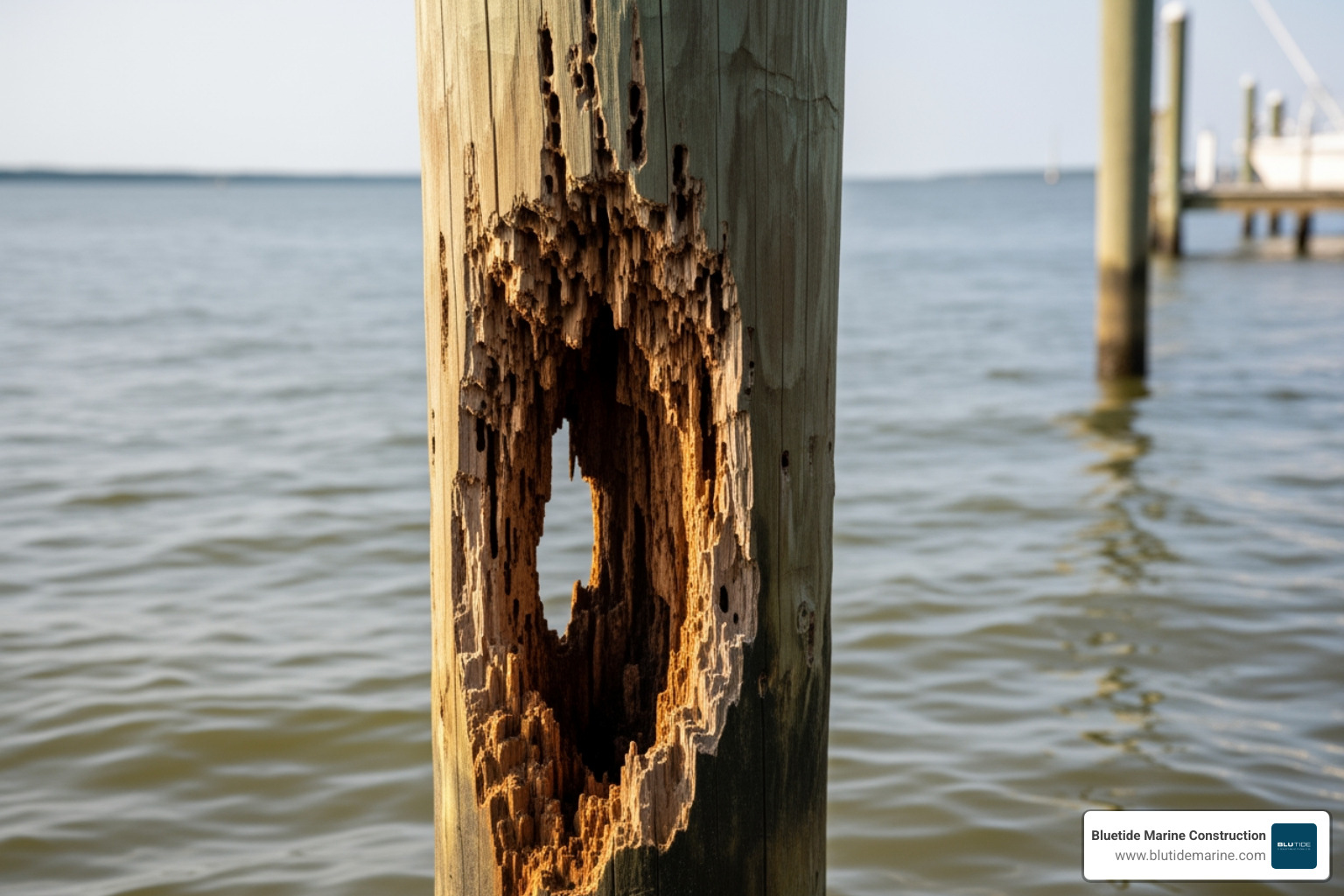
Common Signs of Subsurface Deterioration
While wood pilings are traditional in the Lowcountry, many high-end estates utilize concrete or steel. Each material speaks its own language of distress. For concrete piles, look for spalling—where the outer layer of concrete flakes away, often revealing rusted reinforcement rebar beneath. This rust causes the metal to expand, further cracking the concrete from the inside out.
For wood, keep an eye out for:
- Calcification and Barnacle Overgrowth: While some growth is normal, excessive buildup can hide deep cavities.
- Soft Spots: If you can poke a screwdriver deep into the wood at the waterline, the structural core is likely gone.
- Rusted Fasteners: Bleeding rust stains on the wood often indicate that the internal structural connections are failing.
Understanding these signs is the first step in maintaining your property. You can learn more info about Charleston waterfronts to better understand how local conditions affect these materials.
Environmental Threats in the Lowcountry
The Charleston area presents a “perfect storm” of environmental stressors. Our massive tidal fluctuations mean that a large portion of the piling is constantly transitioning between wet and dry states, which accelerates wood rot. Salt spray acts as a corrosive agent on all hardware, while hurricane surges provide the ultimate stress test for lateral stability.
The most aggressive threats, however, are biological. Limnoria (gribbles) and Teredo navalis (shipworms) are prevalent in South Carolina waters. Shipworms are particularly insidious; they enter the wood as microscopic larvae and spend their lives hollowing out the interior, leaving the exterior looking relatively healthy while the inside is as fragile as a honeycomb. According to a Timber Council study on piling longevity, unprotected wood in these environments has a limited shelf life, often failing decades before it should.
Advanced Methods for Structural Piling Restoration
When the damage is done, we turn to advanced restoration methods. Gone are the days when the only solution was to bring in a massive barge to pull and replace every pole. Modern boat dock piling repair focuses on “in-place” restoration, which is faster, cleaner, and often results in a stronger finished product.
The primary methods we employ include:
- Concrete Encapsulation: This is the gold standard. We surround the pile with a form and fill the void with high-strength, marine-grade concrete.
- SnapJacket System: A specialized, high-durability vinyl jacket that “snaps” around the piling. It serves as a permanent form for the concrete and a shield against future attacks.
- Sister Pilings: For piles that have failed at the mudline, we drive a new pile alongside the old one and bolt them together to transfer the load.
- Epoxy Injection: Used primarily for concrete piles to seal cracks and prevent further rebar corrosion.
The Advantages of Boat Dock Piling Repair Jackets
The use of pile jackets, such as the SnapJacket system, has revolutionized marine maintenance. These jackets are made of UV-protected PVC that is resistant to the harsh South Carolina sun and the abrasive action of salt water. One of the most significant benefits is the 25-year warranty often associated with these systems, with some studies suggesting they can last “indefinitely” once the concrete core is set.
The key to this system is the annular space—the gap between the old piling and the new jacket. By filling this 1.5-inch to 2-inch space with concrete, we essentially create a brand-new concrete piling with a permanent PVC skin. This skin blocks the oxygen and water that marine borers need to survive, effectively killing any organisms currently inside the wood. For more insights on why this is the preferred choice for many homeowners, check out more info about professional marine contractors.
Why Encapsulation Beats Full Replacement
For most homeowners on Johns Island or Folly Beach, encapsulation is the superior choice for several reasons:
- No Deck Disassembly: We can install jackets without touching your high-end Ipe decking or removing boat lifts. This saves an incredible amount of labor and prevents damage to your dock’s surface.
- Cost-Effectiveness: Repairing a piling in place typically saves thousands of dollars compared to the mobilization costs of a piling barge.
- Environmental Safety: Pulling old, pressure-treated pilings can stir up silt and release chemicals. Encapsulation seals those chemicals inside, preventing further leaching into our pristine Lowcountry marshes.
- Structural Superiority: A concrete-encased piling often has a higher axial load capacity than the original timber pile.
To see how these services fit into a broader property plan, you can view more info about residential marine services.
| Feature | Jacket Repair (Encapsulation) | Full Piling Replacement |
|---|---|---|
| Average Lifespan | 25 – 50+ Years | 20 – 30 Years |
| Site Disruption | Minimal (Work done from water) | High (Requires barge/deck removal) |
| Installation Time | ~30-45 mins per pile | 1-2 days per pile |
| Structural Strength | Exceeds original strength | Restores original strength |
| Permitting | Usually simpler/faster | Often requires full OCRM review |
Step-by-Step Guide to Professional Piling Encapsulation
At BluTide Marine, we follow a rigorous engineering process to ensure every boat dock piling repair is permanent. It is not a “DIY” job; it requires specialized underwater equipment and a deep understanding of concrete chemistry in saltwater environments.
1. Site Assessment and Preparation
We begin with a thorough inspection of every piling. We use high-pressure water jets (sand jetting) to clear the sand away from the base of the pile, ensuring the new repair extends at least one foot below the mudline. This prevents organisms from entering through the bottom of the jacket.
2. Sizing and Cutting
We measure the diameter of the existing pile at its widest point. We then select a jacket (usually 10, 12, 14, or 16 inches) that provides at least 1.5 inches of annular space. The jackets are cut to length using fine-tooth blades to ensure a clean, watertight fit.
3. Installation and Locking
The jacket is opened and “snapped” around the pile. A specialized locking device is slid down the joint, securing the form. We then ensure the jacket is plumb and centered around the old piling.
4. Concrete Placement
This is the most critical step. We use a high-strength, non-shrink marine grout or concrete. For shorter piles, we may pour from the top; for deeper water, we use a pump to ensure the concrete displaces all water within the jacket, preventing “honeycombing” or weak spots.
5. Curing and Finishing
The concrete cures inside the PVC shell, bonding to the wood and creating a solid, monolithic structure. Once set, we install a piling cap to protect the top of the wood from rainwater and UV rays.
Learn more about our standards by reading more info about choosing a marine construction team.
Precision Installation Techniques
The difference between a repair that lasts five years and one that lasts fifty lies in the precision of the installation. We utilize specialized jet pumps to ensure the jacket is seated deep enough into the seabed to prevent “undermining” from current scour. Furthermore, our use of structural bonding agents ensures that the concrete core adheres perfectly to the existing timber, creating a unified load-bearing column. If you are currently looking for a partner for your project, find more info about finding a dock builder.
Long-Term Maintenance and Boat Dock Piling Repair Prevention
Once your pilings are repaired, a small amount of preventative care goes a long way.
- Piling Caps: These are essential. They prevent “top-down” rot by keeping rainwater from soaking into the end grain of the wood.
- Biannual Inspections: We recommend a quick visual check every six months to look for new impact damage from boats or floating debris.
- Marine Growth Removal: While the PVC jackets are durable, removing heavy barnacle growth every few years helps reduce the “drag” on your dock during high-velocity tidal flows.
- Cathodic Protection: For docks with steel components, we can install sacrificial anodes to prevent electrolysis and corrosion.
For ongoing care, you might want to look for more info about pier contractors who specialize in maintenance.
Frequently Asked Questions about Piling Restoration
When should I choose repair over full replacement?
Repair via encapsulation is almost always the preferred choice if the piling still has a solid core and is properly aligned. We conduct a structural assessment to determine the remaining life of the pile. If the damage is localized (like hourglassing at the waterline), a jacket is perfect. Full replacement is generally reserved for cases where the pile has snapped, shifted significantly in the soil, or is so infested with shipworms that it can no longer support its own weight during the repair process.
How long do repaired pilings typically last?
When using a system like SnapJacket combined with high-strength marine concrete, the lifespan is considered “indefinite.” The PVC shell is UV-stabilized and does not degrade in saltwater, while the concrete core is protected from the elements. Most systems come with a 25-year manufacturer warranty, but in the calm waters of a Kiawah or Seabrook creek, they can easily last 50 years or more.
Are permits required for piling repairs in South Carolina?
Yes. In the Lowcountry, most marine work falls under the jurisdiction of the South Carolina Department of Health and Environmental Control (DHEC) and the Office of Ocean and Coastal Resource Management (OCRM). Minor repairs and maintenance often fall under “General Permits,” which are easier to obtain than the “Major Permits” required for new construction or full dock replacement. At BluTide, we handle the entire permitting process for our clients, ensuring full environmental compliance.
Conclusion
Your dock is a gateway to the lifestyle that makes the Charleston Lowcountry so special. Protecting that gateway requires more than just surface-level maintenance; it requires a deep commitment to structural integrity and engineering excellence. Whether you are on Kiawah Island, Seabrook Island, or Johns Island, boat dock piling repair is an investment in the longevity and safety of your home.
At BluTide Marine Construction, we merge raw coastal power with refined craftsmanship. We don’t just “fix” docks; we engineer them to withstand the unique challenges of our South Carolina environment. From custom docks to complex structural restorations, our team is dedicated to delivering results that are as beautiful as they are durable.
View our project gallery to see the standard of excellence we bring to every waterfront.
To discuss your waterfront restoration and ensure your dock stands strong for decades to come, contact us at +1 (843) 557-1595 or email blutidemarine@outlook.com.
Schedule a professional consultation today and let us help you protect your piece of the Lowcountry.