Shared waterfront is one of the most valuable amenities a Lowcountry community can offer, and HOA and community dock construction is how a neighborhood turns marsh frontage into something members actually use. These projects are not scaled-up private docks. They carry heavier loads, more stakeholders, real liability, longer permitting, and a maintenance obligation that outlives every board that votes on them. This guide covers what goes into a community dock in South Carolina and what a board should understand before it commits.
What Makes a Community Dock Different
A private dock serves one household that knows its own dock. A community dock serves dozens of families, their guests, and their children, many of whom will step onto it for the first time in the dark. That single fact drives most of what follows: higher design loads, closer attention to railings, lighting and non-slip surfaces, and documentation that proves the structure was engineered rather than assembled.
It also changes the decision-making. A private owner decides and builds. A board has to scope the project, fund it, survive a member vote, and hand a defensible record to the board that follows. Getting the engineering and permitting right the first time is not perfectionism — it is what protects the association from a special assessment in year eight.
Common Configurations
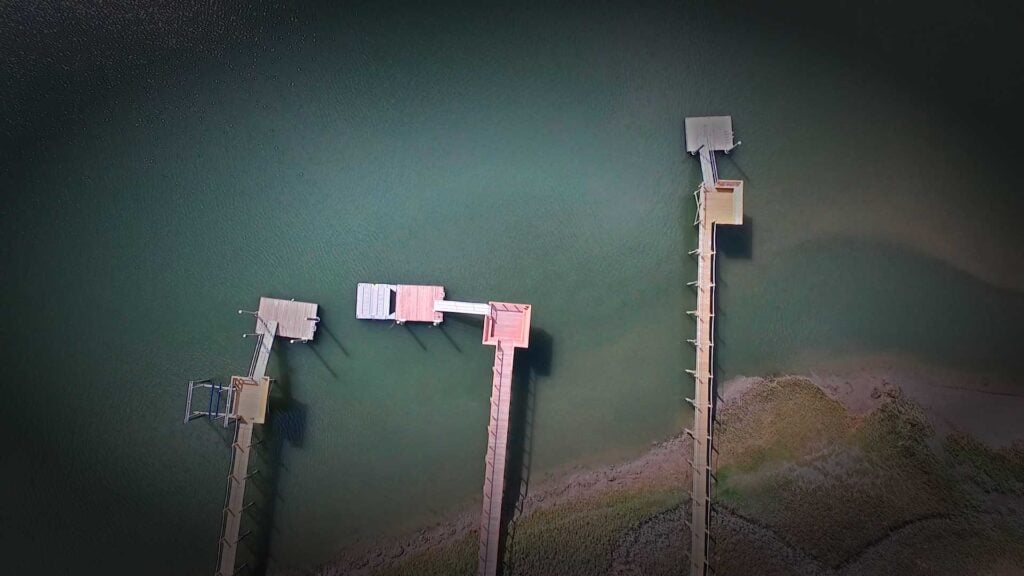
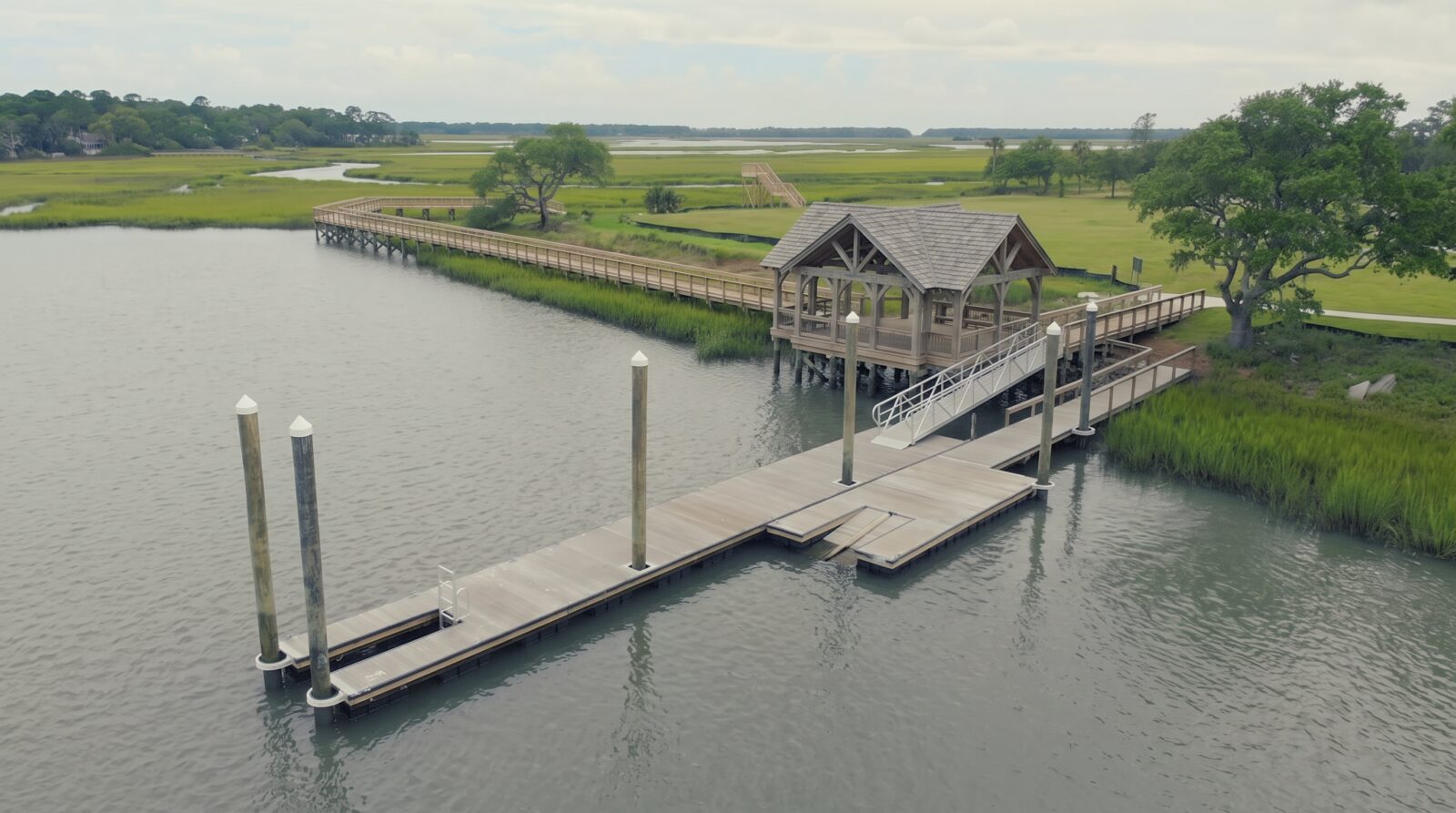
Shared pier and pierhead
A central walkway to a generous covered or open pierhead sized for group use — fishing, crabbing, sunset gatherings. The most common core of a community amenity, and often the most used.
Community floating docks
A gangway to a floating dock restrained by guide piles, providing stable, level access at any point in Charleston’s five-to-six-foot tidal range. Without one, a community dock is only usable near high tide, which is a complaint boards hear quickly.
Kayak and small-craft launches
Dedicated low-freeboard launch structures, sometimes with grab rails or a slide. Increasingly the most requested feature in waterfront communities, and comparatively inexpensive to add while a crew is already mobilized.
Day-slips and group docks
For communities with boating members, day-slips extend the amenity to on-water access. They also introduce assignment policy, wear, and liability questions the board should settle before construction rather than after.
Design Loads and Safety
Community structures are designed for higher live loads than a private dock, because a gathering pier may hold thirty people rather than three. Railing height and infill spacing, gangway slope across the tidal range, non-slip decking, lighting, and life-ring placement all become design decisions with a safety rationale behind them. An engineered structure comes with drawings and calculations that document those decisions — which is exactly what an insurer or an attorney will ask to see if anything ever goes wrong.
How a Board Should Approach the Project
The construction is usually the straightforward part. The sequence around it is where projects stall.
- Confirm the association actually controls the frontage. Riparian rights, easements, and plat language decide whether a dock is possible at all. Settle this before spending on design.
- Check the governing documents. Many declarations set thresholds for capital improvements — a member vote, a spending cap, or both.
- Scope before you budget. A board cannot fund what it has not defined. A site assessment and a preliminary layout turn a wish into a number.
- Fund it honestly. Reserves, a special assessment, or financing — and include the ongoing maintenance line, not just the build.
- Permit, then build. Permitting is the long pole. Construction schedules should be set from the approval date, not hoped for in advance of it.
- Keep the record. Drawings, permits, warranties, and inspection reports belong in association files where the next board can find them.
Permitting and Engineering for Shared Structures
Waterfront work in South Carolina is administered by the SCDES Bureau of Coastal Management — the office most people still call OCRM, which moved to the Department of Environmental Services when DHEC was split in 2024 and was renamed at that time. The critical area rules and critical line are unchanged.
Community docks generally require individual rather than general authorization because of their size and shared use, and that path typically involves more review, engineering documentation, and often public notice. Expect it to take meaningfully longer than a private dock permit. No contractor can promise a board an approval or a date, and any who does should be treated with suspicion. What a good one does is submit a complete, well-documented application so the review is about the project rather than about missing information.
Maintenance and Reserves
This is the part boards most often skip. A dock is a depreciating asset with a maintenance schedule: annual inspection, hardware checks, deck board replacement, gangway and float hardware, and eventually piling work. Building with coastal-grade materials reduces the burden but does not remove it. A community dock funded without a reserve line simply defers the cost onto a future board and a future special assessment. Ask your contractor for an expected maintenance schedule and a realistic service life for each component at handover — float hardware and decking will not age at the same rate as the pilings.
Working With Boards, Developers, and Associations
These projects succeed on communication as much as construction. Boards need scopes and budgets they can present to members without having to defend line items they do not understand. Developers need schedules that align with build-out and sales. Associations need documentation for their records. BluTide works as a partner to the decision-makers — clear about scope, cost, and schedule, and candid when a requested feature is not worth what it costs.
Why Communities Choose BluTide
BluTide Marine Construction has delivered marine infrastructure for municipalities, marinas, resorts, and public agencies across the Lowcountry, including work for the South Carolina Ports Authority, Charleston County Park & Recreation Commission, and coastal towns throughout the region. That commercial record means an HOA gets a contractor fluent in shared-structure engineering, agency permitting, and stakeholder management — with the craftsmanship that makes the finished dock something members are glad they paid for.
Frequently Asked Questions
What does a community or HOA dock cost in South Carolina?
It depends on length, configuration, water depth, features, and permitting scope, and community docks are individually engineered rather than priced from a catalog. A board should expect to fund a site assessment and preliminary design first, then budget from a defined scope. Any number offered before that exists is a guess.
Does a community dock need a different permit than a private dock?
Usually yes. Shared structures typically require individual authorization from the SCDES Bureau of Coastal Management rather than a general permit, with additional engineering review and often public notice.
How long does a community dock project take?
Permitting is the longest and least predictable phase and varies with scale and review requirements. Construction follows approval. A contractor should give the board a realistic overall schedule and be honest that the permitting portion is outside anyone’s control.
Who is responsible for maintaining a shared community dock?
Typically the association, per its governing documents. Boards should establish a reserve line for the dock at the time it is built rather than after the first major repair.
Does a community dock need to be accessible?
It depends on how the structure is classified and used, and it is worth raising early with your design professional rather than late. Gangway slope across the tidal range is the usual constraint, and it is far cheaper to design for than to retrofit.
Can a community dock include floating docks and kayak launches?
Yes, and combining them is common. Floating docks solve tidal access, and kayak launches are among the most-used features per dollar in waterfront communities.
Insurance and Liability
A shared structure over water is a liability the association carries, and it is worth treating that as a design input rather than a closing formality. Boards should confirm with their carrier that the dock will be scheduled on the policy once built, understand what the policy says about member and guest use, and keep engineering drawings and inspection records somewhere they can actually be produced. Posted use rules — no diving, no unattended children, a stated capacity on a gathering pier — cost almost nothing and matter considerably if a claim is ever made.
Have these conversations with counsel and the insurer during design, not after handover. A railing detail or a lighting decision is inexpensive on a drawing and expensive once it is built.
Build a Waterfront Amenity Your Community Will Value
If your HOA, development, or association is planning a shared dock, BluTide Marine Construction can help you scope it, permit it, and build it — and give your board a record it can hand forward. Contact our team to start the conversation, and learn more about our commercial marine construction services.