Beaufort and Hilton Head share the Lowcountry’s beauty with Charleston, but they do not share its water. Anyone looking for a marine contractor in Beaufort or Hilton Head should understand that first, because the single biggest design factor on this part of the coast is a tidal range that dwarfs Charleston’s — and it changes how a dock has to be built. BluTide Marine Construction brings decades of marine infrastructure experience to the lower South Carolina coast, for both high-end residential waterfront and commercial and municipal work.
The Tide Is the Design Problem
Charleston Harbor runs a mean tidal range of roughly five feet. Port Royal Sound averages about eight and a half feet, from around six feet on a neap tide to more than ten on a spring tide — one of the largest ranges on the Southeast coast. Three extra feet sounds modest written down. On a dock it is the whole design.
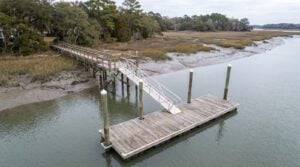
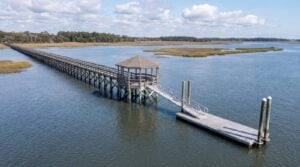
A gangway has to reach from a fixed pierhead to a float across that entire swing while staying at a slope people can actually walk. More range means a longer gangway, which means a larger pierhead to land it on and more structure to carry it. Pilings run taller, so they carry more load and need deeper embedment. Float guide piles must be tall enough that the float cannot ride off the top at spring high water — a failure that happens on this coast when someone builds to Charleston dimensions.
The current that comes with that range matters too. Moving eight feet of water in and out of a creek twice a day produces real velocity, which drives scour around pilings and puts sustained lateral load on float systems. A dock designed for a protected Charleston creek and dropped onto the Beaufort River is underbuilt, and it will show.
Communities We Serve on the Lower Coast
Beaufort, Port Royal, Lady’s Island, Cat Island, Dataw, Fripp, Harbor Island, Hilton Head, Bluffton, Daufuskie, Callawassie, Spring Island, and the surrounding sea islands. Frontage across this area varies enormously — deepwater lots on the Beaufort River, sheltered creek frontage off the May, exposed sound-facing property on Port Royal. Each calls for a different structure, and reading which one you have is the first job.
Services for Beaufort and Hilton Head Waterfronts
Dock and pier construction
Private docks for waterfront homes and larger piers for commercial and community use, engineered for the lower coast’s tidal range rather than borrowed from a Charleston detail.
Seawalls and bulkheads
Shoreline protection that holds land against tide, wake, and surge — from residential vinyl walls to engineered commercial structures.
Pile driving and marine foundations
Pilings driven to the embedment the site actually requires, sized for scour and load in high-current water.
Waterfront restoration and repair
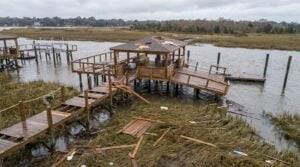
Assessment and repair of aging or storm-damaged docks, seawalls, and marine structures, restoring both function and appearance.
Living shorelines and erosion control
Natural and hybrid stabilization for owners who want to hold an eroding bank while keeping the marsh edge.
Built for Storm Exposure
The lower coast takes real storm exposure, and Hurricane Matthew in 2016 is still the local reference point for what surge does to underbuilt structures. Coastal-grade materials, proper embedment, engineered connections, and deck elevation set with surge in mind are what separate a dock that is inspected after a storm from one that is rebuilt. On this coast that is not over-engineering; it is the baseline.
Permitting on the Lower Coast
Waterfront work here is administered by the SCDES Bureau of Coastal Management — the office long known as OCRM, which moved to the Department of Environmental Services when DHEC was split in 2024 and was renamed at the same time. Usefully for owners in this area, the Bureau maintains a Beaufort office alongside Charleston and Myrtle Beach, so lower-coast projects are reviewed by staff who know these waters.
Expect local layers on top of the state permit. Beaufort County, the Town of Hilton Head Island, and the Town of Bluffton each apply their own land-use and buffer requirements, and many communities here — Dataw, Spring Island, Callawassie, and the Sea Pines and Hilton Head Plantation associations among them — add architectural review with its own standards and its own calendar. Those reviews are frequently the schedule constraint rather than the state permit. No contractor can promise you an approval or a date from any of them; what a good one does is identify every body that has to say yes before design begins, rather than discovering the third one halfway through.
What to Look for in a Lower-Coast Contractor
Ask whether they have built in this tidal range specifically, and ask to see it. Ask how they size gangways and guide piles for a ten-foot spring tide. Ask about embedment and scour in high-current water. Ask which local review boards they have been through. Proper licensing and insurance for marine work is the floor, not the differentiator — the differentiator is whether the person quoting has solved these particular problems before.
Why BluTide on the Lower Coast
BluTide pairs large-scale commercial and municipal experience — including work for public agencies, marinas, and coastal towns across the Lowcountry — with the finish quality high-end residential owners expect. A homeowner gets a builder who engineers like a commercial contractor; a developer or municipality gets one who finishes like a custom builder. Every project runs end to end: assessment, engineering, permitting, construction, and honest maintenance guidance at handover.
Frequently Asked Questions
Does BluTide serve Beaufort and Hilton Head?
Yes. BluTide serves the Charleston metro and the broader Lowcountry coast, including Beaufort, Port Royal, Hilton Head, Bluffton, Daufuskie, and the surrounding sea islands, for residential, commercial, and municipal waterfront work.
Why does the tidal range matter so much here?
Port Royal Sound averages about 8.5 feet of tidal range against roughly 5 feet in Charleston Harbor, reaching over 10 feet on spring tides. That drives gangway length and slope, pierhead size, piling height and embedment, and guide pile height for floats. A dock designed to Charleston dimensions will not work properly here.
Do waterfront projects in Beaufort and Hilton Head need state permits?
Yes. The same critical area rules apply, administered by the SCDES Bureau of Coastal Management, which maintains a Beaufort office. County, municipal, and community architectural review requirements frequently apply on top of the state permit.
How long does permitting take on the lower coast?
It varies with project scale, review requirements, and how many local bodies are involved. Community architectural review often takes longer than owners expect and can be the binding constraint. No contractor can guarantee a timeline for any of these approvals.
How do I choose a marine contractor here?
Look for licensing and insurance for marine work, direct experience in this tidal range, in-house permitting capability, and completed projects on shorelines like yours. Ask specifically how they size gangways and guide piles for a ten-foot spring tide — the answer tells you quickly whether they have worked this coast.
Can BluTide handle both residential and commercial projects here?
Yes. BluTide works across high-end residential waterfront and commercial, community, and municipal marine infrastructure, with the same engineering discipline applied to each.
Deepwater, Creek, and Sound Frontage Are Different Jobs
Owners often ask what a dock costs on the lower coast as though it were one place. It is at least three, and which one you own drives the scope more than anything on a price list.
Deepwater frontage on the Beaufort River or Calibogue Sound usually means a shorter walkway but a bigger structure at the end — deeper pilings, a larger pierhead to land a long gangway, and a float system built for current. Cost concentrates offshore.
Creek frontage off the May River or through the sea island marshes typically means the opposite: a long walkway crossing marsh to reach navigable water, then a comparatively modest pierhead. Cost concentrates in the walkway, and permitting attention concentrates on the marsh crossing, since the length of that walkway is exactly what reviewers scrutinize.
Sound-facing frontage exposed to Port Royal is the most demanding of the three. Fetch, wind chop, and full tidal current arrive together, and the structure has to be engineered for all of it. This is where borrowed details fail fastest.
Knowing which you have before you start budgeting saves a great deal of wasted design.
Start Your Lower-Coast Waterfront Project
Planning a dock, seawall, or waterfront project in Beaufort or Hilton Head? BluTide Marine Construction can assess your site, size it for the tide you actually have, and build it to last. Contact our team to get started, and explore our residential and commercial marine construction services.