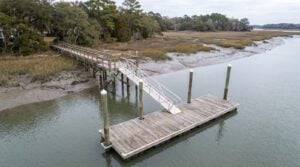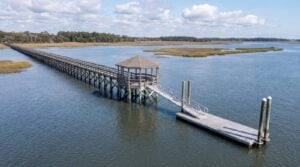
A dock without power is a daytime structure. Add lighting, outlets, a hose bib and a fish-cleaning station, and it becomes the part of the property the family actually uses — after work, after dark, most of the year. It is also, consistently, the part of a dock build that gets done worst.
Marine electrical work in a brackish tidal environment is not household wiring stretched over the water. The salt, the humidity, the twice-daily wetting of everything below the deck, and the simple fact that people stand on a wet surface while touching metal all raise the stakes considerably. Done properly it is safe and lasts decades. Done casually it corrodes in three years and, in the worst case, energises the water around the dock.
What the code actually requires
Dock electrical installations in South Carolina fall under Article 555 of the National Electrical Code, which governs marinas, boatyards and floating buildings. The provisions that matter most to a private residential dock owner are these:
- GFCI protection on every receptacle. Non-negotiable, and it should be a marine-rated device, not a builder-grade bathroom unit.
- Ground-fault protection of the feeder — a whole-dock device set at 30 milliamps that trips the entire circuit if current is leaking to water. This is the protection that prevents electric shock drowning, and it is the single most important component on the dock.
- An emergency disconnect on shore, clearly labelled, within sight of the dock, so anyone can cut power from dry land.
- Wiring methods rated for wet locations, run in conduit, with no splices below the deck.
- Bonding of metallic components so there is no potential difference between anything a person can touch.
Every dock we wire in the Charleston area is installed by a licensed electrician and inspected. It is not an area where we improvise.
Lighting that works on the water
Good dock lighting does three things at once: it lets you walk the structure safely, it lets you work at the pierhead, and it does not blind you, your neighbours, or the wildlife. Those goals conflict if you simply mount bright fixtures on posts, which is what most docks end up with.
The approach that works:
Low, downward, warm. Recessed deck lights or low-profile rail lights at 2700K to 3000K, aimed down at the walking surface. You need far less light than you think — the eye adapts, and a dock lit to a comfortable path level looks better and costs less to run than one floodlit to daylight.
Task light where you work. A single switched fixture over the cleaning station and the boarding area, on its own circuit, that comes on when you need it and stays off otherwise.
Nothing pointing at the water. Light spilling onto the creek attracts baitfish, which attracts predators, which is entertaining once and a nuisance permanently. It also disorients wildlife and irritates neighbours across the creek, whose view of the marsh at night is part of why they live there.
Piling caps as the finish detail. Solar or low-voltage piling cap lights on the outer pilings mark the structure for boat traffic and give the dock its shape after dark. On a long marsh crossing they are what makes the walk feel considered rather than utilitarian.
Every fixture should be marine-rated — sealed, ideally bronze, 316 stainless or a marine-grade polymer. Standard outdoor fixtures from a home centre will corrode through in two to three seasons in this air. The same logic applies to every other metal component on the structure, which we cover in our guide to materials that survive Charleston saltwater.
Power: what to run and how much
| Use | Typical service | Notes |
|---|---|---|
| Lighting only | 15 A, 120 V | Low-voltage transformer on shore is often better |
| Lighting + receptacles | 20 A, 120 V | Most common residential dock spec |
| Add a boat lift | 20–30 A dedicated circuit | Lift motor should never share with receptacles |
| Shore power for a boat | 30 A or 50 A, 120/240 V | Requires isolation transformer or galvanic isolator |
| Full pierhead (lift, lights, power, pump) | 60–100 A subpanel | Subpanel located on the fixed pierhead, not the float |
The most common mistake is undersizing. Running a single 15-amp circuit out to a dock is cheap on the day and expensive in five years, when a lift is added and the whole feeder has to be pulled and replaced. Because the trench and the conduit run are most of the cost, size the feeder for what the dock might carry, not what it carries on day one.
If you are planning boat lift installation now or later, tell your builder before the conduit goes in the ground.
Getting the conduit across the marsh
This is the part unique to Lowcountry building. The service has to travel from the house, across protected salt marsh, to the pierhead — and the marsh cannot simply be trenched.
The standard solution is to run the conduit under the walkway, strapped to the framing above the marsh surface, in a schedule 80 PVC or a marine-grade non-metallic raceway with expansion fittings for thermal movement. It stays above the highest tide, out of sight from the deck, and accessible for future pulls. Directional boring under the marsh is possible but rarely justified for a residential dock.
Two details that separate a good install from a bad one: pull strings left in the conduit for future circuits, and every penetration sealed and sloped so water drains out rather than collecting in a low spot and corroding a joint from the inside.
Water at the pierhead
A hose bib on the dock is the least glamorous and most used utility on the whole structure. Rinsing salt off gear, hosing down after a fishing trip, filling a live well, washing the deck — all of it depends on fresh water arriving at the pierhead with usable pressure.
Run it in the same conduit bundle as the electrical, in PEX or CPVC rather than rigid PVC, with a shutoff and a drain point on shore so the line can be emptied before a freeze. Charleston does not freeze often, but it freezes hard enough occasionally to split a dock water line, and the repair means pulling the line out from under the walkway.
A fish-cleaning station with a sink, a light and a hose connection is a modest addition at build time and effectively impossible to retrofit neatly. If you fish, specify it up front.
Electric shock drowning: the reason any of this matters
Faulty dock wiring can energise the water around a dock. A swimmer entering that water can be paralysed by the current and drown without any visible sign of what happened. It is rare, it is entirely preventable, and it is the reason the ground-fault protection requirement exists.
Three practical rules for any Lowcountry dock owner: install and test 30 mA ground-fault protection on the feeder; test the shore disconnect and every GFCI at least twice a year; and do not swim near a dock with shore power connected to a boat. If a swimmer near your dock reports tingling, get them out of the water without entering it and cut power immediately.
Detailed guidance for owners is published by the National Fire Protection Association, which maintains the electrical code these provisions come from.
Frequently asked questions
How much does it cost to run power to a dock in Charleston?
For a typical residential dock with a marsh crossing, budget $6,000 to $18,000 depending on the distance from the panel, the size of the service, and whether a subpanel and lift circuit are included. Long crossings and 240-volt lift service sit at the upper end.
Can I use solar lighting instead of running power?
For path and piling-cap lighting, yes, and it is a reasonable choice on a dock with no lift and no receptacles. Modern marine solar caps are genuinely serviceable. They will not run a lift, a pump or a fish-cleaning station.
Do dock lights have to be a particular colour?
There is no residential requirement, but warm, low, downward-facing light is the right choice for the marsh, for your neighbours and for your own night vision. Cool white floodlights aimed at the water are the most common mistake we are asked to fix.
Should the electrical panel go on the float or the pierhead?
Always the fixed pierhead. Nothing electrical should live on a structure that moves six feet twice a day and can be lifted by surge.
Can utilities be added to an existing dock?
Yes, and we do it regularly — usually alongside a re-deck or a repair. Access under the walkway is the constraint. It is far cheaper when combined with other work; see our dock repair guide for how those projects are usually scoped together.
Building it in from the start
Utilities are the clearest example of something that costs a fraction as much at build time as it does later. The conduit run, the feeder size, the fixture locations and the water line all want to be decided before the decking goes down — after that, every change means lifting boards.
Whether you are planning a new dock or improving one you already have, get in touch and we will walk the property with you before anything is specified. You can see how we finish this work in our project gallery.