Building on Kiawah Island is unlike building anywhere else in the Charleston area. The island sits inside a coastal critical zone with some of the most carefully managed shoreline in South Carolina, the Kiawah River and Bohicket Creek both fall under SCDES jurisdiction, and the homes that line the water tend to be among the most architecturally refined in the Lowcountry. A Kiawah Island dock and seawall contractor has to combine deep understanding of the OCRM critical line with the craftsmanship that matches the architectural standard of the houses behind the bulkhead. BluTide has been building docks, dock walks, seawalls, and bulkheads on Kiawah for years, and we approach every Kiawah project as both a permitting exercise and a design exercise.
Why Kiawah Is Different
Three things make Kiawah a more involved environment than most of the Charleston region:
- The OCRM coastal critical line is tighter. Kiawah’s marsh-front lots typically have a coastal critical line set well back from the high-tide mark to protect spartina marsh and tidal creeks. New docks, dock walks, and seawalls require a permit through the SC Department of Environmental Services, and the SCDES staff who review Kiawah projects know the island well. Submittals have to be cleaner and more thorough than for less-managed shoreline.
- Town of Kiawah Island review is a real additional gate. The town’s design review board and ARB (architectural review board) review every shoreline structure for visual, ecological, and material consistency with the island’s character. Plans that read fine to SCDES sometimes get sent back from the town for architectural revisions.
- The architectural bar is high. A dock on Kiawah is part of a house — usually visible from the deck, the pool, the great room. The waterfront structure is a design element, not just a functional piece of infrastructure. Decking, railing, light fixtures, the ipe-vs-composite question, the angle of the gangway — these get the same attention an architect would give to a porch railing.
What We Build on Kiawah
Across the river-facing and marsh-facing properties on Kiawah, BluTide builds:
- Marsh dock walks — the elevated boardwalk from the upland yard out across the marsh to the dock pierhead. These tend to be long on Kiawah; many lots have 200–400 feet of marsh between the bulkhead and the open creek. Materials, pile spacing, and railing style all matter visually.
- Pierheads, T-docks, and L-docks — the working end of the dock walk. Sized to the family’s vessel(s), often with a covered seating area, sometimes with an integrated boathouse.
- Floating slips and boat lifts — Kiawah’s tidal range and creek depths usually warrant a floating slip rather than a fixed one. Boat lifts range from single 4-piling cradle lifts for center consoles up to twin-piling 16,000-lb lifts for larger powerboats.
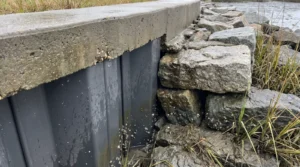
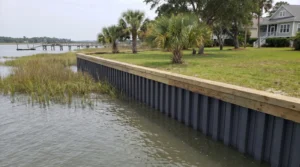
- Seawalls and bulkheads — vinyl sheet pile, composite, or natural granite/stone bulkheads where the upland is being protected from tidal erosion. Material selection depends as much on visual outcome as on engineering.
- Riprap shoreline armoring — for properties where a hard seawall would be too visually intrusive, properly engineered riprap (anchored with geotextile fabric) is often the right compromise.
- Boathouses — covered, often with second-story porches and architectural detailing that ties into the main house.
OCRM & Local Approvals on Kiawah
A Kiawah waterfront project almost always involves three approval tracks running in parallel:
- SCDES (OCRM) coastal permit — submitted as a joint application with the US Army Corps of Engineers. For most residential docks and dock walks the path is the SC Coastal Zone Consistency Certification + Army Corps Nationwide Permit; for larger or more impactful work it’s a Standard Individual Permit with a public-notice comment period.
- Town of Kiawah Island architectural review — design review for materials, finishes, railing details, and visual impact. The town generally reviews after SCDES has accepted the application but before the permit is issued, so you can submit to both in parallel.
- POA / community standards — depending on the development (Kiawah Island Club, Kiawah Resort, the original master plan), additional review for things like accessory structures (boathouses) and visual screening.
We coordinate all three approvals on behalf of our clients — managing the SCDES joint application, the town review, and the POA standards — so the client doesn’t have to triangulate between three reviewers. The full picture of the state-and-federal piece is in our OCRM and SCDES permitting guide.
Materials & Architectural Details
The material choices on Kiawah tend to be at the upper end of the available options:
- Decking: ipe, cumaru, or premium composite. Pressure-treated yellow pine is rarely the choice for new Kiawah work even though it’s the structural workhorse.
- Railing: stainless cable rail is the dominant choice for ocean-facing visibility; powder-coated aluminum railings for areas where the visual is more sheltered.
- Pilings: typically treated timber for the lower-load areas of the dock walk; helical piles for tight-access pierheads or boathouse retrofits where vibration would be a concern. See our notes on marine pile driving for the engineering background.
- Lighting: low-glare, dark-sky-compliant fixtures are standard; the town reviews fixture selections closely.
- Hardware: 316 stainless steel throughout — Kiawah’s salt environment is aggressive and lower grades corrode within a few years.
Storm & Salt Considerations
Kiawah’s exposure to Atlantic storm surge and steady salt spray means design decisions need to account for environmental loads that aren’t an issue further inland. We design and build to:
- Wave loads at the dock walk and pierhead from named storms (Matthew 2016, Irma 2017, and Ian 2022 are all in living memory).
- Tidal current loads on pilings where the dock crosses a strong-flowing creek.
- Salt-induced corrosion on hardware and fasteners (mitigated through 316 stainless and isolation of dissimilar metals).
- UV degradation on composite decking and railing (mitigated through material selection and color choice).
Recent BluTide Work on Kiawah
BluTide has completed projects on Kiawah Island for the Town of Kiawah and for Kiawah Island Golf Resort, plus a range of private residential dock and seawall projects. Visit our project gallery for representative work, and check out our broader piece on choosing the right Lowcountry marine construction team for the deeper question of vetting a contractor.
Frequently Asked Questions
How long does the permit take for a Kiawah dock?
For a straightforward residential dock walk under a Nationwide Permit, expect 90–150 days from submittal to permit issuance. For a Standard Individual Permit (larger or more impactful), 6–12 months including the public-notice comment period. The town architectural review usually finishes in parallel.
Can I build a boathouse on my Kiawah dock?
Sometimes, depending on the location, the surrounding properties, and the town’s review of the proposed visual impact. Boathouses are not categorically prohibited on Kiawah but they require careful design and architectural review. Plan on the design phase running 8–12 weeks for a boathouse vs. 4–6 weeks for a pure dock walk.
What’s the typical cost for a new Kiawah dock?
A new marsh dock walk + pierhead + boat lift on a typical Kiawah lot, built to the island’s material standard, usually runs $250,000–$600,000. The variables are dock walk length (marsh distance from upland to creek), pierhead size, lift specification, and material upgrades.
Do you handle seawall and bulkhead work on Kiawah?
Yes. We design and install vinyl sheet pile and composite bulkheads, granite/stone seawalls, and riprap shoreline armoring on Kiawah. Permit pathway is the same SCDES + Army Corps + town review described above; material and visual decisions are reviewed by the town’s ARB.
Are you familiar with the Kiawah ARB / design review process?
Yes. We submit Kiawah projects through the town’s design review board regularly and have working relationships with the staff. We provide drawings, material samples, and visual renderings as part of the submittal package.
Start the Conversation
Kiawah is a place where the right contractor brings as much design judgment as engineering judgment. We’d welcome a site walk and a conversation about what you have in mind — the views you’re trying to preserve, the boats you want to accommodate, the architectural language of your house. Reach out and we’ll set up a visit.