The Ultimate Guide to Professional Beach Crossover Construction
What Is Beach Crossover Construction and Why Does It Matter?
Beach crossover construction is the process of building elevated walkways, boardwalks, or dune paths that give people safe access to the beach without damaging the fragile coastal ecosystem beneath their feet.
Here’s a quick overview of what you need to know:
- What they are: Elevated timber or composite walkways that span dunes and beach vegetation
- Why they’re required: To protect sand dunes, sea turtle nesting sites, and native coastal plants from foot traffic
- Who regulates them: Florida DEP (CCCL program), SC DHEC-OCRM, USACE, and local agencies depending on your state
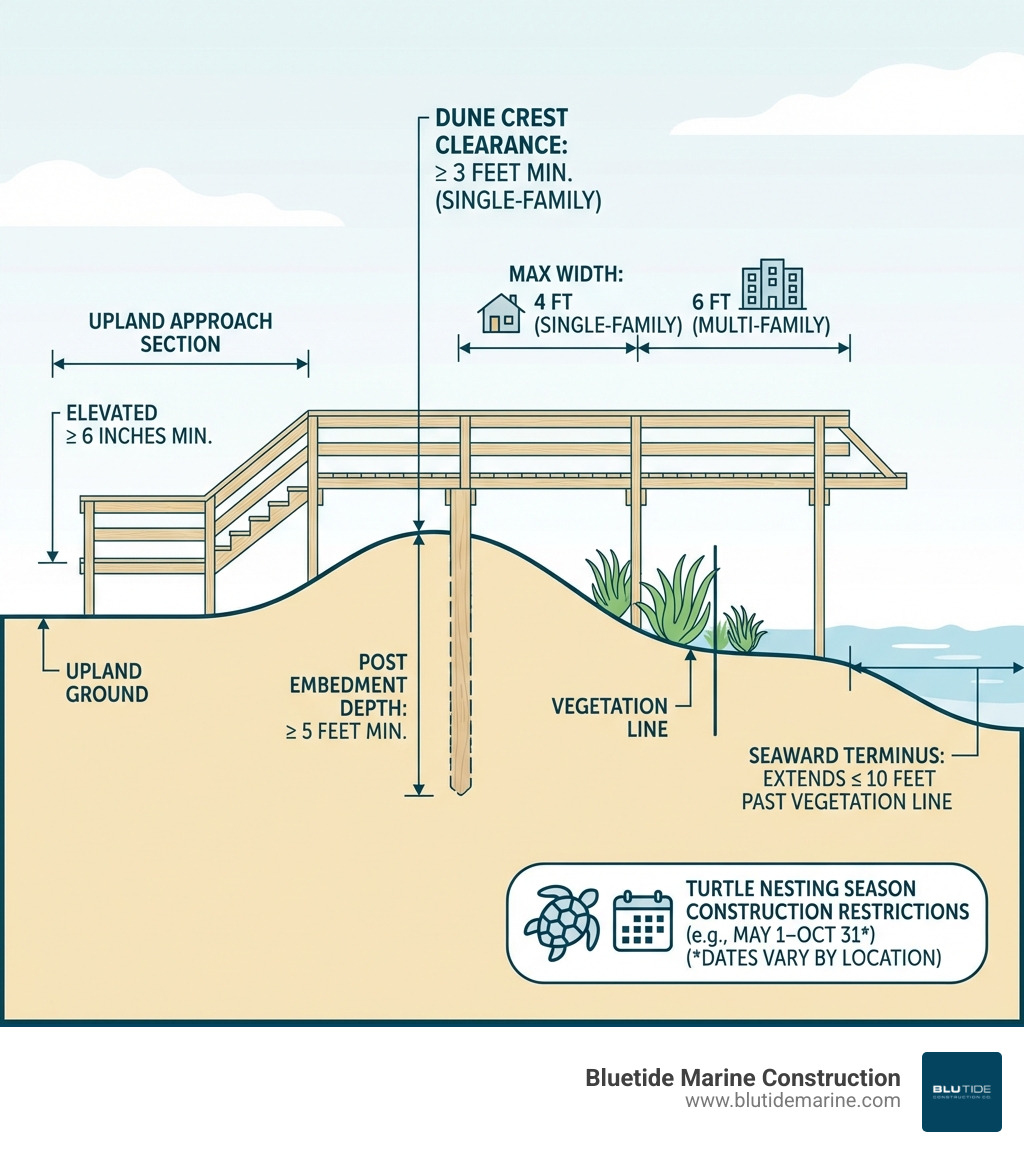
- Key design rules: Single-family walkovers max 4 ft wide; multi-family walkovers max 6 ft wide; posts must penetrate at least 5 ft into the soil
- Best construction method: Top-down construction, where workers — not heavy equipment — do the building, minimizing ground disturbance
- When to build: Outside of sea turtle nesting season (May 1–Oct 31 in most areas; March 1–Oct 31 in some Florida counties)
Without a properly built crossover, everyday beach access quietly destroys the very dunes that protect coastal homes from storms and flooding. Dunes aren’t just scenic — they’re the first line of defense against storm surge and erosion.
The good news is that a well-designed beach crossover solves both problems at once. It gives residents, guests, and visitors a clear path to the water while keeping the dune system intact underneath.
This guide covers everything you need to know — from permits and regulations to materials, construction methods, maintenance, and real-world project examples — so you can build a beach crossover that lasts and stays compliant.
The Importance of beach crossover construction for Coastal Ecosystems
When we talk about the Lowcountry coastline, we aren’t just talking about a place to tan; we’re talking about a living, breathing defense system. Sand dunes are the unsung heroes of our waterfront properties. They act as natural barriers, soaking up the energy of crashing waves during a storm and preventing the ocean from deciding your living room is its new favorite tide pool.
However, dunes are surprisingly fragile. The primary purpose of beach crossover construction is to keep human feet off the “sea oats” and other native vegetation that hold the sand in place. When people walk directly on dunes, they crush the plants. Without roots to anchor the sand, the wind simply blows the dune away. This is why professional crossovers are essential for dune preservation and erosion control.
Protecting Our Wild Neighbors
Coastal construction isn’t just about us; it’s about the locals who were here first—specifically, sea turtles. Sea Turtles and Coastal Construction is a major focus for any project in the Southeast. If a crossover is poorly designed or built with the wrong lighting, it can disorient nesting mothers or lead hatchlings away from the ocean.
By elevating our walkways, we ensure that the natural “corridors” beneath the structure remain open for wildlife. We also use specific siting criteria to ensure that the crossover doesn’t occupy prime nesting real estate. This balance of human access and environmental stewardship is at the heart of our residential marine services.
Storm Barriers and Vegetation
In the Lowcountry, a healthy dune system can be the difference between a “scary storm” and a “total loss.” Professional beach crossover construction ensures that the structure itself doesn’t become a hazard during a hurricane. We design these as “expendable” or “minor” structures. This sounds counterintuitive, but if a massive storm hits, you want the walkway to break away in a way that doesn’t take the entire dune with it or create massive debris that acts like a battering ram against your home.
Regulatory Standards and Permitting for Dune Walkovers
If you thought the ocean was deep, wait until you dive into the paperwork. Because beaches are public resources and critical habitats, building anything on them requires strict adherence to state and federal guidelines. In our neck of the woods, we primarily deal with the South Carolina Department of Health and Environmental Control (DHEC) and the Office of Ocean and Coastal Resource Management (OCRM).
While we often look to the Florida DEP Walkover Guidelines as a gold standard for technical specs, South Carolina has its own set of rules. For example, many wooden walkovers in South Carolina can qualify for DHEC-OCRM exemptions if they meet specific criteria:
- They must be made of wood.
- They cannot be wider than 6 feet.
- They must follow the natural contour of the dunes.
- They must have at least 2 feet of vertical clearance above the dune.
Siting and Design Specifications
Where you put the crossover is just as important as how you build it. We always aim to site crossovers perpendicular to the shoreline. This is the shortest path across the dune, which minimizes the “footprint” of the structure.
To help you visualize the requirements, here is a comparison of standard design specs for residential versus larger community projects:
| Feature | Single-Family Design | Multi-Family / Public Design |
|---|---|---|
| Max Overall Width | 4 Feet | 6 Feet |
| Support Post Size | 4-inch (typically round) | 6-inch (typically round) |
| Post Embedment | Minimum 5 Feet | Minimum 5 Feet |
| Upland Elevation | 6 inches above grade | 6 inches above grade |
| Dune Clearance | 3 feet to deck top | 3 feet 10 inches to stringer bottom |
| ADA Compliance | Optional (but recommended) | Mandatory |
Navigating Permits for beach crossover construction
Applying for a permit isn’t just about filling out a form; it’s about proving that your project won’t hurt the beach. This often involves site visits from field inspectors who determine the “optimum siting” to protect sea oats and nesting habitats.
We use tools like Map Direct – CCCL to understand the Coastal Construction Control Line (CCCL) and other regulatory boundaries. Even if your property is in South Carolina, these mapping tools provide invaluable data on historical erosion rates and storm surge risks that inform our engineering.
Compliance with the Endangered Species Act
We can’t talk about beach crossover construction without talking about the calendar. In the Lowcountry, turtle nesting season typically runs from May through October. During this window, heavy construction on the beach is often strictly prohibited.
Furthermore, lighting is a massive concern. Any lighting on a crossover must be:
- Long-wavelength (amber or red LED).
- Fully shielded so the bulb isn’t visible from the beach.
- Mounted as low as possible. The goal is to ensure that the beach stays dark for the turtles, while the walkway stays safe for you.
Advanced Materials and Top-Down Construction Methods
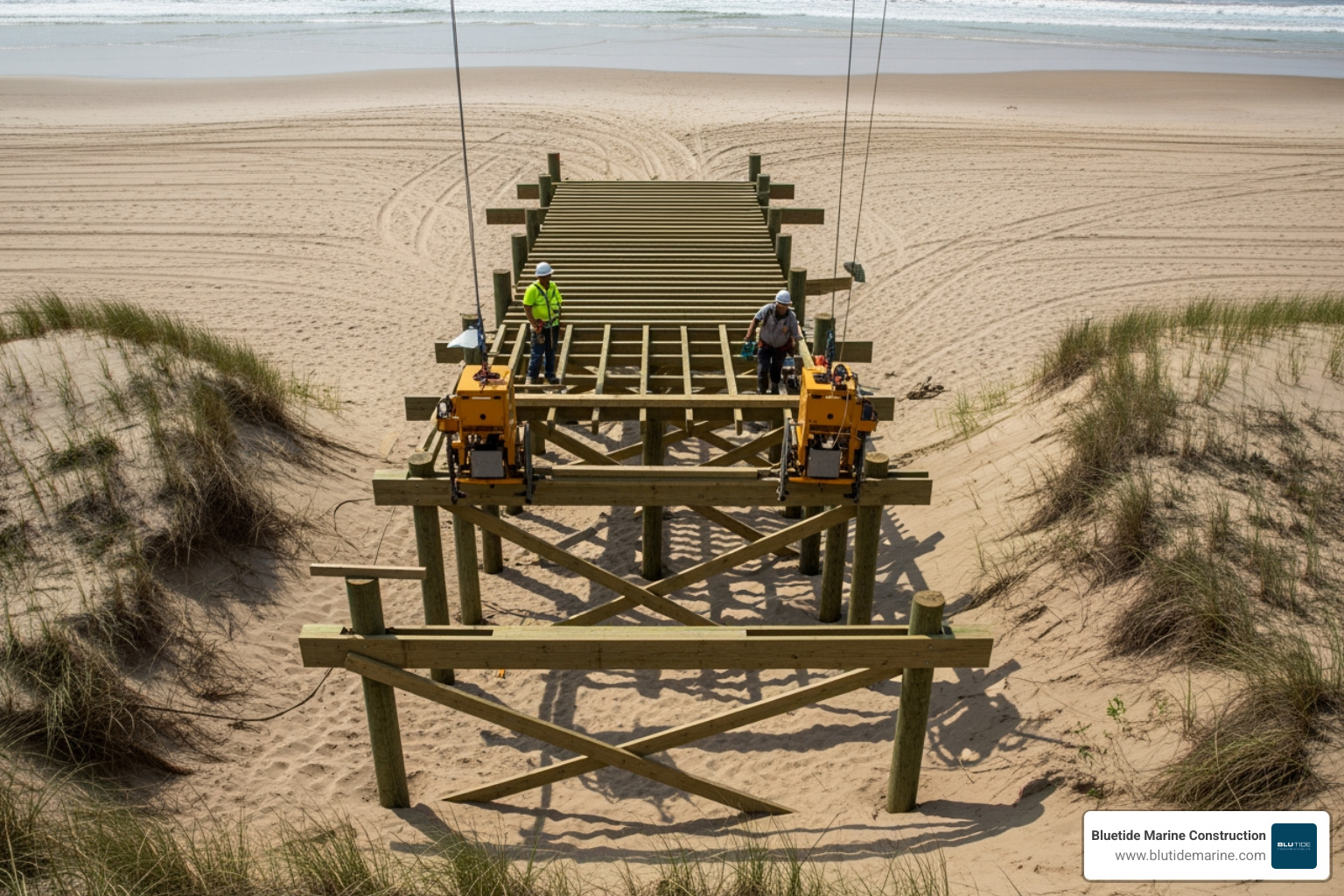
When we build a crossover, we want to leave the dune exactly as we found it. This is where top-down construction comes into play. In traditional construction, you might see a bobcat or a truck driving over the sand to deliver materials. In high-end marine construction, that is a big “no-no.”
The “Top-Down” Philosophy
Top-down construction means we build the first “bent” (the support posts and crossbeams) and then move our equipment onto that structure to build the next one. The machinery never touches the sand. This method:
- Prevents soil compaction.
- Protects the root systems of sea oats.
- Allows us to work in sensitive wetlands or steep bluffs without causing a landslide.
Material Selection: Timber vs. The Elements
The Atlantic Ocean is a brutal environment. Between the salt spray, the constant UV pounding, and the abrasive sand, standard lumber won’t last a season. We choose materials based on scientific research on pile foundations in coastal strata.
We typically recommend:
- Marine-Grade Pressure Treated Timber: Specifically treated for ground and saltwater contact.
- Stainless Steel Fasteners: Because salt air eats galvanized nails for breakfast.
- Permeable Decking: Using spaced boards or “grated” materials that allow sunlight and rainwater to reach the plants underneath, promoting a healthy ecosystem.
Engineering Durability in beach crossover construction
A crossover isn’t just a deck on stilts; it’s a bridge to the ocean. We ensure structural integrity by focusing on post embedment. In the loose, sandy soil of Charleston or Johns Island, posts must penetrate at least 5 feet into the ground to resist being pulled out by storm surge or pushed over by high winds.
For projects involving Marine Construction in Charleston SC, we also consider the “scour” depth—the amount of sand that might be washed away during a storm—to ensure the walkway remains standing even if the beach level drops temporarily.
Accessibility and ADA Standards
Accessibility is a right, not a luxury. For public or multi-family crossovers, compliance with the Americans with Disabilities Act (ADA) is mandatory. This includes:
- Ramp Slopes: Usually a 1:12 ratio (1 inch of rise for every 12 inches of length).
- Handrails: Specific heights and “graspability” standards to help those with mobility challenges.
- Switchbacks: If the dune is high, we design “switchback” ramps that provide a gentle slope without extending the walkway into the surf zone.
Maintenance and Sustainability for Long-Term Coastal Access
Building it is only half the battle. Maintaining a crossover in the Lowcountry requires a proactive approach. The combination of humidity and salt is a recipe for rot and corrosion.
Routine Inspections
We recommend a professional inspection at least once a year, preferably before the hurricane season kicks off. We look for:
- Loose Fasteners: Boards that have “popped” due to wood swelling.
- Structural Decay: Checking the “splash zone” where the posts meet the sand for signs of rot.
- Sand Burial: Sometimes the wind is too good at its job, and the seaward end of your crossover gets buried. This needs to be managed to prevent the wood from rotting prematurely.
Sustainable Practices
Sustainability in beach crossover construction also means looking at the landscape. We often integrate native landscaping around the base of the crossover. Planting extra sea oats or bitter panicum helps “knit” the structure into the dune, providing extra stability.
For more tips on keeping your waterfront in top shape, check out our guide on Dock and Roll: Charleston Waterfronts.
Hurricane Repair and Resilience
If a storm does damage your walkway, don’t panic. Because we design these as “minor structures,” they are often easier and more cost-effective to repair than a house or a seawall. After a major event, the priority is removing any debris that could harm the dune and then assessing if the original posts can be reused for the reconstruction.
Frequently Asked Questions about Beach Crossovers
Do I always need a permit for a beach crossover? In almost all cases, yes. Whether it’s a full CCCL permit in Florida or a DHEC-OCRM notification in South Carolina, building on the dune is highly regulated. However, we can often help you design a structure that qualifies for “expedited” permitting or exemptions.
How long does beach crossover construction take? The physical build often takes only a week or two, depending on the length. The “permit build,” however, can take months. This is why we recommend starting the planning process in the winter so you’re ready to build as soon as the regulatory (and turtle) windows open.
What is the best material for a beach walkway? While composite (like Trex) is popular for decks, high-quality marine-grade timber remains the favorite for crossovers. It’s flexible, durable, and has a natural aesthetic that blends into the coastal landscape. Plus, it’s often required by certain environmental guidelines because it’s a renewable resource.
Conclusion
At Bluetide Marine Construction, we believe that you shouldn’t have to choose between a beautiful beach access and a healthy coastline. Our team specializes in the unique challenges of the Lowcountry, from the marshes of Johns Island to the sandy shores of Southeast South Carolina.
Whether you need a simple residential path or a massive commercial marine project, we bring the same level of expertise, environmental stewardship, and engineering precision to every “bent” we build.
Beach crossover construction is an investment in your property’s value and our coast’s future. By building smart, building high, and building with nature in mind, we can ensure that the beach remains a place of joy for generations to come.
Ready to start your project? Contact us today for a project estimate and let’s build a path to the beach that stands the test of time.