How to Master Marine Piling Repair Before Your Pier Disappears
Assessing the Integrity of Your Waterfront Foundation
Marine piling repair is a sophisticated engineering process dedicated to restoring the structural integrity of deteriorating support piles beneath high-value docks, piers, and waterfront estates. For property owners in the Charleston Lowcountry, this intervention is the definitive line between a resilient maritime asset and a structure compromised by the relentless forces of the Atlantic.
Executive Summary of Repair Methodologies:
- FRP/Carbon Fiber Encapsulation — A high-modulus solution 10x stronger than steel, engineered for a 30-50 year service life on concrete and timber.
- Advanced PVC Jacketing (e.g., SnapJacket) — A precision-engineered vinyl sleeve filled with high-strength concrete, providing a 25-year warranted barrier.
- Structural Epoxy Injection — A technical solution for sealing fractures in concrete piles to restore monolithic integrity.
- Cathodic Protection Systems — Engineered to arrest electrochemical corrosion in steel substructures.
- Structural Splicing — The surgical replacement of compromised timber sections, reinforced with concrete-filled jackets.
In the demanding environments of Kiawah Island, Seabrook Island, and the Charleston harbor, pilings rarely fail catastrophically without warning. Instead, they succumb to “hourglassing” from marine borers, chloride-induced spalling in concrete, or oxidation in steel. By the time deterioration is visible to the untrained eye, the structural capacity of the pile may already be significantly diminished.
At BluTide Marine Construction, we approach every project with the precision of master craftsmen. Most damaged pilings can be restored to—or beyond—their original load-bearing specifications without the invasive necessity of full replacement or the disruption of dismantling the existing deck. This guide details the technical standards and professional methodologies required to secure your waterfront foundation.
Technical Evaluation of the Splash Zone
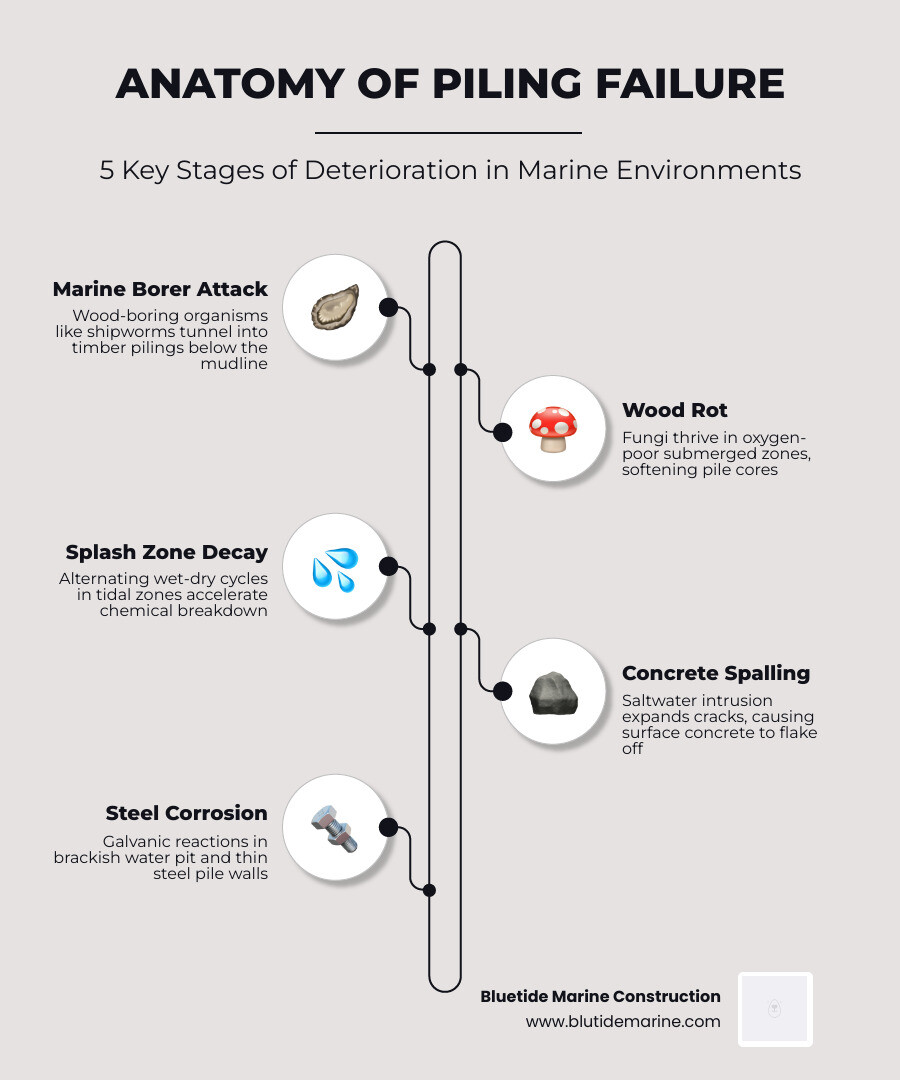
The area between the mudline and the high-tide mark is one of the most biologically and chemically aggressive zones on the planet. Assessing the health of your substructure requires a systematic evaluation of this “splash zone.” At BluTide, we utilize rigorous visual inspections and technical diagnostics to identify subtle indicators of failure that casual observation might miss. For high-value commercial and residential assets, we evaluate the remaining cross-sectional area to ensure the structural envelope remains intact.
More info about residential marine services
Material-Specific Deterioration in the Lowcountry
- Timber Decay: In Charleston’s waters, shipworms and gribbles can compromise the internal cellulose of a pile while leaving the exterior seemingly intact.
- Concrete Spalling: Chloride intrusion leads to the oxidation of internal rebar. As the steel expands, it causes the concrete to fracture and delaminate.
- Steel Oxidation: Without high-performance coatings, steel piles face rapid delamination, losing the wall thickness necessary for axial load support.
Engineering Decision: Repair vs. Replacement
The decision to execute a marine piling repair versus a full replacement is a matter of structural engineering. If the section loss is localized to the tidal zone, modern jacketing and FRP systems can often restore the pile to full capacity. This approach avoids the heavy mobilization of vibratory hammers and barges, providing a high-efficiency solution that preserves the existing structure.
How to measure for the perfect dock
Primary Methods for Professional Marine Piling Repair
We deploy specialized repair strategies tailored to the specific environmental stressors of Folly Beach, Sullivan’s Island, and the surrounding Lowcountry.
More info about commercial marine construction
Advanced FRP and Carbon Fiber Marine Piling Repair
Fiberglass Reinforced Polymer (FRP) and Carbon Fiber systems represent the pinnacle of maritime engineering. Carbon fiber provides a strength-to-weight ratio far exceeding steel while remaining entirely impervious to saltwater corrosion. These systems create a new structural exoskeleton, applied with specialized resins that cure underwater to ensure a seamless bond. Scientific research on carbon fiber strengthening confirms these repairs can extend the lifespan of a dock by decades.
High-Performance Jacketing Systems
- SnapJacket: This system utilizes a UV-stabilized PVC sleeve that is snapped around the pile and filled with high-strength concrete. This process encapsulates the timber, neutralizing marine borers and creating a permanent, concrete-reinforced foundation.
- PileMedic®: Adopted by the U.S. Military and validated by the U.S. Army Corps of Engineers, this system uses structural FRP laminates to provide 360-degree confinement. It is specifically engineered to restore piles with up to 80% section loss to their original design strength. U.S. Army Corps of Engineers study on PileMedic® highlights its efficacy in extreme environments.
The Professional Installation Process for Lasting Durability
A marine piling repair is only as effective as the precision of its execution. In the Charleston area, our installation protocols are designed to account for significant tidal swings and heavy bio-fouling.
- Substrate Preparation: We perform a comprehensive removal of all marine growth and silt to ensure the repair materials achieve a high-integrity bond with the structural core.
- Precision Spacing: We install engineered spacers to maintain a uniform annular space, ensuring the protective grout layer is consistent around the entire circumference of the pile.
- The Tremie Grouting Method: To prevent cement washout in submerged conditions, we utilize the tremie method—pumping high-strength grout from the bottom up to displace water and eliminate voids.
- Technical Epoxies: We utilize industrial-grade, underwater-curing epoxies to seal cracks and ensure the repair is entirely watertight.
More info about marine construction in Charleston
Precision Installation of FRP Laminates
The application of systems like PileMedic® is a technical task requiring expert oversight:
- Custom Fabrication: Laminates are precision-cut to allow for a double-wrap with a specific structural overlap.
- Epoxy Bonding: A high-viscosity, two-part epoxy is applied to create a monolithic shell.
- Structural Grouting: The jacket is secured and filled with specialized grout, often reinforced with GFRP (Glass FRP) rebar for enhanced longitudinal stability.
Watch the PileMedic® installation process
Environmental Stewardship through Encapsulation
Modern marine piling repair also serves as a critical environmental safeguard. By encapsulating older timber piles treated with Creosote or CCA, we create a permanent barrier that prevents chemical leaching into the delicate Lowcountry ecosystem. Research on the environmental impact of treated wood confirms that professional jacketing is a superior “green” alternative to full removal, which often disturbs contaminated sediments.
Strategic Maintenance for Lowcountry Waterfronts
For waterfront estates in Charleston, strategic maintenance is a prerequisite for structural longevity. The tidal amplitude across the Lowcountry, paired with brackish-to-saltwater transitions, creates a constant cycle of wetting, drying, and abrasion that accelerates deterioration right where your piles do the most work: the splash zone and the mudline.
A well-designed repair does not eliminate the need for oversight. Instead, it gives you a durable baseline that can be protected through disciplined inspection and targeted upkeep.
A Practical Inspection Schedule (Designed for Charleston Conditions)
We recommend a comprehensive structural audit every two to three years, and additional targeted inspections after major storm events or unusually high king tides. During these audits, our team evaluates:
- Scour and undermining at the mudline: Loss of supporting soil can reduce lateral capacity even when the pile itself looks sound.
- Connection integrity above the waterline: We confirm bolts, brackets, pile caps, and framing connections remain tight and properly seated.
- Hurricane hardware and uplift resistance: In coastal wind events, failure often begins at connections. We verify that stainless hardware and hurricane straps remain correctly tensioned and free of galvanic interaction.
- Condition of jackets and wraps: We look for impact damage from boats, UV degradation above the tide line, or separation at seams that could allow marine growth to re-establish.
Floating Docks, Guide Piles, and Wear Points
Floating systems require a slightly different maintenance lens. We inspect guide piles and roller assemblies to ensure they track cleanly through tidal swings without grinding through protective jackets. Even a premium repair system can be compromised by repetitive abrasive wear if rollers are misaligned or if debris is trapped at contact points.
Protecting the Investment: Small Corrections Prevent Major Retrofits
In the Charleston harbor, around Kiawah Island, and throughout Seabrook and Johns Island waterways, the most expensive structural failures are often preventable. A proactive program catches early signs of section loss, fastener fatigue, or localized jacket damage before the issue migrates into the framing system or deck surface.
If your dock is exposed to high wake energy, shifting currents, or recurring storm surge, we can also evaluate mooring and restraint strategies that keep the structure aligned and reduce impact loading.
Don’t let your dock go AWOL with these mooring systems
For additional proof-of-work and to see the level of finish we deliver on high-end restorations, review our completed waterfront builds and repairs:
View our Gallery of completed projects
Frequently Asked Questions about Marine Piling Repair
What is the expected service life of a professional piling repair?
Modern marine piling repair systems, such as carbon fiber wraps and PVC jacketing, are engineered for extreme durability. These systems typically offer a service life of 25 to 50 years. Because the materials are inert and do not corrode, the repair often becomes the most resilient part of the entire structure.
Can repairs be executed without dismantling the dock?
Yes. One of the primary advantages of our retrofit solutions is that they can be installed entirely below the deck line by professional divers. This eliminates the need to remove boat lifts or disassemble the deck, ensuring your waterfront remains functional throughout the process.
How does the investment in repair compare to full replacement?
Professional marine piling repair represents a high-value alternative to replacement, typically requiring 40-60% less capital investment. The efficiency stems from avoiding the massive mobilization costs of heavy barge equipment and the complex demolition and disposal of old pilings, allowing for a faster return to service.
Conclusion
Your waterfront property is a significant investment in the Lowcountry lifestyle, and the pilings are the bedrock of that investment. At BluTide Marine Construction, we combine master craftsmanship with the latest in coastal engineering to ensure your dock or pier stands firm against the raw power of the Atlantic. Whether your property is on Kiawah Island, Seabrook, or within the historic Charleston harbor, our team is equipped to deliver the high-end, durable solutions your estate deserves.
Do not wait for structural compromise to become a liability. Expert marine piling repair can restore your structure’s integrity and provide peace of mind for decades to come.
View our Gallery of completed projects
Schedule a Consultation to Discuss Your Project. Phone: +1 (843) 557-1595 Email: blutidemarine@outlook.com Contact Us to Discuss Your Project