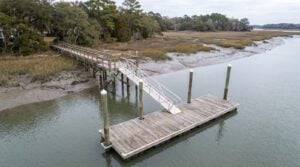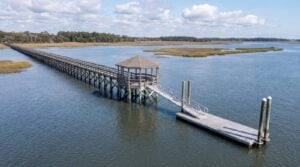
Material is one of the first decisions in any dock project, and the aluminum vs. wood dock question comes up on nearly every Lowcountry waterfront. Both build a good dock. They trade off differently on cost, maintenance, how they feel underfoot in August, and how they age in salt air. This guide compares them the way a builder would — including the parts that do not show up in brochures.
First: Pilings Are a Separate Decision
This trips up more owners than anything else in the conversation. The frame material and the piling material are two different choices. Whether your dock is framed in aluminum or wood, it still stands on pilings driven into the creek bottom, and in the Lowcountry those are almost always treated timber, sometimes concrete or composite on larger structures. Marine borers — shipworms and gribbles — attack timber below the waterline, which is why piling treatment retention and embedment depth matter far more to your dock’s lifespan than what the frame is made of. An aluminum-framed dock on undersized pilings is a short-lived dock. Settle the pilings first; then argue about the frame.
The Case for Wood
Wood is the traditional Lowcountry dock material and still the most common. It is warm, it looks like it belongs on a tidal creek, and it can be built to almost any geometry — curved pierheads, custom rail details, a bench worked into the frame — without special fabrication. Pressure-treated southern yellow pine is the workhorse for framing. Tropical hardwoods like ipe and cumaru show up in decking on higher-end builds, where they weather to a silver-grey and last for decades.
The trade-off is upkeep. Treated pine framing in a saltwater tidal zone works hard, and hardware works harder. Expect to inspect fasteners and connections regularly, replace the occasional deck board, and — if you want to hold the original color rather than let it grey — clean and seal on a cycle. None of this is difficult. It is simply ongoing, and owners who dislike ongoing should factor it honestly rather than assume they will get to it.
The Case for Aluminum
Marine-grade aluminum framing has become popular for good reason. It does not rot, warp, splinter, or feed borers, and the alloys used for marine framing hold up well against salt. Aluminum framing is also lighter than timber, which occasionally simplifies installation and can reduce dead load on the piling system. Structurally, an aluminum frame is close to maintenance-free.
Two honest drawbacks. First, heat: aluminum framing paired with composite decking gets genuinely hot underfoot on a Charleston afternoon in July, more so than natural hardwood. If the dock is where children go barefoot, that matters. Second, galvanic corrosion: aluminum in contact with dissimilar metals in saltwater will corrode at the junction unless the connection is properly isolated and the right fasteners are specified. This is entirely solvable and completely routine for a builder who works in aluminum regularly — but it is a detail that separates a good aluminum dock from a bad one, and it is invisible on the day it is delivered.
Decking Is a Third Decision
Frame and decking are also separable. You can put composite decking on a wood frame or hardwood on an aluminum frame. Composite eliminates sealing and splinters but runs hot and costs more than treated pine. Tropical hardwood is beautiful, stable, and expensive. Treated pine is the least expensive and the most maintenance. The frame decision and the decking decision are often bundled by builders out of habit; they do not have to be.
Head to Head
Up-front cost
Wood generally costs less to build. Aluminum carries a meaningful premium on installation day — the framing itself and the fabrication both cost more.
Cost over the dock’s life
This is where aluminum earns its premium, and where the comparison should actually be made. Over twenty-five years, a wood dock accumulates sealing, board replacement, and hardware work; an aluminum frame accumulates very little. Whether the lifetime numbers cross depends on how diligently the wood dock is actually maintained — which is a question about you, not about the material.
Durability in saltwater
Both last decades when built correctly. Aluminum sidesteps rot and borers in the frame entirely. Wood’s longevity comes down to material grade, fastener quality, and upkeep. Neither protects the pilings, which remain the real lifespan constraint.
Repairability
Wood wins here, quietly. A damaged timber member can be cut out and replaced by any competent crew with lumber from a local yard. A damaged aluminum member usually means fabrication and a lead time. After a storm, that difference is felt.
Appearance
Wood reads traditional and settles into a marsh setting easily. Aluminum reads cleaner and more contemporary, particularly with grey composite decking. Neither is wrong; they simply suit different houses.
Heat underfoot
Natural hardwood is coolest. Treated pine is close behind. Composite over aluminum is hottest. In a Lowcountry summer this is not a trivial consideration.
How to Choose for Your Property
Work through four questions honestly. How long do you intend to own the property — because a lifetime-cost argument only pays off if you are there for the lifetime. How much maintenance will you realistically do, not intend to do. How will the dock be used, particularly by barefoot children. And what does the house look like, since the dock is visible from it every day.
A protected tidal creek behind a traditional Lowcountry home with an owner who enjoys maintaining things points toward wood. An exposed site, a contemporary house, and an owner who wants to think about the dock as little as possible points toward aluminum. Most people land somewhere between, and a hybrid — aluminum frame, hardwood decking, or a wood frame with composite deck — is a legitimate answer rather than a compromise.
How BluTide Builds Either
BluTide Marine Construction builds in both, matching the material to the site and to how the owner actually plans to use and maintain the dock. Whichever frame you choose, the fundamentals do not change: pilings sized and driven for the conditions, marine-rated hardware with dissimilar metals properly isolated, connections detailed for a saltwater tidal zone, and finish work that holds up to being looked at every day. The material is your call. Building it to survive the Lowcountry is ours.
Frequently Asked Questions
Is an aluminum or wood dock better in saltwater?
Both perform well when built correctly. Aluminum avoids rot and borers in the frame and needs almost no structural maintenance, at a higher up-front cost. Wood costs less initially, looks traditional, and requires ongoing care. Neither choice affects the pilings, which are the real lifespan constraint.
Which dock material lasts longer?
Properly built, both last decades. Aluminum framing sidesteps rot and marine borers entirely; wood depends on grade, fasteners, and upkeep. In practice, most docks reach the end of their life because of the pilings, not the frame.
Is an aluminum dock more expensive than wood?
Up front, generally yes. The case for aluminum is lifetime cost, which depends on how much maintenance the wood alternative would actually receive. Compare over the period you plan to own the property.
Do aluminum docks get hot in the summer?
Yes, particularly with composite decking. It is one of the more common regrets among owners who did not think about it beforehand. Natural hardwood decking runs noticeably cooler and can be used on an aluminum frame.
What is galvanic corrosion and should I worry about it?
It is the accelerated corrosion that occurs where dissimilar metals meet in saltwater. On an aluminum dock it is managed with correct fastener specification and isolation at the connections. It is routine for an experienced builder and a genuine problem when ignored — worth asking any bidder how they handle it.
Does the frame material affect the pilings?
No. Pilings are selected and driven for the site’s conditions regardless of frame material, and they carry the greatest influence over how long the dock lasts.
Questions Worth Asking Any Builder About Materials
The material conversation gets clearer quickly when you ask the right things. What treatment retention are the pilings, and to what depth are they being driven? If the frame is aluminum, what alloy, and how are dissimilar metals isolated at the connections? What fasteners are specified, and are they rated for saltwater immersion rather than general exterior use? What decking is included in the quoted price, and what would the alternative add? What is the warranty on the frame, and separately on the decking and the hardware — they rarely carry the same term. And what does the maintenance schedule look like at years one, five, and fifteen?
A builder who answers those plainly is telling you how the dock is actually assembled. One who redirects to how good the material is has told you something as well.
Build the Dock That Fits Your Waterfront
Still weighing aluminum against wood? BluTide Marine Construction can walk your shoreline, talk through the trade-offs for your specific site, and build a dock that lasts. Contact our team, explore our residential dock services, or see finished docks in our gallery.