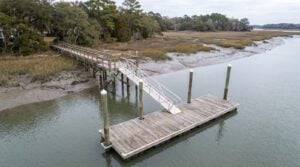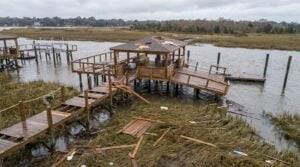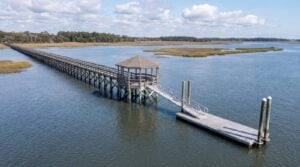
Most Lowcountry docks are not fixed or floating. They are both — a fixed timber walkway crossing the marsh, a fixed pierhead at the end of it, and an aluminium ramp dropping down to a floating dock that rises and falls with the tide. Understanding why that combination became the regional standard is the fastest way to understand what your own property needs.
The short answer: a fixed structure gives you a stable, permanent, load-bearing platform. A float gives you a surface that stays at boat level through a five-to-six-foot tidal swing. In Charleston’s tidal range you generally want both, and the real design question is how much of each, and where the transition happens.
The two structures, side by side
| Fixed dock | Floating dock | |
|---|---|---|
| How it is supported | Driven pilings into competent soil | Buoyancy; held in position by piles or a mooring system |
| Height above water | Constant — changes with the tide | Constant relative to the water |
| Best at | Crossing marsh, carrying load, lasting decades | Boarding a boat at any tide stage |
| Service life | 25 – 40 years (structure) | 15 – 25 years (float units and hardware) |
| Installed cost | $110 – $190 per linear foot of walkway | $18,000 – $40,000 for a typical ramp-and-float system |
| Storm behaviour | Vulnerable to surge lifting the deck if built too low | Rises with surge; vulnerable if piles are too short |
| Maintenance | Low — periodic inspection, re-decking at 15–20 years | Higher — hardware, rollers, float units, ramp wheels |
| Shallow water | Works anywhere | Grounds out; needs depth at low tide |
Why a fixed dock alone struggles here
A fixed dock sits at one height. Set it for high tide and you are climbing down six feet to a boat at low water. Set it for low tide and it floods twice a day, which destroys decking, invites marine growth on the framing, and makes the structure a liability in any surge event.
There are places where a fixed-only dock is exactly right. Shallow marsh creeks where a boat could never float at low tide anyway. Fishing and crabbing docks. Properties where the owner wants a place to sit over the water rather than a place to keep a boat. On those, we build a fixed pierhead with a good rail, a bench and a ladder, and we skip the float entirely — it would spend half its life sitting in pluff mud, which is bad for the float and bad for the marsh underneath it.
Why a floating dock alone struggles here too
A float has to be reached. On most Lowcountry lots, the water is a long way from dry land across protected salt marsh, and you cannot float a walkway over marsh that drains completely at low tide. So the float needs a fixed approach, and once you are building a fixed approach you are building most of the cost of the dock.
Floats also need depth. A float that grounds at low water sits on its bottom, stresses the mooring hardware, and scours the creek bed underneath it. State permitting takes a dim view of floats designed to rest on the bottom, and rightly so. As a working rule, we want at least two to three feet of water under a float at mean low water before we recommend one.
The Lowcountry standard: fixed walkway, fixed pierhead, ramp, float
The combination that dominates Charleston-area docks does each job with the right structure:
- Fixed walkway crosses the marsh at a permitted height, on driven pilings, with the least possible footprint on the Spartina below.
- Fixed pierhead gives you the stable, load-bearing platform — the place for a bench, a fish-cleaning station, a lift, a roof, storage.
- Aluminium gangway hinges at the pierhead and rides on rollers or a wheeled end on the float, absorbing the tidal difference.
- Float holds the boat at a constant boarding height, held laterally by float piles or a spud-and-guide arrangement.
Get the ramp length wrong and the whole system fails in a specific, annoying way: at dead low tide the gangway becomes a slide. Ramp length is set by tidal range, and in Charleston that means a longer gangway than most out-of-state suppliers quote by default. Twenty-four to thirty-two feet is common here; a twenty-foot ramp sold as “standard” elsewhere will be steep enough to be genuinely unsafe at spring lows.
How to read your own water
Four measurements decide this for you, and none of them require a designer’s opinion.
- Depth at mean low water at the point you want to moor. Under two feet, a float is the wrong answer. Over three, it is usually the right one.
- Distance from the high ground to that depth. This is your fixed walkway, and it is the biggest single line in the budget.
- Creek width. State critical-area rules limit how far a private structure may extend relative to the waterway width, which can cap where the float can sit regardless of depth.
- What you actually do on the water. A 26-foot centre console needs a float and probably a lift. A kayak, a crab trap and a sunset chair do not.
Tide predictions and datums for Charleston Harbour and the surrounding creeks are published by NOAA Tides and Currents, which is the reference we use when setting deck and ramp elevations.
What the float itself should be made of
Float construction matters more than most owners expect. Encapsulated polystyrene inside a rotationally moulded polyethylene shell is the current standard and holds up well in brackish water. Older bare-foam floats shed polystyrene into the creek as they degrade and are increasingly restricted. Aluminium float frames resist corrosion better than steel and weigh less, which matters when a float has to be lifted for repair.
The framing above the floats can be aluminium or treated timber. Aluminium is lighter, needs no maintenance and never splinters; timber is warmer underfoot and easier to match to a fixed dock built in wood. We covered that trade-off in depth in aluminium vs. wood docks in the Lowcountry.
The mooring arrangement — how the float is held in place while it moves vertically — is the component that most often fails first on a poorly built system. Our guide to floating dock mooring systems in Lowcountry tidal waters covers the options and where each one belongs.
Cost and storm considerations
A float adds roughly $18,000 to $40,000 to a Lowcountry dock depending on size, ramp length and mooring type. It also adds maintenance: hardware, rollers, bumpers and eventually the float units themselves. If you will use it, it is money well spent. If the boat lives at a marina and the dock is for family use, it may not be.
In a storm, the two structures fail differently. Fixed docks are lost when surge lifts the deck off the pilings — which is why deck elevation and through-flow decking matter so much. Floats are lost when surge lifts them clear off the tops of their piles and they sail away. Both failures are preventable with correct pile height and embedment. Our hurricane season dock and seawall preparation guide goes through the pre-storm checklist for each.
Frequently asked questions
Is a floating dock cheaper than a fixed dock?
Per square foot of usable surface, often yes. In total, usually no — because in the Lowcountry a float still requires a fixed walkway and pierhead to reach it. The float is an addition to a fixed dock here, not an alternative to one.
Will a floating dock work if my creek dries out at low tide?
No. A float that grounds is a float that is being damaged, and permitting generally will not support it. On those properties we build a fixed pierhead sized for the tidal window you actually have.
How long should my gangway be?
Long enough that the slope stays walkable at the lowest tide you will use the dock in. In Charleston’s range that usually means 24 to 32 feet. Longer ramps are safer and cost less than the injury they prevent.
Can I add a float to an existing fixed dock?
Often yes, if the pierhead framing can carry the gangway hinge load and the water depth supports it. It normally requires a permit modification. It is one of the most common upgrades we do.
How long do float units last in salt water?
Fifteen to twenty-five years for good rotationally moulded units, less for older foam-and-timber construction. Hardware — rollers, hinges, guides — wears faster and should be inspected annually. Our repair and replacement guide covers what to look for.
Choosing well
The right dock is the one that matches the water in front of your property, not the one in the brochure. On a deep Wando or Ashley River lot, that is almost always a fixed approach to a float with a lift. On a shallow northern creek, it is a well-built fixed pierhead and no float at all — and that dock will serve the family better and cost considerably less.
We survey the depth profile at low water before we design anything. If you would like to know what your creek will genuinely support, talk to us.