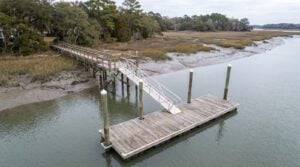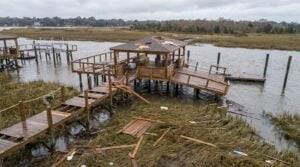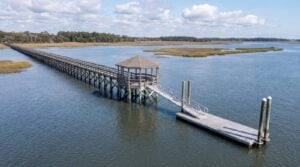
Mount Pleasant is not one waterfront. It is four or five distinct ones, and a dock that works beautifully on the Wando would be the wrong structure entirely on Copahee Sound. The town runs from the hard-working shrimp docks of Shem Creek, through the deep-water frontage along the Wando River, out past the Old Village and Hobcaw, and up into the wide shallow marsh systems north of the Isle of Palms Connector. Each of those has its own tidal range, its own bottom, its own permitting pressure, and its own answer to the question of how far you have to walk before you reach water you can float a boat in.
This is a guide to what building a dock in Mount Pleasant actually involves, organised the way the town is organised — by water.
What Mount Pleasant waterfront has in common
Before the differences, the constants. Every dock built in this town has to answer the same three Lowcountry conditions.
A five-to-six-foot tidal swing. The water you see when you walk the property is not the water your dock has to work in. A pierhead that sits comfortably above a spring high tide can leave you eight feet above the mud at a winter low. Every deck height, ramp length and float position on a Mount Pleasant dock is a calculation made against both extremes, not the pleasant middle.
Pluff mud. The grey, deep, famously fragrant mud in these creeks has very little bearing capacity near the surface. Pilings have to reach past it into competent sand or firm clay, and how far that is varies enormously across a single property. This is the single biggest reason two docks a mile apart can cost noticeably different amounts.
Salt. Brackish water at 20 to 30 parts per thousand, twice a day, for the life of the structure. It governs the lumber treatment, the fastener metallurgy, and whether a piece of hardware lasts five years or thirty. We wrote about the material side of that in detail in our guide to dock decking and lumber that survives Charleston saltwater.
Shem Creek and the Old Village
Shem Creek is the most constrained water in Mount Pleasant and the most interesting to build on. It is a narrow, busy, commercially active creek with shrimp boats, tour operators, restaurants on pilings and a strong tidal current running through the middle of it. Creek width drives everything here: South Carolina’s critical area rules limit how far a private structure may extend into a waterway relative to its width, and on a creek this size that often means a shorter pier and a smaller pierhead than an owner initially imagines.
What Shem Creek gives you in exchange is depth. You generally do not need a long marsh crossing to reach usable water, which shortens the walkway and concentrates the budget into the pierhead and the float.
The Old Village frontage along Charleston Harbour is a different problem again — more exposed, more wave energy, and structures that have to be built to take weather rather than just tide. Deck heights go up, pile embedment goes deeper, and bracing becomes a serious part of the design rather than an afterthought.
The Wando River corridor
Properties along the Wando — Dunes West, Rivertowne, Park West and the older frontage below them — sit on the best deep water in the town. The river carries real depth close to the bank in places, and where it does, a Wando dock can be relatively short and genuinely useful for a larger boat.
The complication is the marsh in front of it. Many Wando lots are separated from the river by a broad band of Spartina, and the crossing is the expensive part. A 200-foot walkway to reach 150 feet of usable structure is common on this stretch, and that ratio is worth understanding before you set a budget. Our guide to what a boat dock really costs breaks down how walkway length drives the total.
Wando frontage is also where boat lift installation makes the most sense. Depth is reliable enough to justify the lift, and the river’s fetch means a boat left in the water takes more punishment than one lifted clear of it.
North Mount Pleasant: Copahee Sound, Hamlin Creek and the Connector
North of the Isle of Palms Connector the character changes completely. Copahee Sound and the creek systems feeding it are wide, shallow and marsh-dominated. Depths at low water are measured in inches across large areas, and the practical question stops being “where do we put the dock” and becomes “is there a tidal window that makes a dock worth building at all.”
The honest answer on some of these lots is that a dock is a crabbing, fishing and sunset structure rather than a boat-launching one, and it should be designed as that. We build a lot of these, and they are among the most rewarding projects on our board — a shorter pierhead, a bench, a good rail, cleats sized for a jon boat or a skiff on a rising tide, and none of the cost of a lift and float system that would sit in mud for eight hours a day.
Where the water does support a float, the mooring system matters more here than anywhere else in the town, because the float has further to travel between high and low. We covered how those systems work in floating dock mooring systems for Lowcountry tides.
Permitting in Mount Pleasant
Every dock here needs a critical area permit from the state’s coastal programme, and most also need authorisation from the U.S. Army Corps of Engineers. On top of that, Mount Pleasant applies its own zoning and setback review, and many neighbourhoods — Dunes West, Rivertowne, Hobcaw, Snee Farm and others — carry HOA architectural standards that constrain height, materials, roof forms and lighting.
Practically, that means three approvals running in parallel, and the HOA is often the one that surprises people. We walk clients through all of it in our full guide to OCRM and DHEC permitting for Charleston waterfront construction. Current state rules, forms and critical-area line information are published by the South Carolina Department of Environmental Services.
What a Mount Pleasant dock typically costs
| Element | Typical range | What moves it |
|---|---|---|
| Marsh walkway | $110 – $190 per linear foot | Length, width, pile depth, marsh access |
| Pierhead (fixed) | $60 – $110 per square foot | Size, roof, rails, benches, finish |
| Aluminium ramp + float | $18,000 – $40,000 | Ramp length, float size, mooring type |
| Boat lift | $9,000 – $30,000+ | Capacity, lift type, new pilings |
| Permitting & survey | $3,500 – $9,000 | Agency review depth, HOA, surveys required |
A short Shem Creek pier with a modest pierhead can land near the bottom of that stack. A full Wando system — long crossing, covered pierhead, ramp, float and lift — sits well above it. The variable that moves the number most is almost always the length of the walk to water.
How we build here
Our pilings are driven, not augered or jetted, so they set by friction into competent soil rather than sitting in disturbed ground. Framing is marine-grade pressure-treated southern yellow pine sized for coastal loading. Fasteners are hot-dip galvanised at minimum, with 316 stainless at every connection that touches the waterline or the salt spray zone. Decking is specified to the property — treated pine, ipe, or a composite where the owner wants a barefoot surface with no annual maintenance.
Access matters too. Some Mount Pleasant lots allow land-based equipment down a side yard. Many do not, and the work is done from a barge on a tide window. Knowing which one applies to your property before pricing the job is the difference between an estimate that holds and one that does not. You can see finished work across the area in our project gallery.
Frequently asked questions
How long does a dock permit take in Mount Pleasant?
Plan on six to twelve months from application to approval for a standard private residential dock, longer if the property requires a public notice or falls near a shellfish bed or navigation channel. HOA review runs alongside and can add its own weeks. Construction itself is usually four to ten weeks once permitted.
Can I build a dock on Copahee Sound?
Often yes, but the design should be honest about the water. Many north Mount Pleasant lots support an excellent fishing and crabbing dock and will not support a floating dock with reliable boat access at all tides. We survey the depth profile at low water before designing anything.
Do I need a boat lift on the Wando?
Not strictly, but the Wando’s current and boat wake make it one of the better arguments for a lift in the region. Lifting a boat clear of brackish water extends hull, running gear and bottom-paint life considerably.
How wide can my dock be?
State rules cap walkway width for private residential docks, and pierhead size is limited relative to the waterway. On a narrow creek like Shem Creek the constraint binds hard; on the Wando there is more room. Our dock dimensions guide covers the standard sizes in detail.
Can you repair an existing Mount Pleasant dock instead of replacing it?
Frequently, and it is usually the better value. Existing permitted footprints are worth preserving. Where the pilings are sound, re-decking and re-framing is a fraction of the cost of a new structure — see our guide to dock piling repair and replacement.
Building on your Mount Pleasant waterfront
A dock should look like it belongs to the property and the marsh it crosses, and it should still be standing and straight in thirty years. Those two goals are not in tension — they come from the same discipline of getting the pilings right, sizing the structure to the water it sits in, and finishing the details properly.
If you own waterfront in Mount Pleasant and want a straight answer about what your specific creek will support, get in touch. We will look at the depth profile, the marsh crossing and the permitting picture before anyone talks about price.