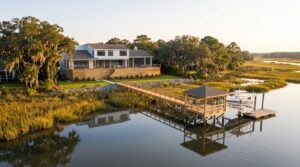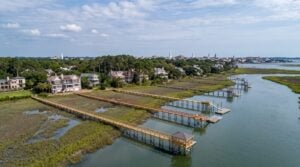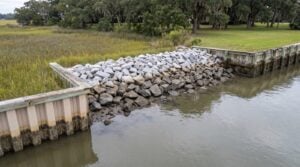
Does a dock add value to waterfront property?
Yes — and in the Charleston market, more reliably than almost any other improvement a waterfront owner can make. Appraisers and agents working the Lowcountry generally attribute $30,000 to $150,000 of value to a permitted, well-built private dock, and on deep-water lots the effect is larger than that because the dock is what makes the property deep-water in the first place.
But the number is not the interesting part. What matters is why a dock carries value here, which conditions change the answer, and when building one is the wrong financial decision. This is the honest version.
Why a Lowcountry dock carries more value than a lake dock
Three things are true here that are not true in most waterfront markets.
The permit is the scarce asset, not the timber. A dock permit in South Carolina’s critical area is not automatic. Waterway width, marsh depth, adjacent structures, and neighbour setbacks all constrain what can be authorised, and a meaningful share of nominally waterfront lots in the Charleston area cannot get a private dock permit at all — the criteria are published by the South Carolina Department of Environmental Services Bureau of Coastal Management, and they are stricter than most buyers assume. A property that has one holds something a buyer cannot simply go and buy. A property with an existing permitted structure is also far simpler to maintain than a property starting from nothing — repair in kind is a very different regulatory proposition from new construction.
Access is not the same as frontage. Plenty of Lowcountry lots front a marsh that is only navigable for two hours either side of high tide. A dock that reaches water deep enough to float a boat at any stage of the tide converts “waterfront” into “usable waterfront”, and buyers price that distinction accurately.
Replacement cost is high and rising. A buyer looking at a property without a dock is looking at $75,000 to $150,000 and a permitting timeline measured in seasons before they can use the water. That deferred cost and delay is priced into the offer.
What the value actually depends on
Not all docks contribute equally. In rough order of impact:
| Factor | Effect on value |
|---|---|
| Water depth at mean low water | The dominant variable. A dock that floats a boat at low tide is worth far more than one that sits on mud for four hours. |
| Permit status and transferability | An unpermitted structure is a liability, not an asset. Buyers’ attorneys find these. |
| Structural condition and remaining life | A dock at the end of its service life reads to a buyer as a demolition cost. |
| Boat lift present and functional | Consistently adds value, particularly to buyers who keep a boat year-round. |
| Covered pierhead | Adds usable outdoor living space; strong in this market. |
| Power and water on the structure | Modest on its own, but signals a properly built dock. |
| Aesthetic integration with the house and shoreline | Harder to quantify, real in practice. A dock that looks like it belongs to the property photographs better and shows better. |
Return on investment: the realistic picture
Most home improvements return a fraction of their cost. Waterfront access is one of the few categories where full or better-than-full recovery is common — but that is an average across a wide distribution, and it is worth understanding both tails.
Where the return is strongest: a deep-water lot that currently has no dock, where a permit is obtainable. Here the dock does not just add its own cost to the property — it moves the property into a different category of listing. This is the case where owners routinely see more than they spent.
Where the return is solid: replacing a dock that is past its service life on a property being prepared for sale. A buyer discounts a failing dock by more than it costs to fix, because they are pricing in the unknown as well as the work.
Where the return is weak: over-building for the location. A $200,000 dock system on a $600,000 property will not return its cost. Neither will a large covered pierhead on a shallow creek where a boat cannot reliably reach it. The market rewards a dock that fits the property and the water it sits on — which is why getting the sizing right matters. Our guide to dock dimensions for Lowcountry waters works through that.
Where it can go negative: unpermitted construction. A structure built without authorisation can require removal at the owner’s cost, and it complicates or kills a sale. This is not a theoretical risk in South Carolina.
The maintenance side of the ledger
A dock is an asset that depreciates unless it is maintained, and buyers assess maintenance history. Budget realistically:
- Annual inspection and minor repairs: $500 – $2,000
- Decking replacement at 15 – 20 years on timber: $8,000 – $25,000
- Piling repair or replacement over the structure’s life: variable, and the largest single item
- Boat lift servicing: $400 – $1,200 annually, more after a storm
A documented maintenance record is genuinely worth something at sale — it converts an unknown into a known. Our annual dock inspection checklist is designed to produce exactly that record, and our guide to decking materials for saltwater covers the choices that determine how often you are back out there.
Building for value: what the market rewards
If the intention is resale rather than personal use, the priorities shift slightly:
- Reach the depth. Every dollar spent getting the structure out to water that stays deep at low tide does more for value than anything spent on finish.
- Build to a long service life. A buyer’s surveyor will estimate remaining life. Marine-grade materials buy years on that estimate.
- Keep the paperwork. Permits, drawings, inspection reports, repair invoices. Assemble them as a file.
- Make it look like it belongs. Alignment with the house, consistent detailing, handrails and lighting that match the property’s character. This costs relatively little and shows disproportionately.
- Do not over-build. Match the structure to the water and the property.
Commercial and community waterfront
The same logic scales. For marinas, waterfront restaurants, and hospitality properties, dockage is directly revenue-generating and valued on income rather than comparable sales — the calculation is about berth-nights and slip fees rather than appraisal. For HOAs and residential developments, a shared community dock raises the value of every lot with access to it, often at a lower cost per household than individual structures, and it is frequently permissible where individual docks are not. Our guide to commercial marina construction in South Carolina covers that side.
Frequently asked questions
How much value does a dock add to a waterfront home?
In the Charleston area, a permitted, well-built private dock typically contributes $30,000 to $150,000 of value, depending most heavily on water depth at low tide, permit status, and structural condition. On deep-water lots the effect can exceed the dock’s construction cost, because the dock is what makes the property usable as deep-water frontage.
Is building a dock a good investment?
On a deep-water lot where a permit is obtainable and no dock currently exists, it is one of the strongest returns available to a waterfront owner. It is a weaker investment where the structure would be over-built for the property’s value, or where shallow water limits how usable the dock will be. It is a negative where the structure is built without authorisation.
What is the average value of a boat dock on a waterfront home?
Estimates vary by market and by appraiser, but the Lowcountry range most commonly cited falls between $30,000 and $150,000. The single largest determinant is whether a boat can reach and leave the dock at any stage of the tide. A dock that grounds at low water is valued closer to the bottom of that range regardless of how well it is built.
Does a boat lift add value?
Yes, consistently — particularly with buyers who keep a boat in the water year-round, because a lift materially reduces hull maintenance and storm exposure. A lift that is functional and recently serviced adds more than one of unknown condition.
Will an old or damaged dock hurt my property value?
It can. Buyers tend to discount a failing structure by more than the cost of repairing it, because they are pricing in uncertainty as well as work. A dock at the end of its service life with no maintenance record reads as a demolition and rebuild cost.
Do I need a permit, and does it transfer when I sell?
Yes, a permit is required for structures in South Carolina’s critical area, and authorisation is tied to the property rather than the owner — but verify status before you buy or sell, because unpermitted or lapsed structures are found routinely during due diligence and are difficult to resolve after the fact.
Find out what your waterfront can support
Whether a dock makes financial sense on a specific property comes down to what can be permitted there and how deep the water is at low tide. Both are answerable with a site visit. If you are weighing a new dock, replacing an ageing one, or preparing a waterfront property for sale, talk to our team — we will tell you what your shoreline can support and what it is likely to be worth doing.