Bulkhead vs. seawall vs. riprap: what the difference actually is
The three terms get used interchangeably, including by people who should know better. They describe genuinely different structures that solve the same problem in different ways, and choosing between them is the single most consequential decision a Lowcountry waterfront owner makes about shoreline protection.
The short version:
- A bulkhead is a vertical retaining wall that holds soil in place. Its job is to stop the land behind it from moving.
- A seawall is a vertical or sloped structure built to absorb and deflect wave energy. Its job is to stop the water in front of it from doing damage.
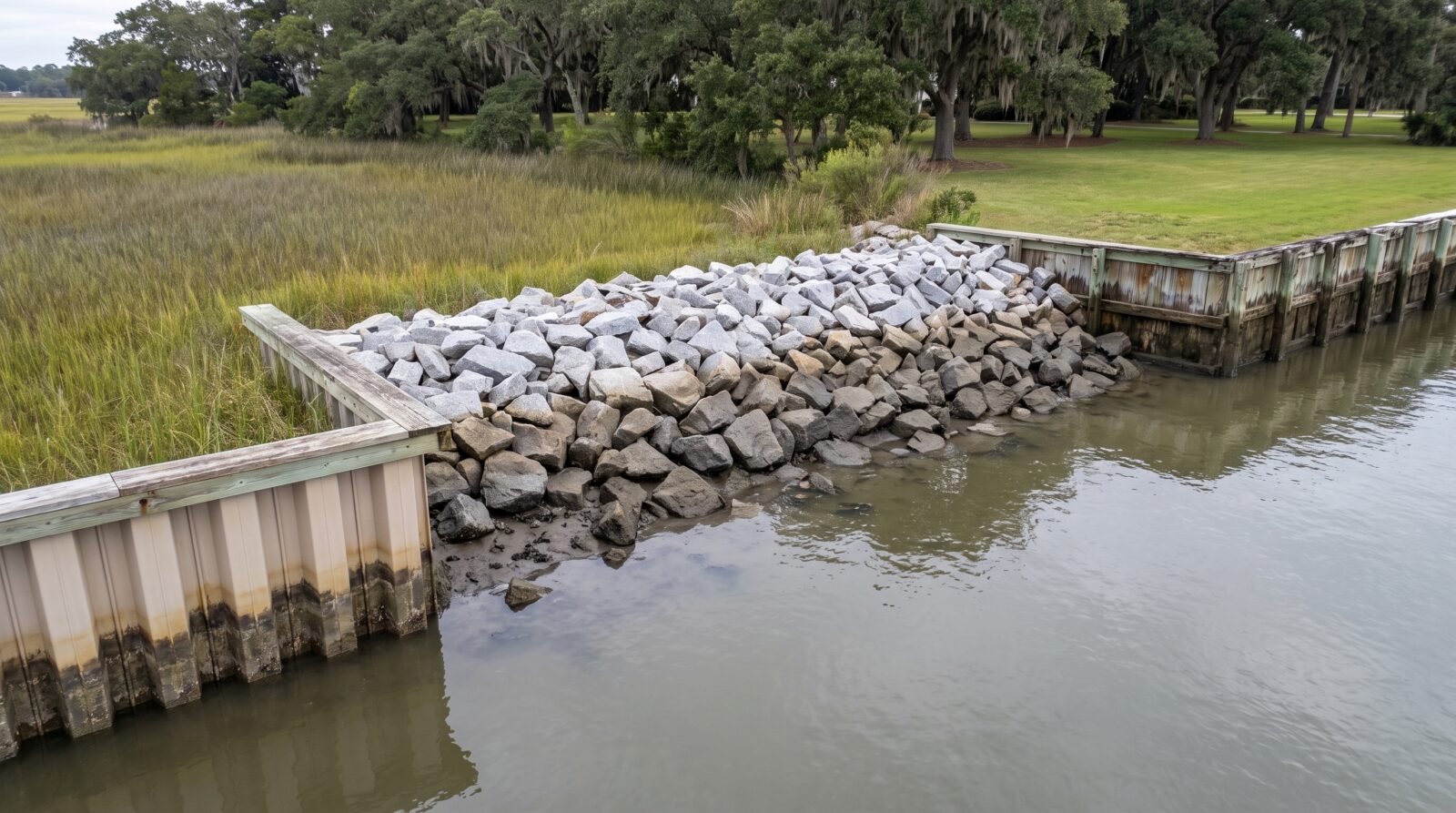
- Riprap is a graded blanket of quarried stone laid on a slope. Its job is to dissipate wave energy by letting water break up through the voids between rocks rather than reflecting off a hard face.
In practice most Lowcountry residential structures called “seawalls” are bulkheads — the tidal creeks and sheltered reaches around Charleston rarely generate the wave energy a true seawall is designed for. What they do generate is a relentless twice-daily tidal cycle that pulls soil out from behind anything holding it.
The comparison, side by side
| Bulkhead | Seawall | Riprap | |
|---|---|---|---|
| Primary job | Retain soil | Deflect wave energy | Absorb wave energy |
| Profile | Vertical | Vertical, stepped, or curved | Sloped stone blanket |
| Typical Lowcountry use | Tidal creeks, sheltered banks, residential lots | Exposed harbour frontage, commercial and municipal | Eroding banks, marsh edges, toe protection |
| Installed cost (per linear foot) | $400 – $900 | $700 – $1,800+ | $150 – $450 |
| Service life | 25 – 40 years (vinyl/composite), 15 – 25 (timber) | 40 – 75 years (concrete) | 40+ years with periodic re-dressing |
| Land preserved | Maximum — vertical face | Maximum — vertical face | Consumes shoreline to the slope |
| Effect on neighbours | Can accelerate scour at the ends | Reflects energy; can scour adjacent property | Absorbs energy; generally neutral or beneficial |
| Habitat value | Low | Low | Moderate — voids provide habitat |
| Permitting difficulty | Moderate | Higher | Often the most straightforward |
When a bulkhead is the right answer
A bulkhead earns its place when you need to hold a defined property line and preserve usable land right up to the water. It is the standard solution along Charleston’s tidal creeks and on lots where a sloped stone revetment would consume yard you cannot spare.
Modern Lowcountry bulkheads are typically vinyl or composite sheet pile driven to depth, capped with a treated timber or concrete cap, and held back by tie-back rods anchored to deadmen buried behind the wall. Timber bulkheads are still built, and they still work, but they give roughly half the service life of vinyl in saltwater at a cost difference that has narrowed considerably.
The failure modes are worth knowing, because they are what you are paying to avoid:
- Tie-back failure — the wall leans outward at the top. Almost always the corroded rod rather than the sheet pile itself.
- Loss of fill — soil escapes through joints or under the toe, showing up as sinkholes and settling in the yard behind. This is the most common and most expensive problem, and it is progressive.
- End scour — water accelerates around the end of the wall and undermines whatever is next to it. Bulkheads need proper returns and transitions.
When a seawall is the right answer
A true seawall is engineered for wave energy, and around Charleston that means exposed harbour frontage, the ocean-facing sides of the barrier islands, and commercial or municipal waterfront where boat wake and fetch combine to produce real hydrodynamic loading. These are typically reinforced concrete, often with a stepped or recurved face designed to send energy back down rather than up and over.
They cost more, they last longer, and they demand more engineering. They also reflect energy rather than absorbing it, which is why a seawall on one property can accelerate erosion on the next one along. That is a design problem, not a reason to avoid them — but it is a reason the design should be done properly. Our overview of seawall construction options covers the material choices in more depth.
When riprap is the right answer
Riprap is underrated by owners and well regarded by regulators. A graded stone revetment laid over filter fabric on a prepared slope dissipates wave energy instead of reflecting it, tolerates settlement without failing, and is repaired by adding stone rather than rebuilding.
It is frequently the best answer for an eroding marsh edge, for protecting the toe of an existing bulkhead that is being undermined, and for owners who have the shoreline depth to give up to a slope. It is also generally the least difficult of the three to permit, because it works with the shoreline rather than replacing it. Our riprap installation guide covers stone sizing and slope preparation.
The trade-off is real: a 3:1 slope on a four-foot bank consumes twelve feet of shoreline. On a narrow lot that is not available.
A fourth option worth knowing about
Living shorelines — engineered combinations of oyster reef, marsh planting, and low stone sills — are increasingly the preferred approach in sheltered Lowcountry conditions, and regulators look on them favourably. They perform best where wave energy is low, the bank slope is gentle, and there is room to work. They perform poorly on high-energy frontage or where the property line sits at the water’s edge. They are not a universal substitute for a hard structure, but they are a genuine option that too few owners are shown.
How to choose
Four questions settle it most of the time.
- What is failing — land, or the water’s edge? If soil is leaving the property, you have a retention problem and you need a bulkhead. If the bank is being cut back by wave action, you have an energy problem and riprap or a seawall is the answer.
- How much shoreline can you give up? If the answer is none, the sloped options are out.
- What is the wave environment? A sheltered tidal creek and an exposed harbour frontage are different engineering problems. Boat wake counts.
- What already exists next door? Transitions between different structure types are where failures start. A bulkhead that ends against a neighbour’s riprap needs a designed transition, not a butt joint.
A site visit answers all four in about an hour. What it also does is establish where the critical line falls on your property, which determines what you are allowed to build at all.
Permitting: the part that decides your timeline
Shoreline structures sit in the state’s critical area, and authorisation comes from the South Carolina Department of Environmental Services Bureau of Coastal Management — the agency formerly known as DHEC OCRM. Larger or federally connected work also goes to the U.S. Army Corps of Engineers Charleston District.
A few things reliably affect how long this takes. Repair in kind is simpler than replacement. Replacement on the same alignment is simpler than moving the wall waterward — and moving it waterward is frequently not permissible at all. Sloped and habitat-friendly approaches generally meet less resistance than new hard armouring. Our full guide to coastal permitting in Charleston walks through the process and the realistic timelines.
Frequently asked questions
What is the difference between a bulkhead and a seawall?
A bulkhead is a retaining wall whose job is to hold soil in place behind it. A seawall is built to absorb and deflect wave energy in front of it. Bulkheads suit sheltered tidal creeks and residential lots; seawalls suit exposed frontage with real wave loading. Most residential structures in the Charleston area described as seawalls are technically bulkheads.
Is riprap cheaper than a bulkhead?
Generally yes — roughly $150 to $450 per linear foot installed against $400 to $900 for a bulkhead. The trade-off is shoreline: riprap needs a slope, so it consumes usable land, while a bulkhead holds a vertical line. On a narrow lot the cost saving is irrelevant if the space is not there.
How long does a bulkhead last in saltwater?
A vinyl or composite sheet pile bulkhead typically gives 25 to 40 years in Lowcountry conditions. Timber runs 15 to 25 years. Service life usually depends on the tie-back system and the cap rather than the sheet pile face — corroded tie-back rods are the most common cause of premature failure.
Do I need a permit to build a bulkhead or seawall in South Carolina?
Yes. Shoreline structures fall within the state’s critical area and require authorisation from the South Carolina Department of Environmental Services Bureau of Coastal Management, with federal review for larger or connected work. Repair in kind is generally simpler to authorise than replacement or realignment.
Can I replace my bulkhead with riprap?
Often, and regulators frequently prefer it. The constraints are shoreline width — riprap needs a slope — and whether the bank behind it will stay stable once the vertical retention is removed. On a lot with room, converting a failing bulkhead to a stone revetment can be both cheaper and more durable.
What causes a bulkhead to fail?
Three things, in order of frequency: tie-back rod corrosion, which shows as the wall leaning outward at the top; loss of fill through joints or under the toe, which shows as sinkholes and settling in the yard behind; and end scour where water accelerates around the wall’s termination. Sinkholes behind a wall are the earliest warning and should never be ignored.
Get a straight answer on your shoreline
The right structure depends on what is actually happening on your bank, and that is not something to decide from a catalogue. We assess shorelines across Charleston and the Lowcountry for waterfront homeowners, marinas, and municipalities, and we will tell you honestly when the cheaper option is also the better one. Get in touch and we will come and look.