What a dock builder on James Island and in West Ashley needs to know
James Island and West Ashley sit on some of the most workable — and most misunderstood — water in the Charleston area. The Stono River, Wappoo Creek, Ellis Creek, Charleston Municipal Marina’s reach of the Ashley, and the tidal creek network that laces through both areas give hundreds of properties genuine boat access. They also present conditions that a contractor unfamiliar with these particular creeks will price wrong.
We build docks, pierheads, floats, boat lifts, and bulkheads across both areas, for waterfront homes, community properties, and commercial sites. What follows is what we have learned about building here specifically.
What makes this water different
Deep pluff mud, and a lot of it
The creek banks through James Island and West Ashley carry some of the deepest soft sediment in the Charleston metro. That has one direct consequence: pilings have to be driven considerably further to reach the bearing that holds them. A quote priced off a Mount Pleasant or Daniel Island job will be short here, and a piling driven to the wrong depth in this ground does not fail immediately — it fails in year six, usually after a storm. Our guide to marine pile driving in Charleston explains how embedment depth is determined and why it is not a number you can assume.
Long marsh crossings
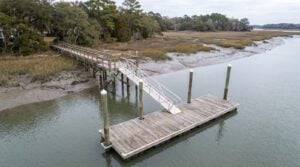
Very few properties here have deep water at the bank. The typical James Island or West Ashley dock is a long elevated walkway across protected salt marsh, ending at a pierhead with enough water beneath it to float a boat at low tide. On many lots the walkway is 120 to 300 feet, and it is the larger share of the project cost — not the dock at the end of it. Anyone quoting a dock here without measuring that crossing is guessing.
Real tidal range and real current
The Stono and the Wappoo Cut both move water hard on a falling tide. That affects float and mooring design, boat lift positioning, and how a pierhead should be oriented so that coming alongside is manageable rather than an event. Our explainer on floating dock mooring systems in tidal water covers how floats are held in place under those conditions.
Barge access is not a given
Some of these creeks are shallow or narrow enough that a work barge can only reach a site on a particular stage of the tide, which compresses the working day. Others allow land access to the bank, which is faster and cheaper. This is one of the largest cost variables between two otherwise identical projects a mile apart.
Where we work
James Island — the Stono River frontage, Ellis Creek, Clark Sound and the Secessionville reach, the creeks off Fort Johnson Road, Riverland Terrace and the Wappoo shoreline, and the marsh-front neighbourhoods through the island’s interior.
West Ashley — the Ashley River frontage from the Wappoo Cut upriver, Church Creek, the Bulls Creek and Rantowles systems, Northbridge, and the waterfront communities along Bees Ferry and Savannah Highway.
We also work the adjoining reaches out to Folly Beach and Johns Island, which is where our own yard sits.
What we build here
- Private docks — walkway, pierhead, ramp, and float, sized to the property and the water rather than a catalogue. See our sizing guide.
- Floating docks — pile-guided for the tidal range. Our floating dock cost guide covers what drives the budget.
- Boat lifts — sized to the vessel and the water depth, positioned for the current. See boat lift installation in Charleston.
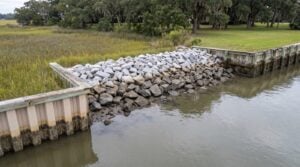
- Bulkheads and shoreline protection — for the eroding creek banks that are common through both areas. Our comparison of bulkheads, seawalls and riprap covers the choice.
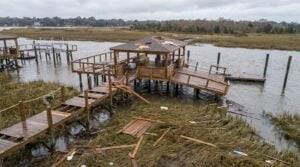
- Repairs, re-decking, and piling replacement — much of the dock stock here dates from the 1980s and 1990s and is reaching the end of its service life. See dock piling repair and replacement.
- Community and HOA docks — shared structures for neighbourhoods where individual docks are constrained.
Materials for this water
Everything here is a saltwater specification. Pressure-treated southern yellow pine remains the workhorse for framing and pilings — the phrase “marine treated” that shows up in local searches refers to the higher retention treatment used for structures in continuous contact with saltwater, and it matters. Hardware is hot-dip galvanised or stainless throughout; anything less has a short and disappointing life in this environment. For decking, the choice between treated timber, composite, and hardwood comes down to how the dock is used and how much upkeep the owner wants. We work through that in our guide to decking and lumber that survives Charleston saltwater.
Permitting on these creeks
Both areas fall within South Carolina’s critical area, so any structure needs authorisation from the South Carolina Department of Environmental Services Bureau of Coastal Management, with federal review through the Army Corps of Engineers Charleston District where applicable. Two constraints come up repeatedly on James Island and in West Ashley: creek width, which governs how far a structure may extend and whether a dock is permissible at all on narrow reaches, and neighbour setbacks, which on the tighter creeks can be the deciding factor. City of Charleston and Charleston County requirements apply on top of the state process depending on the address.
The realistic timeline is several months from application, longer where a variance is involved. Our full permitting guide walks through it, and we handle the process for the projects we build.
What a project looks like
- Site visit — we walk the bank, look at the marsh crossing, and check depth at low water. This is where a real number starts.
- Survey and design — alignment, length, and configuration, drawn to what the site and the regulations will support.
- Permitting — application, agency review, and any conditions.
- Construction — pile driving first, then framing, decking, and the float or lift. Tide-dependent, and honestly scheduled around it.
- Handover — drawings, permit documentation, and a maintenance schedule.
Frequently asked questions
Do I need a permit to build a dock on James Island or in West Ashley?
Yes. Both areas are within South Carolina’s critical area, so a dock requires authorisation from the South Carolina Department of Environmental Services Bureau of Coastal Management, with federal review where applicable and local requirements depending on whether the address falls under the City of Charleston or Charleston County. Expect several months.
Can every waterfront property here get a dock permit?
No. Creek width and neighbour setbacks are the usual constraints — on narrow reaches a private dock may not be permissible at all, or may be limited in how far it can extend. This is worth establishing before you buy a lot on the strength of its water frontage.
Why does a James Island dock cost more than one in Mount Pleasant?
Two reasons, usually. The pluff mud here is deeper, so pilings have to be driven further to reach bearing. And most properties need a long elevated walkway to reach water that stays deep at low tide — on many lots the walkway is the larger share of the cost, not the dock.
What does “marine treated” mean for a dock?
It refers to the higher preservative retention level used for timber in continuous contact with saltwater, above the retention specified for general ground contact. For pilings and any framing near or below the waterline in these creeks, it is the correct specification, and it is a meaningful factor in how long the structure lasts.
How long does it take to build a dock here?
Construction itself typically runs a few weeks to a couple of months depending on walkway length and barge access. Permitting is the longer part of the timeline — plan on several months before a shovel moves, and longer where a variance is required.
Can you repair my existing dock rather than replacing it?
Frequently, yes. If the pilings are sound and plumb, most of what sits above them can be repaired economically. Where a significant share of the pilings have moved or lost embedment, a rebuild usually costs less than a phased repair. A proper assessment tells you which situation you are in — and repair in kind is generally simpler to permit than replacement.
Talk to a marine contractor who knows these creeks
We are based on Johns Island and work James Island, West Ashley, and the surrounding waterways year-round. If you are planning a dock, weighing a repair, or dealing with an eroding creek bank, get in touch and we will come and look at the site. The conversation is more useful once we have both seen the water at low tide.