Choosing a seawall material is a fifty-year decision made once. It sets what the wall costs to build, how long it lasts, what it looks like from the water, and — most importantly — how it behaves as it ages. Get it right and the structure becomes a piece of the property nobody thinks about. Get it wrong and it becomes an expensive, recurring problem.
Four materials dominate shoreline structures in the South Carolina Lowcountry. Each is genuinely the right answer somewhere.
The comparison
| Vinyl (PVC) | Concrete | Treated timber | Steel | |
|---|---|---|---|---|
| Installed cost / linear ft | $450 – $950 | $700 – $1,400 | $350 – $650 | $800 – $1,600 |
| Service life (brackish) | 30 – 50 yrs | 50 – 75 yrs | 15 – 25 yrs | 25 – 40 yrs |
| Corrosion | None | Rebar can spall over time | N/A — but borers attack | Significant without coating or anodes |
| Marine borers | Immune | Immune | Primary failure mode | Immune |
| Retained height suited to | Up to ~10 ft | Any | Up to ~6 ft | Any |
| Installation | Light equipment; clean | Heavy; often cast in place | Light equipment | Heavy driving equipment |
| Appearance | Uniform; capped in timber or concrete | Substantial, architectural | Warm; weathers to grey | Industrial |
| Typical use here | Residential frontage | Commercial, municipal, exposed | Budget residential, short walls | Commercial, deep retained height |
Vinyl sheet pile: the Lowcountry default
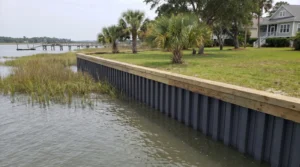
PVC sheet piling has become the standard for residential bulkheads and seawalls across the Charleston area, and for good reasons. It does not corrode, marine borers cannot touch it, it will not spall, and it comes out of the ground looking much as it went in. Installation is comparatively light — it can often be driven with equipment small enough to reach a residential shoreline without barge work, which meaningfully reduces the cost of the job.
What to look for: section modulus, which is the measure of a profile’s stiffness and the number that actually determines whether the wall can carry the retained soil. Thin, cheap vinyl profiles deflect visibly under load and are the reason vinyl occasionally gets an undeserved reputation. Specify the profile to the retained height and the soil, not to the price.
Its limits: ultraviolet exposure degrades PVC over decades, so the exposed portion should be capped and the wall should not be built with excessive freeboard. Above about ten feet of retained height, the profiles needed become uneconomic and concrete or steel take over.
Concrete: where it has to last longest
Concrete is the material of choice where the wall carries real load, faces real wave energy, or has to last three generations — commercial frontage, municipal work, exposed harbour edges, and high-end residential where the wall is an architectural element of the property.
Modern marine concrete with proper cover over epoxy-coated or stainless reinforcement, and a mix designed for chloride resistance, will run fifty to seventy-five years in this environment. It also does something no other material does: it can be shaped. Stepped faces, curved returns, integrated stairs, and cast finishes that match the house are all available in concrete and in nothing else.
The costs are the obvious ones — higher price, heavier equipment, longer construction. The subtler one is that concrete’s failure mode is slow and expensive to correct. Where reinforcement corrodes because cover was inadequate, the resulting spalling is a genuine repair project.
Treated timber: honest, limited, still useful
Timber built most of the older bulkheads on these creeks and it still has a place. It is the cheapest way to build a wall, it looks right on a rustic or traditional property, and for a short retained height on a sheltered creek it does the job.
Its problem is biological. Marine borers — teredo worms and gribbles — are active in Lowcountry brackish water and they eat timber from the inside. Marine-grade treatment with high retention slows this considerably; it does not stop it. Fifteen to twenty-five years is a realistic expectation, and the wall often looks fine from the lawn while the submerged sheeting is losing section.
Where we still specify it: short walls, sheltered creeks, properties where the owner explicitly prefers timber’s appearance and accepts the service life, and repairs to existing timber structures where matching is the point.
Steel: the commercial answer
Steel sheet pile is the strongest option per unit of wall and handles the deepest retained heights. On commercial and municipal projects — bulkheads along working waterfront, deep-water frontage, structures carrying surcharge from equipment or vehicles behind them — it is frequently the only material that works.
Brackish water is hard on it. Uncoated steel in this environment loses meaningful section, particularly in the splash zone where wetting and drying alternate. That is manageable — coal tar epoxy coatings, sacrificial anodes, or simply specifying a heavier section with a sacrificial thickness allowance — but it is a design decision that must be made deliberately and a maintenance programme that has to be followed.
Steel is rarely the right answer on residential frontage in the Lowcountry. Vinyl does the same job for less money and needs no cathodic protection.
The components that matter more than the material
This is the part most comparisons leave out. A wall’s service life is usually decided by things other than the sheeting.
The tie-back system. Anchor rods running back to deadmen behind the wall carry the soil load. They are buried, invisible, and they are what fails first on the majority of walls we replace. A vinyl wall with undersized, unprotected steel rods will fail long before the vinyl does. Specify hot-dip galvanised or fibreglass rods, generously sized.
Drainage. Weep holes with aggregate and filter fabric relieve the hydrostatic pressure that builds behind a wall after heavy rain. That pressure is what pushes walls over. Its absence is why walls lean.
Filter fabric at every joint. Water passes, soil does not. Without it, the lawn slowly migrates into the creek and reappears as a sinkhole.
Toe protection. Where current or wave energy scours the base, a stone apron protects the embedded portion. Losing toe embedment is losing the wall.
We go through the failure sequence in detail in bulkhead replacement in Charleston.
The option that is not a wall at all
On plenty of Lowcountry shorelines the right answer is riprap or a living shoreline rather than a vertical structure. Both absorb wave energy instead of reflecting it, both cost considerably less, and both are generally easier to permit — the trade is that they consume shoreline to the slope, which tight lots cannot spare.
Before committing to a wall, it is worth reading bulkhead vs. seawall vs. riprap and living shorelines and erosion control on the South Carolina coast.
Permitting
All of these structures sit within the coastal critical area and require authorisation from the state’s Bureau of Coastal Management, generally with a concurrent Army Corps review. Material choice does not change the process, though softer approaches often move through it more smoothly. Our full guide is at SCDES and OCRM critical area permits; current rules are published by the South Carolina Department of Environmental Services.
Frequently asked questions
Is vinyl sheet pile strong enough for a real seawall?
For residential retained heights up to around ten feet, yes — provided the profile’s section modulus is specified for the load. The failures attributed to vinyl are almost always under-specified profiles or failed tie-backs, not the material itself.
How much does a seawall cost in Charleston?
Roughly $450 to $1,400 per linear foot installed depending on material, retained height and access. A 120-foot residential frontage in vinyl typically lands between $60,000 and $115,000. Full detail is in seawall cost in Charleston.
Can I put a new wall in front of an old failing one?
Sometimes, and it can save the cost of demolition — but moving the alignment waterward is significantly harder to permit and may not be approved. It has to be evaluated case by case before it is designed.
Does the material affect how long permitting takes?
Not directly. What affects it is alignment, footprint and whether the work is a replacement in place or something new. Softer solutions such as living shorelines often receive a more favourable review.
What is the best material for a Lowcountry residential shoreline?
Vinyl sheet pile with a properly engineered tie-back system, in most cases — the best combination of cost, service life and freedom from corrosion and borers. Concrete where the wall must last longest or be an architectural feature; riprap where the shoreline can spare the slope.
Specifying it properly
The right material is set by retained height, soil conditions, wave exposure, access and how the wall should look against the property. Those are site questions, and they are answered by standing on the shoreline at low tide rather than reading a spec sheet.
If you are planning a seawall or bulkhead anywhere on the South Carolina coast, get in touch. We will tell you what your shoreline needs before anyone talks about material.