What a floating dock actually costs in the Lowcountry
Most of what you will read about floating dock cost was written for a lake. Search the question and you will find kit retailers quoting $15 to $50 per square foot for a modular platform that sits on a body of water which stays more or less where it is all day. Charleston does not work that way. The tide here moves five to seven feet twice a day, and on a spring tide in the tidal creeks it moves more. That single fact changes the design, the hardware, and the price.
A professionally built floating dock in the Charleston area — pile-guided, permitted, and engineered for the tidal range — generally runs $45 to $110 per square foot installed. A modest residential float with a ramp and a walkway out to it typically lands between $28,000 and $75,000. Larger residential systems with a covered pierhead, a boat lift, and utilities run past $150,000. Commercial and marina dockage is priced per linear foot of berthing rather than per square foot, and starts around $500 per linear foot for a basic timber-framed float.
Those are wide ranges, and they should be. Below is what actually moves the number, why the national figures do not translate to a tidal creek, and what a realistic Lowcountry budget looks like.
Why Lowcountry floating docks cost more than the national figures
A floating dock has to be held in place. On a lake, that is often a pair of short pipe guides or a couple of anchor cables. In Charleston, the float has to ride up and down a five-to-seven-foot tidal swing without leaving its guides, so the pilings that restrain it have to stand well above the highest tide and well below the lowest — which means driving them deeper and taller than a lake installation ever requires. NOAA’s Charleston Harbor tide station records the mean range; storm surge and king tides go well beyond it.
Three consequences follow, and each one carries cost:
- Deeper, taller pilings. Guide pilings for a tidal float are longer and driven further into the pluff mud than a fixed dock’s support pilings of the same footprint. This is the single biggest reason a Lowcountry float costs more than a lake float of identical size. Our guide to marine pile driving in Charleston covers how depth is determined on a given site.
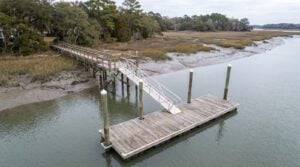
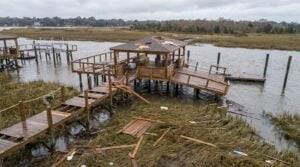
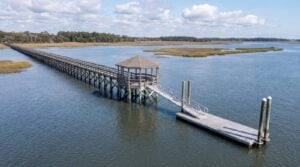
- Longer approach structures. Very few Lowcountry properties have deep water at the bank. Most floats sit at the end of a walkway that crosses marsh grass, and that walkway is frequently the larger share of the total build. Two hundred feet of elevated walkway across a protected marsh will cost more than the float it serves.
- Salt. Hardware that survives a freshwater lake for twenty years fails here in five. Hot-dip galvanised or stainless fasteners, marine-grade aluminium framing, and sealed flotation are not upgrades in this environment — they are the baseline. We go into this in detail in our comparison of decking and lumber that survives Charleston saltwater.
Cost by material and construction type
| Float construction | Installed cost per sq. ft. | Expected service life | Best suited to |
|---|---|---|---|
| Pressure-treated timber frame, encapsulated foam billets | $45 – $65 | 15 – 20 years | Residential creek docks, budget-conscious builds |
| Timber frame with composite decking | $55 – $80 | 20 – 25 years | Residential where barefoot comfort and low upkeep matter |
| Marine-grade aluminium frame, composite or aluminium deck | $70 – $110 | 30 – 40 years | Exposed sites, higher-end residential, commercial dockage |
| Concrete floating dock systems | $95 – $150+ | 40+ years | Marinas, commercial berthing, high-traffic public access |
Aluminium tends to look expensive on a per-square-foot basis and inexpensive over thirty years. In a saltwater tidal environment it does not rot, does not need annual sealing, and is light enough that the flotation and guide hardware can be sized down. For an owner who intends to keep the property, it is frequently the better arithmetic. Our side-by-side on material selection works through that trade in more depth.
The line items that surprise people
Permitting and survey
Any structure in or over a critical area needs authorisation from the state, and depending on the waterway and the scope, from the federal side as well. Expect $2,500 to $9,000 for survey work, drawings, and permit administration on a residential float, and considerably more where a joint federal review or a variance is involved. Timelines run from a few months to well over a year. We walk through the process in our guide to coastal permitting for Charleston waterfront construction, and the state’s own requirements are published by the South Carolina Department of Environmental Services Bureau of Coastal Management.
The walkway and the ramp
The ramp — the hinged gangway between the fixed structure and the float — is a real cost item, typically $4,000 to $18,000 depending on length and material. It has to be long enough that its slope stays walkable at dead low tide, which in a creek with a seven-foot range means a longer ramp than most people expect.
Access for the barge and crew
Sites that can only be reached by water cost more to build than sites a crew can reach by land. Barge mobilisation, tide-dependent work windows, and equipment staging are all real. Two identical docks on two different creeks can differ by fifteen percent on access alone.
Utilities and lifts
Power, water, and lighting on the float add $3,000 to $12,000. A boat lift is a separate project with its own pilings and its own budget — see our guide to boat lift installation in Charleston.
Floating or fixed?
The honest answer is that most Lowcountry properties end up with both: a fixed walkway and pierhead, with a float and ramp at the end for boat access at any stage of the tide. That combination is the regional norm for a reason.
A float is the right call when you want to step onto your boat at the same height regardless of tide, when the water at your pierhead is deep enough to keep the float from grounding at low tide, and when you use the dock primarily for boat access. A fixed structure is the better choice for a crabbing and fishing platform, for covered pierheads, and for sites where the float would sit on mud for four hours a day. Sizing the whole system correctly matters more than the float-versus-fixed question on its own — our guide to dock dimensions for Lowcountry waters covers how to get that right. If you already know a float is the answer, our explainer on floating dock mooring systems in tidal water covers the mechanics of how they are held in place.
A realistic budget, start to finish
| Component | Typical Lowcountry range |
|---|---|
| Survey, drawings, permitting | $2,500 – $9,000 |
| Elevated walkway across marsh (per linear foot) | $180 – $340 |
| Fixed pierhead, 12ft × 16ft | $18,000 – $38,000 |
| Ramp / gangway | $4,000 – $18,000 |
| Float, 8ft × 20ft | $9,000 – $19,000 |
| Guide pilings and hardware | $4,000 – $11,000 |
| Power, water, lighting | $3,000 – $12,000 |
A common Charleston-area project — a 150-foot walkway, a modest pierhead, a ramp, and an 8ft × 20ft float, permitted and powered — lands somewhere between $75,000 and $140,000. A short walkway on a deep-water lot with no pierhead can come in under $40,000. The variable that moves the number most is almost never the float itself. It is the distance from your bank to water deep enough to float a boat at low tide.
What to ask before you sign
- Is the quote for a permitted structure, and who is carrying the permitting risk if the authorisation comes back with conditions?
- What is the guide piling embedment depth, and how was it determined for this site?
- What is the hardware specification — galvanised, stainless, or coated — and what is the warranty on it in saltwater?
- At mean low water, how much water will sit under the float?
- Is barge mobilisation included or excluded?
A contractor who can answer those five without hesitation is quoting a real dock. A number that arrives without a site visit is quoting a lake kit.
Frequently asked questions
How much does a floating dock cost in Charleston, SC?
A professionally built, permitted floating dock in the Charleston area generally costs $45 to $110 per square foot installed, with most complete residential projects — walkway, pierhead, ramp, and float — falling between $28,000 and $150,000. The tidal range drives the cost above national averages because guide pilings must be driven deeper and stand taller than a lake installation requires.
Why is a floating dock more expensive here than the prices I see online?
Most published floating dock prices describe DIY kits for calm freshwater lakes. Charleston’s five-to-seven-foot tidal range requires taller, deeper guide pilings; most properties need a long elevated walkway to reach water that stays deep at low tide; and saltwater requires marine-grade hardware throughout. None of those costs appear in a lake kit price.
Do I need a permit for a floating dock in South Carolina?
Yes. Structures in or over the state’s critical areas require authorisation from the South Carolina Department of Environmental Services Bureau of Coastal Management, and many projects also require federal review. Budget several months at minimum, and longer where a variance or a joint review is involved.
How long does a floating dock last in saltwater?
A timber-framed float with encapsulated flotation typically gives 15 to 20 years in Lowcountry conditions. Marine-grade aluminium construction reaches 30 to 40 years. Service life depends heavily on hardware specification and on whether the dock is inspected and maintained annually.
Is a floating dock better than a fixed dock in the Lowcountry?
Neither is universally better. A float gives you level boat access at any tide stage, which matters most for regular boaters. A fixed structure is better for fishing platforms, covered pierheads, and shallow sites where a float would ground at low tide. Most Lowcountry properties use a fixed walkway and pierhead with a float and ramp at the end.
What size floating dock do I need?
Size follows the boat and the intended use. An 8ft × 20ft float handles a single mid-size centre console comfortably. Add beam for side-tie access or a second vessel. The controlling constraint is usually water depth at low tide rather than the boat itself.
Talk to us about your site
Every one of the numbers above moves once we see the property. Water depth at low tide, the distance across the marsh, and the permitting posture of your particular waterway will tell us more in one visit than any calculator can. If you are weighing a floating dock for a Charleston-area waterfront home, marina, or community property, reach out to our team and we will walk the site with you and put real figures against it.