Boat ramp and public launch construction in South Carolina
A boat ramp looks like the simplest structure on the waterfront. It is a slab on a slope. In practice it is one of the least forgiving things we build, because it has to work at every stage of the tide, carry loaded trailers and tow vehicles on a wet surface, resist scour at the toe where the water works hardest, and stay serviceable for decades under public use with minimal maintenance.
We build and rehabilitate ramps, launches, and public access structures for municipalities, counties, parks departments, marinas, HOAs, and commercial waterfront operators across the South Carolina coast — work we have done for clients including Charleston County Park & Recreation Commission, Berkeley County, the Town of Edisto Beach, the Town of Kiawah Island, and the South Carolina State Ports Authority.
What determines whether a ramp works
Slope
The controlling decision. Too shallow and trailers have to back so far that tow vehicles get their rear wheels wet — the most common complaint at underperforming public ramps and a genuine safety issue on an algae-slicked surface. Too steep and launching becomes difficult and recovery worse, particularly for less experienced users. A grade in the range of 12 to 15 percent suits most tidal applications, tuned to the local range and the vessel mix. On the coast that calculation has to hold across a five-to-seven-foot swing, which is a different problem from an inland lake ramp with a stable pool.
Depth at the toe
The ramp must extend far enough below mean low water that a boat floats off the trailer at the lowest working tide. Cutting this short is the single most common design failure, and it is expensive to correct after the fact — extending a ramp toe is close to rebuilding it. Getting it right means designing to the actual tidal datum for the site, not a regional average. NOAA Tides and Currents publishes the station data that the design should reference.
Scour protection
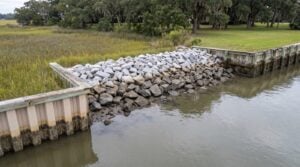
Water accelerates at the end of a hard surface, and the ground at the toe is where a ramp fails. Proper toe protection — riprap keyed in, a toe wall, or a sheet pile cutoff depending on the site — is what separates a ramp that lasts thirty years from one that undermines in eight. Our riprap guide covers stone sizing and how a revetment is keyed in.
Surface
Cast-in-place reinforced concrete with a broomed or grooved finish is the durable answer for permanent installations. Precast planks suit sites where the working window is tight or the tide limits pour time. Grooving direction and depth matter more than owners expect — it is the difference between a usable ramp and a liability claim.
Everything around the ramp
A launch is a system, not a slab. Courtesy or boarding docks alongside give people somewhere to hold the boat while the driver parks. Fixed timber or floating dockage, guide piles, lighting, bollards, signage, trailer parking with adequate turning geometry, and ADA-compliant access all shape whether the facility works in practice. For public facilities the parking layout is often the real bottleneck, not the ramp itself.
What we build
| Facility type | Typical scope |
|---|---|
| Municipal and county public launches | Single or multi-lane ramp, boarding docks, guide piles, toe protection, lighting, signage, ADA access |
| State and federal access sites | Ramp rehabilitation, toe extension, scour repair, dockage renewal |
| Marina and commercial launches | Ramp plus service dockage, fuel-dock adjacency, heavy-duty surfacing for repeat commercial use |
| HOA and community launches | Small-craft ramps, kayak and paddle launches, shared boarding docks |
| Kayak and paddlecraft launches | Low-freeboard floating launches, transfer benches, accessible entry |
| Emergency services and government | Hardened ramps for rescue craft and patrol vessels, all-tide access |
Ramp work commonly pairs with dockage, bulkheads, and pile-driven structures on the same site. Our overview of commercial marina construction in South Carolina covers the wider commercial and municipal scope, and marine pile driving underpins most of it.
Rehabilitating an existing ramp
A great deal of the public ramp stock on the South Carolina coast was built decades ago and is now working outside its design conditions — heavier trailers, larger vessels, more traffic, and in some locations a measurably different tidal regime. The common failure patterns are consistent:
- Toe undermining — a drop-off at the end of the slab, the classic cause of trailers falling off the end. Usually a scour protection failure.
- Slab cracking and settlement — from inadequate base preparation or loss of support beneath.
- Insufficient length for current low tides — a ramp that was adequate at design is now unusable for part of the day.
- Surface polishing — grooving worn smooth over years of use, creating a traction hazard.
- Failed or missing boarding dockage — pushing all handling onto the ramp itself and slowing throughput.
Rehabilitation is frequently far cheaper than replacement and can often be done within a single closure window if it is scoped properly. It is also, importantly, simpler to permit than new construction.
Permitting and procurement
Ramps and launches sit in the critical area and require authorisation from the South Carolina Department of Environmental Services Bureau of Coastal Management, with review by the U.S. Army Corps of Engineers Charleston District on most public projects. Public access facilities frequently involve South Carolina Department of Natural Resources as well, particularly where grant funding through the state’s boating access programme is in play, and federal Sport Fish Restoration funding brings its own requirements.
For public entities the practical consequences are worth planning around. Grant-funded projects carry documentation and procurement obligations that shape the schedule as much as the construction does. In-water work windows may be restricted seasonally for protected species. And rehabilitation of an existing facility is generally a shorter regulatory path than a new launch on a new site — a distinction that can be worth a fiscal year. Our permitting guide covers the state process in detail.
Working with public clients
Municipal and county work has requirements that residential work does not: bonding and insurance thresholds, prevailing wage where applicable, public-notice obligations, coordination with parks and public works schedules, and a real need to minimise closure time at a facility the public depends on. We have delivered projects under those conditions across the Lowcountry for two decades, and we plan the closure window as carefully as the construction.
Frequently asked questions
What slope should a boat ramp be?
For tidal applications on the South Carolina coast, a grade in the range of 12 to 15 percent works for most vessel mixes. Shallower ramps force tow vehicles too far into the water; steeper ramps make recovery difficult, particularly on a wet, algae-affected surface. The right figure for a given site depends on the local tidal range and the vessels the facility serves.
How far below the water should a boat ramp extend?
Far enough that a boat floats free of the trailer at the lowest working tide, which on the South Carolina coast means designing to the site’s actual tidal datum rather than a regional average. Under-extending the toe is the most common design failure and the most expensive to correct later.
How much does a boat ramp cost to build?
It depends almost entirely on site access, water depth, scour protection requirements, and whether boarding dockage and parking are in scope. A single-lane rehabilitation of an existing ramp is a very different project from a new multi-lane public facility with docks, lighting, and a trailer lot. A site assessment is the only honest basis for a figure.
Do I need a permit to build a boat ramp in South Carolina?
Yes. Ramps and launches are in the critical area and require authorisation from the South Carolina Department of Environmental Services Bureau of Coastal Management, with Army Corps review on most public projects and SCDNR involvement where public access funding is involved.
Can an existing ramp be extended rather than replaced?
Often, and it is usually the better value. Toe extension, scour repair, re-grooving, and dockage renewal can restore a facility for a fraction of replacement cost and within a shorter closure window. Rehabilitation is also generally simpler to permit than new construction.
What is a courtesy dock and does a ramp need one?
A courtesy or boarding dock alongside the ramp gives users somewhere to secure the boat while the driver parks the trailer. It is not strictly required, but at any facility with meaningful traffic it roughly doubles effective throughput and significantly reduces congestion and incidents on the ramp.
Planning a launch project?
Whether it is a new public facility, a rehabilitation with a tight closure window, or a community launch for a waterfront development, the useful conversation starts at the site with a look at the slope, the depth, and what the water is doing at the toe. Contact our team to discuss the project — we work with municipalities, counties, marinas, and developers across the South Carolina coast.