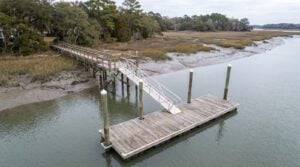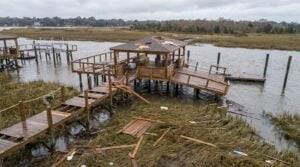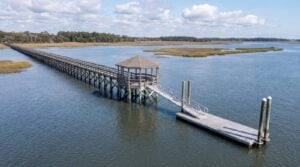
The question every waterfront owner asks first is how much a dock costs. The question they should ask second — and usually ask too late — is how long it takes. The answer surprises people: building the dock is the short part. Getting permission to build it is the long part.
For a straightforward private residential dock in the Charleston area, plan on nine to fifteen months from first conversation to finished structure. Roughly six to twelve of those months are permitting and design. Construction itself is typically four to ten weeks. Understanding where the time goes is what lets you start early enough to have the dock for the season you want it.
The timeline at a glance
| Phase | Typical duration | What is happening |
|---|---|---|
| Site assessment & concept | 2 – 4 weeks | Low-tide depth survey, marsh crossing measurement, concept layout |
| Survey & drawings | 4 – 8 weeks | Boundary and critical-area survey, engineered plan set |
| HOA / architectural review | 2 – 12 weeks | Runs in parallel where applicable; can gate everything |
| State critical area permit | 3 – 8 months | Application, completeness review, public notice, decision |
| Army Corps authorisation | Usually concurrent | Often a general permit; individual permits take far longer |
| Scheduling & mobilisation | 4 – 12 weeks | Barge and crew availability, material lead times |
| Construction | 4 – 10 weeks | Pile driving, framing, decking, ramp and float, utilities |
Phase one: understanding what the property will support
Nothing sensible can be designed until someone has stood on the property at dead low tide. That single visit answers the questions that drive both the design and the cost: how far the water is from high ground, how deep it is at the point you would want to moor, how wide the creek is, and where the critical-area line falls.
This phase takes two to four weeks mostly because it depends on tide timing. A useful low-tide visit needs a spring low in daylight, and those come in windows.
Phase two: survey and drawings
A permit application needs a plat showing property boundaries, the critical-area line, the proposed structure with dimensions, and the position of neighbouring docks. That means a licensed surveyor, and surveyor lead times in the Charleston market currently run three to six weeks in busy periods.
Once the survey is in hand, the plan set comes together relatively quickly — typically one to two weeks for a standard residential dock. The design work at this stage is where the decisions that matter get locked in: walkway length and height, pierhead size, whether there is a float or a fixed pierhead only, ramp length, and whether a lift is included. Changing any of those after submission means resubmitting.
Phase three: the permit, and why it takes months
Private docks in South Carolina’s coastal zone require a critical area permit from the state’s coastal management programme, now administered by the Department of Environmental Services. Most also require authorisation from the U.S. Army Corps of Engineers, usually under a general permit that runs concurrently.
The clock breaks down roughly like this:
- Completeness review — two to six weeks. The agency confirms the application has everything it needs. Incomplete applications restart this stage, which is the most common self-inflicted delay.
- Public notice — typically 30 days, during which adjacent property owners and the public may comment.
- Agency review — one to four months. Longer where the project sits near a shellfish bed, a navigation channel, an established marsh island, or where a neighbour has objected.
- Decision and issuance — weeks.
Objections from adjacent owners are the biggest single variable. A dock nobody contests can clear in three to four months. One that draws a neighbour’s objection over view, access or creek crowding can run past a year. Our full guide to OCRM and DHEC permitting for Charleston waterfront construction covers what agencies look for and how to avoid the common rejections. Current application forms and process guidance are published by the South Carolina Department of Environmental Services.
The HOA timeline nobody plans for
In Kiawah, Seabrook, Daniel Island, Dunes West, Rivertowne, Wild Dunes and dozens of other communities, an architectural review board has its own say over dock height, roof form, materials, railing style and lighting. These boards often meet monthly. A submission that misses a meeting date waits four weeks for the next one, and a request for changes can cost two cycles.
Start the HOA process at the same time as the state application, not after it. We have seen more projects delayed by a missed architectural review meeting than by any agency.
Phase four: scheduling and materials
A permit in hand is not a crew on site. Marine construction in the Lowcountry is barge work on most properties, and barge and crane availability is the real constraint on start dates. Reputable builders in this market run four to twelve weeks out, and longer in spring when everyone wants a dock for summer.
Material lead times add their own weight. Aluminium gangways and float systems are frequently made to order with six to ten week lead times. Boat lifts of a specific capacity can run longer. Ordering those the week the permit is issued, rather than the week before mobilisation, saves a month.
Phase five: construction
Once the crew is on site, a typical private dock goes up in this order:
- Pile driving — one to three weeks. Pilings are driven to refusal in competent soil below the pluff mud. Deep mud, hard strata or tight barge access all extend this. We cover the methods in detail in our marine pile driving guide.
- Framing — one to two weeks. Stringers, joists and bracing, set to the permitted deck elevation.
- Decking and rails — one to two weeks.
- Ramp, float and lift — several days to a week once components are on site.
- Utilities and finish — days. Conduit, lighting, water, cleats, ladders, benches.
Weather governs all of it. Marine crews work tide windows, and a stretch of high wind or heavy rain simply removes working days. Between June and November, tropical systems can cost a week at a time. A four-week dock in March can honestly be a seven-week dock in September.
How to compress the timeline
You cannot make an agency move faster, but you can avoid adding months to your own project.
- Start in autumn for a summer dock. An application submitted in October is realistically a dock finished the following summer. One submitted in March is not.
- Order the survey early. It gates everything downstream and has the longest lead time of anything you control.
- Submit HOA and state applications in parallel.
- Talk to your neighbours before you submit. An objection resolved over a fence in April is cheaper than one resolved through an agency in November.
- Submit a complete application. The single largest avoidable delay in this process is a file returned for missing information.
- Fix the design before submission. Adding a lift or lengthening the pierhead after the permit is issued means a modification and more waiting.
Frequently asked questions
Can I start construction before the permit is issued?
No. Unpermitted work in the critical area carries removal orders and penalties, and it complicates every future permit on the property. There is no version of this that ends well.
How long does a dock repair take compared to a new build?
Far less. Repairs and re-decking within an existing permitted footprint often need no new permit and can be scheduled in weeks rather than months. See our guide to dock piling repair and replacement.
Does a commercial or municipal project take longer?
Usually yes. Larger structures, deeper environmental review and public procurement all add time — twelve to twenty-four months is common. Our commercial marina construction guide covers that process.
What time of year is best to build?
Late autumn through early spring. Lower storm risk, better crew availability, and low spring tides that make marsh work easier. It is also the quietest season on the creeks.
How long is a permit valid once issued?
Typically several years, with extension available. There is no need to rush construction the moment it lands — but do not let it lapse, because reapplying means starting the clock again.
Planning your build
The owners who end up happiest with their docks are the ones who started the conversation a year before they wanted to use it. Everything about this process rewards early, unhurried decisions and punishes late changes.
If you are thinking about a dock for next season, now is the right time to walk the property. Get in touch and we will give you a realistic timeline for your specific creek before anything is designed.