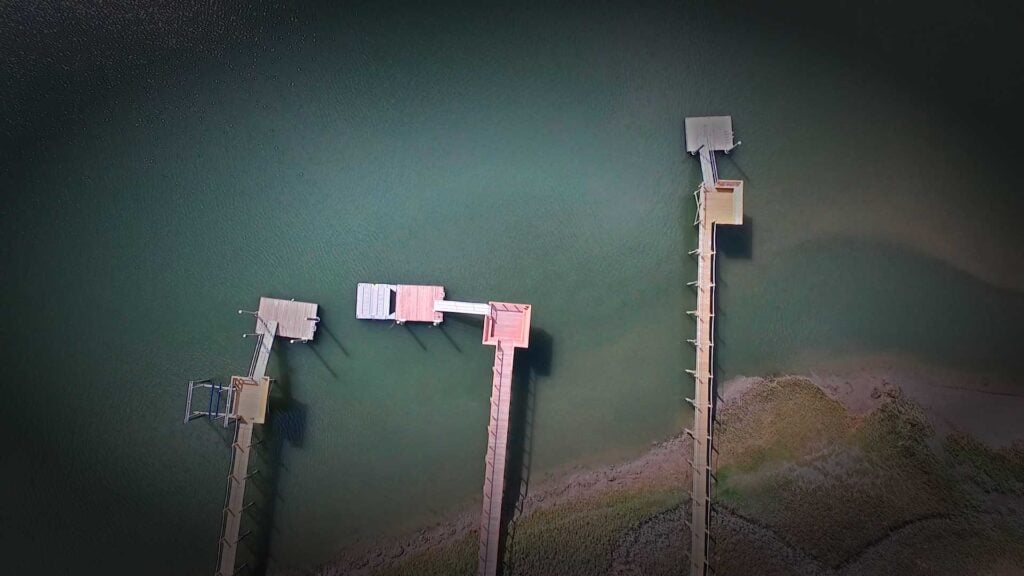
There is no single dock piling installation cost in the Lowcountry, and any contractor who quotes a per-pile price over the phone is guessing. What a pile costs to put in the ground comes down to how deep it has to go before it holds, how the crew reaches it, how long and heavy the pile has to be, and what has to happen before the work can legally start. Two docks a mile apart on the same creek can price very differently for reasons a homeowner can see from the dock. Here is what moves the number on a Charleston-area dock.
What a Piling Quote Actually Covers
A piling quote is rarely just the piling. It usually includes moving equipment to the site, driving each pile to the depth where it stops, cutting the tops to a consistent elevation, bracing or capping them, the hardware that ties the structure back together, and hauling off whatever came out. Those pieces move independently of each other. A dock that needs four new pilings in an easy spot can cost less per pile than a dock that needs two in a hard one, which is why a flat per-pile figure tells you so little. Our page on marine pile driving in Charleston walks through how a pile actually goes into the ground, and most of the money lives in that sequence rather than in the wood itself.
Depth to Refusal Is the Biggest Unknown
Every pile has to reach material dense enough to carry the load above it. Crews call that point refusal: the depth where the pile stops advancing under the hammer. Along Charleston’s tidal creeks that usually means pushing through pluff mud, the soft organic muck that lines our marsh banks, before anything firm shows up.
Nobody can read that depth from shore, and it does not stay constant across a property. The landward end of a walkway and the outer end of a floating pier can refuse at different depths on the same dock. Deeper refusal means longer piles, more time on the hammer, and sometimes a heavier pile than the one in the original quote. That is the single biggest reason two honest estimates for the same job can differ, and it is worth asking any contractor what they expect in your creek and what happens to the price if the ground surprises them.
How the Crew Reaches the Pilings
Access is the second lever. A pile a machine can reach from high ground is a different job from one that has to be driven from the water. Working from the water means floating equipment in, setting up, and working inside the window the tide allows, and in tidal waters that swing several feet twice a day, that window can be short. Mobilizing to a site is usually priced once, which is part of why replacing six pilings in a single visit costs less per pile than replacing two now and four next spring. Narrow creeks, shallow approaches, overhead power lines, and a neighbor’s dock in the way all cost time, and time is what you are buying.
Pile Length, Class, and Material
Pilings are sold by length and by class. For timber piles, class sets the minimum circumference at the tip and butt under ASTM D25, so a higher class means a thicker, stronger pile. A longer, heavier pile costs more before anyone touches it, and a site with deep refusal needs both. Treated southern yellow pine is the common choice on Lowcountry docks, and it is what most structures here already stand on. Concrete and composite-jacketed options exist and cost more up front. Marine helical pile foundations are a different approach again, turned into the bottom rather than driven, and they are worth asking about where driving is awkward. Whatever goes in, salt and marine borers go to work on it at the waterline and below, so the pile you pick is a long-term decision rather than a line item.
Replacing a Pile, or Saving It
The cheapest pile is often the one that stays. A pile with surface checking and some loss at the waterline is not automatically a pile that has to come out. Jacketing, splicing, or adding a sister pile alongside can carry a structure for years, and each of those costs less than driving new. The judgment call is whether enough sound wood remains below the damage. Our guide to judging a dock pile after storm season covers what to look at before you decide, and dock piling repair and replacement explains what each route involves. Get that call right and the quote changes shape, because repair work rarely needs the same equipment driving does.
The Permit Clock Belongs in the Budget
Work in South Carolina’s critical area, which takes in the tidelands, marsh, and waters the state regulates, generally needs a permit from the South Carolina Department of Environmental Services (SCDES) Bureau of Coastal Management, formerly known as OCRM, before a crew can start. Federal review by the U.S. Army Corps of Engineers may also apply to work in navigable waters. Like-for-like repair and new construction are not treated the same way, and the path your project falls into affects both the paperwork and the calendar. Our OCRM critical area permit guide for Charleston lays out how the process runs. The real cost here is usually timing rather than fees: an approval that lands mid-season can push a job past the window you hoped to work in, and a dock that waits another winter is a dock that keeps giving ground.
Reading Two Piling Quotes Side by Side
When the numbers come back, compare what sits behind them. Does the quote name the pile length and class, or only a count? Does it say what happens if the piles refuse shallower or deeper than expected? Who pulls and disposes of the old pilings? Is the permit work in the price or yours to handle? Does it include guide pilings for a floating dock, the vertical piles a float rides up and down on, or only the structural ones? A low number with none of that spelled out is not a lower price, it is an unfinished one. How to choose a dock builder in Charleston goes further into the questions worth asking.
Getting a Number for Your Own Dock
A real figure comes from someone standing on your dock at low tide. BluTide Marine works on waterfront structures across the Lowcountry and Southeast South Carolina, from community docks, a boat landing, and pond docks at Kiawah River to dock and floating pier construction at Higgins Pier and the beach boardwalk on Seabrook Island. Out of Johns Island, we build for Charleston’s coastal climate from the waterline up, because that is the water these structures have to live in. If you came out of this storm season looking at pilings you are not sure about, send us the details of your dock and we will tell you what the work involves before we tell you what it costs.
Frequently asked questions
How much does it cost to put in pilings?
There is no honest flat rate, and the per-pile numbers you find in forums usually come from other states and other bottoms. On a Charleston-area dock the price follows how deep each pile has to go before it refuses, whether the crew works from land or from the water, and the length and class of pile the site calls for. A contractor who has driven in your creek can price it after a site visit; one who quotes before seeing it is guessing.
How much does a 30 foot dock cost?
Length alone does not set the price. A 30-foot walkway over firm ground with easy access is a far smaller job than 30 feet of structure reached by water across soft marsh, even though the dimension on paper is the same. The pile count, the depth each one has to reach, and the permit path matter more than the footage. Ask for a quote that shows those items separately so you can see what you are paying for.
What is a piling in the water?
A piling is a vertical post driven into the bottom until it reaches material dense enough to hold the load above it. The pilings are the foundation of a dock, a pier, or a boat lift, and everything else is built on top of them. On a floating dock, some pilings carry no deck at all; they are guide pilings, and the float rides up and down on them with the tide.