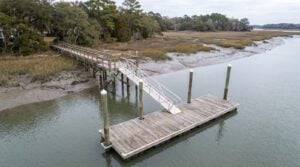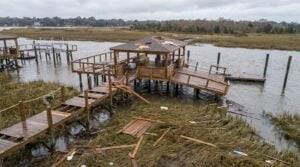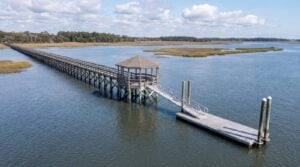
What to do when a storm damages your dock
Storm damage dock repair in Charleston follows a predictable order: make the structure safe, document everything before you touch it, get a professional assessment of what is actually load-bearing, and only then decide between repair and replacement. Getting that order wrong is what turns a recoverable dock into a total loss — or an insurable claim into a denied one.
September is the peak of the Atlantic hurricane season, and in the Lowcountry the damage that follows a storm is rarely the damage you can see from the bank. Decking splinters and handrails go missing, and those are obvious. What matters more is what happened below the waterline to the pilings, and whether the structure that looks intact is still connected to anything.
First: what is safe to walk on
Do not walk out onto a storm-damaged dock to assess it. This is the most common and most dangerous mistake owners make. A dock can look sound from shore and have lost the connection between its stringers and its pilings — a decked-over structure holds its shape long after it has stopped being supported.
Signs that a dock should be treated as unsafe until a professional has looked at it:
- Any piling that has visibly shifted, tilted, or changed height relative to its neighbours
- Decking that flexes, springs, or sounds hollow underfoot near the bank — the point where you would first step on
- Gaps opening between the walkway sections, or a walkway that is no longer straight
- A float that has ridden up out of its guide pilings, or a ramp that has come off its hinge or roller
- Exposed or dangling electrical, whether or not the breaker is off
- Debris pinned under the structure — a floating log or a displaced boat trapped beneath a dock exerts enormous uplift on the next tide
If the dock serves the only water access to a property, or if a vessel is trapped against it, treat that as an emergency and call a marine contractor rather than attempting to free it yourself.
Second: document before you clear
Insurers and adjusters want to see the damage in the state the storm left it. The instinct to tidy up is understandable and it costs people money.
Before anything is moved:
- Photograph the full structure from the bank, from both sides, and from the water if you can do so safely
- Photograph each damaged element close up, with something in frame for scale
- Photograph the pilings at the waterline, and again at low tide if the schedule allows — low tide is when piling damage becomes visible
- Record the date and time, and keep the storm’s official record. The National Hurricane Center advisory archive establishes wind and surge conditions for your location on the day
- Find your original dock permit, construction drawings, and any prior repair invoices — these establish what was there before
Only then clear debris, and only debris that can be removed without going onto the structure.
A note on insurance
Dock coverage is inconsistent. Many homeowner policies exclude structures over water entirely, or cap them at a small percentage of the dwelling limit. Flood policies and windstorm policies frequently treat dock damage differently, and surge damage is often handled separately from wind damage. Read the declarations page before you assume you are covered, and be aware that a professional damage assessment from a licensed marine contractor carries more weight with an adjuster than an owner’s description does. We are not insurance advisers — but we write a lot of assessments, and the ones that get paid are the ones with photographs, measurements, and a clear repair-versus-replace rationale.
Third: the professional assessment
A proper post-storm assessment looks at four things in order, because each one determines whether the next one matters.
1. The pilings
Everything else rests on these. A piling can be sound above the water and compromised below it, where surge-driven debris does its work and where marine borers exploit any breach in the treated shell. An assessment checks plumb, embedment, section loss at the mudline and the waterline, and whether the storm has scoured sediment away from the base. If pilings have moved, nothing above them can be trusted. Our guide to dock piling repair and replacement covers what can be saved and what cannot, and this piece on marine piling repair goes into the failure modes in more detail.
2. The connections
Bolts, brackets, and straps take the load in a storm. Hot-dip galvanised hardware that has been working loose for years often lets go under surge. Elongated bolt holes, sheared fasteners, and separated stringer-to-piling connections are the difference between a dock that needs decking and one that needs rebuilding.
3. The framing and decking
The visible layer, and usually the least important structurally. Replacing boards is straightforward. Replacing them on a compromised frame is money spent twice.
4. The float, ramp, and lift
Floats that have jumped their guides usually need the guides re-driven, not just the float reset. Ramps that have come off their bearing need the bearing points inspected. Boat lifts take storm loads badly — cables, motors, and cradle beams should all be checked before the lift carries a boat again. See our guide to boat lifts in Charleston for what a sound installation looks like.
Repair or replace?
The rule of thumb we use: if the pilings are sound and plumb, almost everything above them can be repaired economically. If more than roughly a third of the pilings need replacing, a rebuild usually costs less than a phased repair and gives you a structure with a single, known age rather than a patchwork of decades.
| Condition found | Usual path |
|---|---|
| Decking and handrail damage, pilings plumb and sound | Repair — often within days |
| Isolated piling damage, 1–3 pilings | Repair — replace or sleeve affected pilings, re-set framing above |
| Connection failures across multiple bays, framing intact | Repair — re-hardware and re-tie the structure |
| Widespread piling movement or scour, or structure off alignment | Replace — a partial fix will not hold |
| Pre-storm structure already past service life | Replace — and take the opportunity to size it correctly |
There is a permitting dimension to this decision. Repair in kind is generally simpler to authorise than replacement, and replacement that changes footprint or configuration is treated as new construction by the state. That distinction can be worth months. Our coastal permitting guide explains where the line falls, and the current requirements are published by the South Carolina Department of Environmental Services Bureau of Coastal Management.
What we can usually do quickly
In the weeks after a named storm, marine contractors across the Lowcountry are working through a queue, and the honest position is that everyone is triaging. Emergency stabilisation — making a structure safe, securing a float, removing a trapped vessel, isolating electrical — moves ahead of cosmetic work. If your dock is unsafe or your boat is at risk, say so when you call; that is genuinely a different queue.
Full repairs typically begin once assessments are complete and, where insurance is involved, once the adjuster has been out. Building the relationship before the storm is worth something here — owners with a documented pre-season inspection on file move faster through both the insurance process and the repair schedule. Our pre-season preparation guide covers what to do in advance, and our dock inspection checklist is the annual walk-through that produces that documentation.
Seawalls and bulkheads after a storm
Dock damage gets the attention because it is visible. Seawall and bulkhead damage is often more consequential and easier to miss. Look for soil settling or sinkholes behind the wall — a sign that fill is escaping through a breach — for cap separation, for tie-back failure showing as outward lean, and for scour at the toe. A wall that has lost material behind it will keep losing it with every tide until it is addressed. If you are weighing what to rebuild with, our comparison of bulkheads, seawalls and riprap lays out the options, and this piece on shoreline protection covers the fundamentals.
Frequently asked questions
Is my dock safe to walk on after a hurricane?
Assume it is not until a professional has assessed it. Storm-damaged docks routinely retain their shape after losing structural connections, so a dock that looks intact from the bank can fail under load. Tilted or shifted pilings, springy decking, gaps between walkway sections, and debris trapped underneath are all reasons to stay off.
Does homeowners insurance cover dock damage in South Carolina?
It varies significantly. Many homeowner policies exclude structures over water or cap them at a small share of the dwelling limit, and wind, flood, and surge damage are often handled under different policies. Check your declarations page, photograph everything before clearing debris, and get a written assessment from a licensed marine contractor to support the claim.
How much does storm damage dock repair cost in Charleston?
Decking and handrail repairs on a sound structure often run a few thousand dollars. Piling replacement moves the figure substantially because it requires a barge and pile-driving equipment. Where widespread piling movement has occurred, a rebuild frequently costs less than a phased repair — a proper assessment is what tells you which situation you are in.
What should I photograph after storm damage?
The whole structure from shore and both sides, each damaged element close up with something for scale, and the pilings at the waterline and again at low tide. Keep the storm’s official advisory record and your original permit and construction drawings. Photograph before you clear any debris.
How long does dock repair take after a major storm?
Emergency stabilisation can usually happen within days. Full repairs depend on the assessment queue, insurance timelines, and whether new permitting is required — repair in kind is faster to authorise than reconfiguration. After a named storm affecting the whole region, expect the schedule to reflect a queue.
Can damaged pilings be repaired instead of replaced?
Sometimes. Pilings with limited section loss above the mudline can often be sleeved or wrapped. Pilings that have shifted, lost embedment, or suffered scour at the base generally need replacing, because the problem is not the timber — it is what the storm did to the ground holding it.
If your dock took damage, call us
We assess storm-damaged docks, seawalls, and bulkheads across Charleston and the Lowcountry for residential owners, marinas, and municipalities, and we write the kind of documented assessment that insurers act on. If the structure is unsafe or a vessel is at risk, tell us when you get in touch and we will prioritise it. Reach out to our team and we will get someone out to look at it.