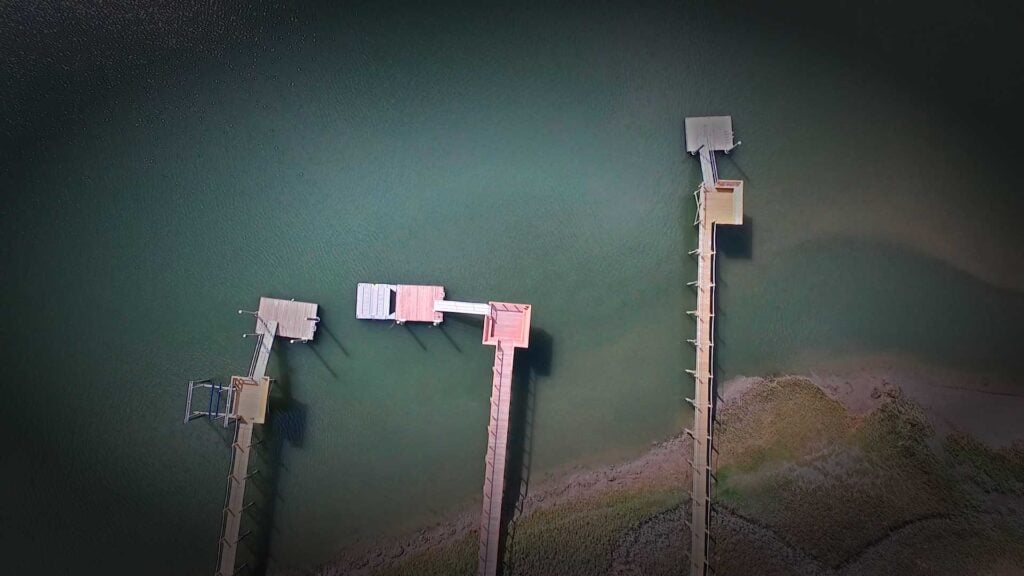
A Charleston County dock permit is really two or three approvals wearing one name, and the part owners underestimate is not the fee. It is the calendar. The state reviews the structure in the water, the county or your town reviews the building of it, and the application fees are small next to what a lost building season costs. Most private dock reviews in the Lowcountry run in months, not weeks. That is why an application filed in the fall is what makes a spring build possible.
What a Charleston County dock permit covers
Nearly every dock here is built in what South Carolina calls the critical area: the coastal waters, tidelands, and marsh below the high-water mark. That ground belongs to the state rather than to your deed, so a private dock needs state authorization before a single piling goes in the mud.
Critical area permitting is handled by the Bureau of Coastal Management, the OCRM office waterfront owners still call by that name, inside the South Carolina Department of Environmental Services. Older paperwork and older articles say DHEC; the coastal program now sits in DES, and the review covers the same ground. Our guide to the OCRM critical area permit walks through the application itself.
Three approvals, not one
Owners usually find out about the second and third approvals after they think they are finished.
- State critical area permit. Reviews what the structure does to tidal water and marsh: where the walkway crosses, how long it runs, how far the float sits from the channel, and what your property lines and your neighbors’ setbacks allow.
- Federal authorization. Structures in navigable waters also answer to the U.S. Army Corps of Engineers. For routine private docks that review commonly runs alongside the state’s rather than after it, but it is a separate authority with its own standards.
- Local building permit. Charleston County Building Inspection Services issues building permits for unincorporated county property. If your address is inside Charleston, Mount Pleasant, Isle of Palms, or another municipality, that city or town issues it instead. County building fees are calculated from the project’s construction valuation rather than charged as a flat rate, so a larger dock carries a larger permit.
Add a layer if you live under architectural review. Many Lowcountry communities, island neighborhoods like Kiawah and Seabrook among them, review dock design themselves, and that approval often has to come first. Shared structures carry the most process of all, which is its own subject in community dock construction in South Carolina.
What the paperwork actually costs
State application fees are published, and they are smaller than most owners expect. The Bureau of Coastal Management charges a non-refundable administrative fee in the low hundreds of dollars for a minor activity, with a reduced fee for docks whose walkway runs less than 100 feet, and a separate lower flat fee where the work qualifies under the standing general permit for docks. Replacing or reconstructing an existing structure has its own general permit and its own fee. Those amounts are revised from time to time, so confirm the current fee schedule before you write the check.
The real money sits around the application rather than in it: a current plat, a surveyed drawing of the proposed structure, and sometimes water-depth information. After that comes the structure itself, which depends far more on the dock dimensions that suit Lowcountry water than on anything a reviewing agency charges.
How long approval takes
For an uncomplicated private residential dock, published Lowcountry guidance puts state review at several months from a complete application, and marine contractors here commonly tell owners to plan on four to six. None of that means something went wrong. It is the normal clock, and it starts only once the application is genuinely complete.
So work backward from the water instead of forward from the paperwork. An application filed in October puts a permit in your hand near the start of the spring building season, which is also when crews and barges book up. Once approvals are issued the build is the shorter chapter, and how long a dock build takes in Charleston is the part of the schedule you can plan around.
What slows an application down
Almost every delay traces back to one of four things.
- A drawing that does not match the plat, or a plat too old to show the current marsh edge.
- A structure that reaches farther into the creek than review will support, which sends you back to redraw rather than to argue.
- Property-line and joint-use questions. Narrow lots on a shared creek often cannot each support a separate dock.
- Choosing the structure late. Fixed or floating changes the footprint under review, so settle it first; our comparison of fixed and floating docks in Lowcountry tides is the place to start.
The answer to all four is the same. Decide what you are building, draw it accurately, and file it once.
Why the wait is the expensive part
A permit clock is not only a delay. It decides which season you build in and what condition your waterfront is in when the next storm season arrives. File in October and you build in spring. Wait until February and you are looking at next fall with a hurricane season in between, which is how an aging dock becomes something you are documenting and claiming after storm damage instead of using. Repairs follow the same logic: replacing one failing piling under a reconstruction general permit is a far shorter conversation than replacing the deck that followed it into the water.
Start with the structure, then the paperwork
The order matters. Owners who arrive with a clear picture of what they want, including length, decking, a lift, a boathouse, and how the float will handle a Lowcountry tide swing, get a drawing that survives review. Owners who file first and decide later tend to file twice.
BluTide Marine builds from the waterline up in these waters, working out of Johns Island across Charleston and the Lowcountry into southeast South Carolina: the community dock, boat landing, and pond docks at Kiawah River, dock and floating pier construction at Higgins Pier, the beach boardwalk on Seabrook Island. That range matters before anything is filed, because the structure that clears review is not always the one first sketched on a napkin. Tell us what you want on the water and we will talk through what it takes to build it. Get in touch with BluTide Marine while there is still fall left on the calendar.
Frequently asked questions
What happens if you build a dock without a permit?
An unpermitted structure in the critical area is an enforcement matter for the state, and the usual outcome is the one owners least want: an order to remove or restore what was built, plus penalties. It also follows the property. Unpermitted work tends to surface during a sale, an insurance claim, or a later permit application, and it has to be resolved before anything else moves. If you inherited a structure you are unsure about, ask the Bureau of Coastal Management what is on record for your parcel before you add to it.
Do I need a permit to repair or replace an existing dock?
Usually yes, though often on a shorter track. South Carolina maintains general permits for reconstruction of existing structures, which exist precisely because replacing in kind is a narrower question than building new. Routine maintenance such as swapping deck boards is treated differently from replacing pilings or rebuilding a walkway. Describe the work accurately to the permitting office first, because a repair that grows into a replacement mid-project is the version that stalls.
Who issues a dock permit, the state, the county, or the city?
All of them, for different things. The state’s Bureau of Coastal Management authorizes the structure in the critical area, the U.S. Army Corps of Engineers covers federal interests in navigable waters, and the building permit comes from Charleston County Building Inspection Services or from your municipality if your property sits inside city or town limits. A community with architectural review adds a fourth approval, and it often needs to be the first one you get.
Can I apply for a dock permit myself?
Yes. An owner can file the application. What it needs is accuracy more than expertise: a current plat, a drawing of the proposed structure that matches it, and a clear description of what you intend to build and where. Most of the back-and-forth that stretches a review out comes from drawings that do not match the site, so whoever prepares yours should know the waterway and the current marsh edge.
Does a dock on a freshwater pond need a critical area permit?
Generally no. A pond above the high-water mark sits outside the critical area, so the state coastal review that governs tidal docks usually does not apply. A local building permit and community architectural review still can, and a pond dock carries its own structural questions about bank stability and water level. Check with the permitting office for your address rather than assuming either way.