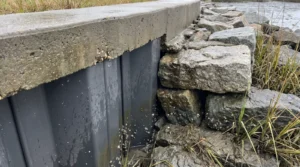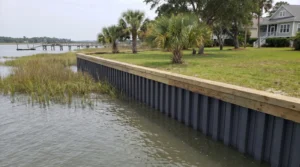
A storm moves through, the tide falls back, and the dock is not where you left it. Before you pull a single board out of the marsh, know this: a dock damage claim is built almost entirely from what you record in the first day or two — photographs with the waterline visible, measurements, and a written list of what is missing. Coverage for docks varies more than most owners expect, and the repair cost depends on what happened under the water as much as on what you can see from the deck.
First make it safe, then make the record
Do not step onto a deck whose pilings have shifted. A dock can look intact and be held up by little more than friction after surge has scoured the mud away from its posts. If the structure carries lights or outlets, shut that circuit off at the house panel before anyone walks out. Loose floats, snapped lines, and a gangway sitting at a new angle are all reasons to stay on land and work with a camera instead.
On a floating pier, pay attention to the guide pilings — the vertical posts the float rides up and down on as the tide moves. Charleston’s tidal waters swing far enough that a float pushed above its guides by surge can come back down in the wrong place, bent hardware and all. That damage is easy to miss from shore and expensive to ignore.
What to document before you file a dock damage claim
Adjusters work from evidence, and the evidence disappears as soon as cleanup starts. The National Association of Insurance Commissioners publishes a post-disaster claims guide, and state insurance departments say the same thing in their own words: report the loss promptly, photograph everything, and keep damaged material until the adjuster has seen it or has told you in writing that you can clear it.
Photograph and film more than you think you need
- Wide shots from shore that show the whole structure and the waterline, then close shots of every break.
- Video walking the length of the dock, saying out loud what you are looking at and the date.
- The marsh and creek around the dock, where floats, boards, and hardware end up.
- Anything that shows the force involved: debris wedged under the frame, a mud line on a piling, a bent lift beam.
Measure and count
- How many pilings moved, leaned, or broke, and where on the structure each one sits.
- Length and width of every missing or damaged section of decking and framing.
- Model plates and serial numbers on a boat lift, plus the condition of its cables and motor.
- Water depth at the end of the dock at low tide, if you can take it safely.
Find the paper
Your declarations page, the original build or repair invoices, any permit records, and photos taken before the storm are what turn “the dock is damaged” into a documented loss with a known starting condition. A dated set of inspection notes, the kind our fall dock inspection and maintenance checklist produces, can be worth as much as the storm photos, because it shows the structure was sound before the weather arrived.
What storm repair costs, and what drives the number
There is no honest single price for storm repair, because two docks on the same creek can need very different work. What moves the number:
- Pilings. New posts need a rig on the water or on the bank, and moving that equipment in costs much the same whether you replace two pilings or ten. Dock piling repair and replacement is usually the biggest line on the estimate.
- Access. A dock a barge can reach is one job. A dock at the end of a narrow marsh crossing is another.
- Whether the frame is still square. Decking is straightforward work. A racked frame or a twisted stringer means more comes apart than you first thought.
- Equipment. Lifts, power, and water lines each bring their own trade. Salt water driven in by surge often means boat lift cable replacement even when the lift still runs.
- Repair or rebuild. Past a certain amount of damage, patching year after year costs more than rebuilding once, from the waterline up.
For a sense of how those pieces price out in normal conditions, our breakdown of what a boat dock really costs covers the same materials and labor a storm repair draws on.
The damage you cannot see from the deck
Surge does its worst work below the waterline. A piling can stand plumb and still be loose in the mud, its holding strength cut by scour nobody can see at high tide. Through-bolts stretch. Anchor-and-chain mooring hardware on a floating pier — the chain and fittings that hold a float in position against the tide — takes a shock load and comes out of it deformed. Timber that stayed submerged longer than it was built to be keeps salt water in its checks and starts giving way from the inside.
That is why a claim written only from what is visible tends to come up short. Have the structural and below-water condition assessed before you agree on a scope of work, and get that assessment in writing, so there is something solid to reopen the file with if more shows up once the work begins.
Repairs, permits, and the cost of waiting
In South Carolina, work on the water happens inside a regulated critical area, and whether a job counts as repair in kind or as new construction decides how much review it needs. Our OCRM critical area permit guide explains where those lines fall, and the companion piece on what a Charleston County dock permit costs and how long approval takes covers the clock you are working against if a storm turned your repair into a rebuild.
That clock is the real argument against waiting. Atlantic hurricane season runs from June 1 through November 30, so a dock left compromised in early October still has weeks of exposure in front of it. A leaning piling is a repair. The same piling, after it drops a deck section into the creek, is a rebuild with a permit review attached. Getting ahead of it before the season closes is the same thinking behind hurricane prep for docks and seawalls.
Getting a number you can hand to an adjuster
An adjuster will ask for a repair estimate from a contractor who works on the water. BluTide Marine builds and repairs these structures across the Lowcountry — community dock, boat landing, and pond dock construction at Kiawah River, dock and floating pier work at Higgins Pier, and the beach boardwalk on Seabrook Island — so an assessment here accounts for tide, access, and salt rather than a generic climate. If your dock took damage this season, send your photographs and measurements through our contact page and ask for a written assessment of storm damage dock repair in Charleston.
The record you make today is what the claim rests on, so make it before anything moves. This article is general information about documenting damage, not insurance advice: your policy, your declarations page, and your own agent govern what is covered.
Frequently asked questions
How long after storm damage can I claim?
Most property policies require notice promptly, or as soon as practicable, rather than within a fixed number of days, and some add a separate deadline for hurricane and windstorm losses. Your declarations page and your agent are the authority on your policy. The practical answer is to report the loss as soon as it is safe to look at the dock, because the photographs and measurements you take in the first day or two are the strongest part of the file.
Does homeowners insurance cover dock damage?
Sometimes, and it varies widely. A dock is often treated as a detached or other structure, with its own limit that may be a fraction of the coverage on the house, and some policies limit or exclude structures over the water. Wind damage and flood or surge damage are also frequently handled under different policies, so which one applies can decide whether a claim goes anywhere. Read the other structures section of your policy before a storm, not after one.
How much does it cost to fix a dock after a storm?
It depends on how many pilings have to be driven, how a crew and equipment reach the site, whether the frame is still square, and whether a lift, power, or water lines were damaged. Mobilizing pile-driving equipment is a large fixed part of the cost, which is why replacing two pilings is not a fifth of the price of replacing ten. The way to get a real number is a written assessment that includes the below-water condition.
What should I avoid saying to an insurance adjuster?
Stick to what you observed and recorded. Guessing at the cause, estimating the repair cost off the top of your head, or volunteering that the dock was already getting old can all be read back to you later as an admission. Describe what the dock looked like before, what it looks like now, and let the photographs and a contractor’s written estimate carry the rest.
Should I clear damaged dock material before the adjuster visits?
Leave it in place when you safely can, and photograph it where it sits first. Debris that is a hazard to boats or neighbors may have to be recovered sooner; if so, document where each piece was found and keep it on your property until the claim is resolved. Clearing material early is one of the most common ways owners weaken a file that was otherwise well documented.