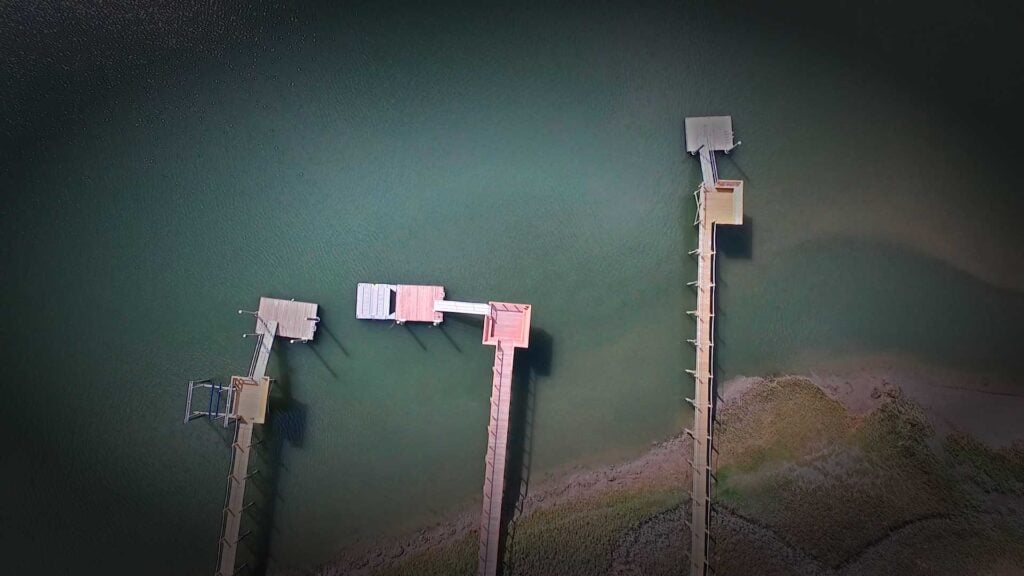
Building public fishing piers and kayak launches in South Carolina: a guide for municipalities and developers
Public access to the water is one of the things that defines coastal communities. A fishing pier, a kayak launch, or a boardwalk lets residents and visitors reach the creek or river without owning a dock, and for a town, county, park district, or waterfront developer, these facilities do real work: they support recreation, tourism, and local businesses. They are also public structures with public-safety obligations, which changes how they are planned and built.
This guide is for municipal staff, parks departments, HOA boards, and developers considering a public or shared water-access facility in the Charleston area and along the South Carolina coast. It outlines the main decisions, the approvals involved, and what separates a facility that serves a community for decades from one that becomes a maintenance burden.
Start with the purpose and the users
The right design starts with who will use the facility and how. A fishing pier has different needs from a paddle launch, and both differ from a boat ramp. Questions to settle early:
- Who is the intended user: anglers, paddlers, boaters, sightseers, or all of them?
- How many people at peak times, and what are the safety and crowd-control needs?
- What accessibility is required? Public facilities generally need to consider ADA accessibility for routes, ramps, and launch surfaces.
- Is lighting, seating, rails, cleaning stations, or parking part of the program?
- What are the hours, supervision, and maintenance arrangements?
Site conditions that drive design
On the Lowcountry coast, the tide range of roughly five to six feet is the defining condition. A kayak launch must work at low tide and high tide, which affects slope, length, and the choice between fixed and floating components. Currents, wave exposure, boat traffic, marsh edges, and soft soils all shape the structural design. A site investigation and, for larger projects, geotechnical borings give the engineer what they need to size foundations. Our overview of boat ramp and launch construction covers many of the same site considerations.
Structural options
The structure carries public loads and must stand up to salt, storms, and constant use, so material and foundation choices matter.
- Driven piles. Timber, steel, concrete, or composite piles driven to design depth support most piers and boardwalks. See marine pile driving for how piles are selected and installed.
- Decking. Treated timber, composite, and other materials each trade off cost, appearance, traction, and maintenance. Our comparison of decking for saltwater applies here too.
- Floating components. Floating launches rise and fall with the tide and are common for paddle access. They need robust guide pilings and a well-designed gangway. Our guide to floating dock mooring systems explains how they are held in place.
- Hardware and fasteners. Specified for corrosion resistance and public-use loads.
- Railings and safety features. Designed for public use, with appropriate heights, spacing, and edge protection.
Permitting and approvals
Public structures in tidal waters generally require authorization from the Office of Coastal Resource Management (OCRM, part of the South Carolina Department of Environmental Services) and from the U.S. Army Corps of Engineers Charleston District, along with local planning and building approvals. Public projects can involve additional requirements, such as environmental review where state or federal funding is used. Start early, and begin conversations with the agencies during concept design. Our guides to OCRM critical area permits and permitting for waterfront construction outline the process, and the commercial waterfront construction guide covers broader considerations for non-residential projects.
Designing for storms and long service life
Public structures must be built for conditions that will arrive eventually. Design for wind and surge exposure, specify materials that tolerate salt, and detail connections so they can be inspected and maintained. Think about what happens in a hurricane: breakaway elements, removable decking, and elevations that reduce damage are all strategies worth discussing with the engineer. Our storm preparation guide and storm damage guide give useful background.
Plan the maintenance from day one
The lifetime cost of a public facility is mostly maintenance. Agree on an inspection schedule, budget for decking and hardware replacement, and keep the as-built drawings and permit documents where staff can find them. Many agencies pair construction with a written maintenance plan. Our inspection checklist shows the kind of structured review a public pier benefits from.
Marinas, landings, and larger waterfront projects
Where a project grows from a pier or launch into a marina or mixed-use waterfront, the scale and complexity increase. See our overview of commercial marina construction for how larger projects are planned.
Frequently asked questions
How much does it cost to build a fishing pier?
Cost varies widely with length, width, water depth, foundation type, materials, accessibility features, and permitting. A concept design and engineer’s estimate for your site will give a more reliable number than a general range.
What permits are needed for a public pier in South Carolina?
Typically OCRM authorization and U.S. Army Corps of Engineers authorization for work in tidal waters, plus local approvals. Public projects can have additional environmental or funding-related requirements.
What makes a good kayak launch?
A launch that works at all tide levels, has a safe, stable surface, a gentle approach, good access from parking or a trail, and consideration for accessibility. Floating launches are common in tidal areas.
How long does a public pier last?
Service life depends on materials, design, maintenance, and exposure. Well-built and well-maintained piers can serve a community for decades, and inspection and replacement of high-wear components extends that life.
Does a public pier have to be ADA accessible?
Public facilities generally need to address accessibility requirements for routes, ramps, and launches. Your designer and the relevant authority can confirm what applies to your project.
How long does a public waterfront project take?
Planning, design, and permitting usually take longer than construction. Starting agency conversations early and understanding funding and review requirements will shorten the schedule.
Planning a public waterfront facility?
BluTide Marine Construction builds commercial and municipal marine infrastructure across the Charleston area and the South Carolina Lowcountry, from piers and launches to larger waterfront structures. Get in touch to discuss your site and goals.