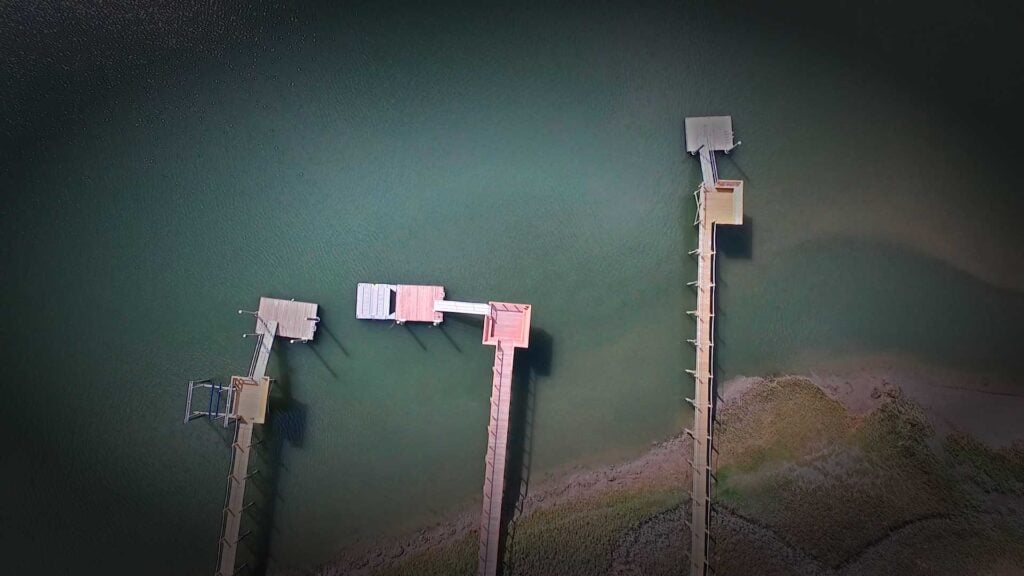
The Lowcountry does most of its dock maintenance in the wrong season. Owners notice problems in June, when the marsh is high, the water is warm, every crew in Charleston is booked, and hurricane season is about to start.
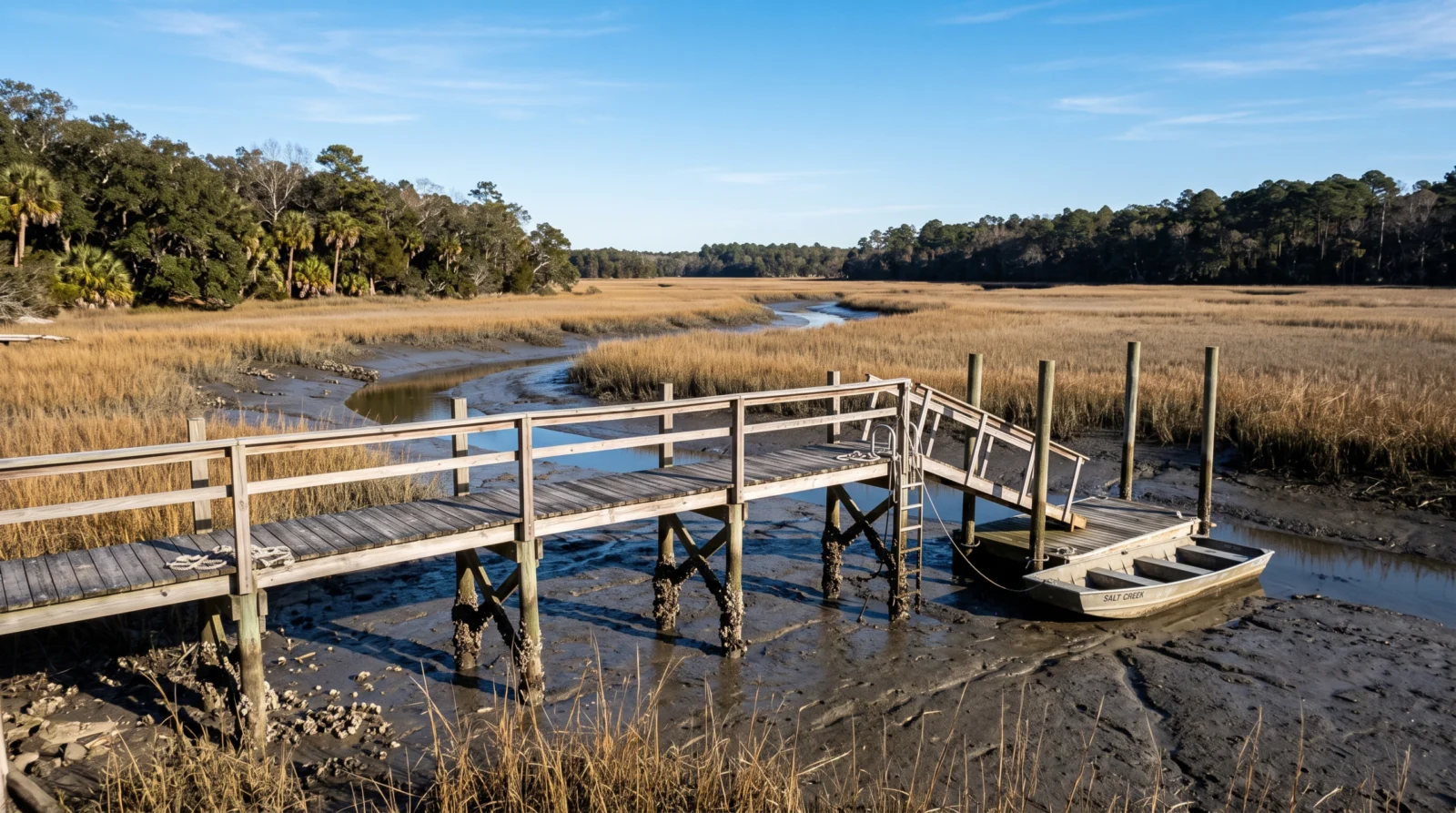
Winter is the better window, and it is better for four specific reasons. Extreme low tides fall in daylight between December and February, exposing pilings, toes and scour holes that are underwater the rest of the year. The marsh grass dies back, so you can actually see the structure. Storm risk is gone. And marine crews have availability they will not have again until autumn.
This is the punch list worth working through between November and March.
Start with a walk at the lowest tide of the year
Check a tide table and pick the lowest daylight tide in the window — usually a spring low around a new or full moon in December or January. Predictions for Charleston Harbour and the surrounding creeks are published by NOAA Tides and Currents.
Take a phone, a screwdriver, a tape measure and an hour. Photograph everything, including the things that look fine — a dated photographic record of your dock’s condition is the single most useful document you can have for an insurance claim, and it costs nothing.
The structure, from the bottom up
Pilings below the waterline. This is what the low tide is for. Look for hourglassing — a narrowing at or just below the mud line where marine borers have been working. Push a screwdriver into the timber at several heights; sound wood resists, compromised wood takes the blade. Check for movement by pushing hard at the top of each pile. Any pile that moves noticeably needs attention before it takes its neighbours with it.
Scour at the base. Look for depressions in the creek bed around pilings and at the toe of any bulkhead. Scour removes the embedment that holds everything up, and it worsens quietly.
Framing and connections. Get under the walkway where you can. Check bolts and straps for rust bleed and section loss. Any zinc-plated hardware still in service should be on the replacement list — it does not survive here. Look for splitting at bolt holes, which is where a connection fails.
Decking. Loose boards, protruding fasteners, soft spots, and boards cupping badly enough to hold water. Winter is the right time to re-deck; the material choice matters more than most owners expect, as we set out in the best decking and lumber for Charleston docks.
Rails, ladders and cleats. Grab every rail post and pull. Check ladder mounting bolts — they corrode faster than anything else on a dock because they sit in the splash zone permanently. Check that cleats are through-bolted, not lag-screwed.
The float, ramp and lift
Float units. Look for waterlogging — a float sitting lower than its neighbours has taken on water and will keep sinking. Check for cracked shells and for any bare polystyrene shedding into the creek.
Mooring hardware. Rollers, guides, bumpers and hinge pins are the components that wear, and winter is when they should be replaced. Check that the float still travels freely up and down its piles — a float that binds is a float that will be damaged by the next big tide. Our guide to floating dock mooring systems covers what each type needs.
Gangway. Check the hinge at the pierhead, the wheels or rollers at the float end, and the walking surface. Confirm the ramp is not bottoming out or riding off its track at extreme tides.
Boat lift. With the boat out for the winter, this is the only sensible time for a real service. Cables should be inspected along their whole length for broken strands, corrosion and flat spots — replaced every five to seven years in salt air regardless of appearance. Check pulleys for wear and free rotation, grease bearings, test the motor, and inspect the bunks or cradle. See our boat lift guide.
Bulkheads and seawalls
Walk the full length of the wall at low tide, then walk it again on the lawn side.
- Depressions or sinkholes in the lawn near the wall — soil is escaping through it. This is the most urgent finding on this entire list.
- A lean at the top, checked against a string line. Leaning means the tie-backs are going.
- Gaps opening behind the cap.
- Standing water behind the wall after rain — drainage has failed and hydrostatic pressure is building.
- Exposed tie-back rods or plates, and their condition.
- Scour at the toe, particularly at the ends where the wall meets a neighbour’s.
Our full diagnostic guide is at bulkhead replacement in Charleston, and the material comparison at choosing a seawall material for Lowcountry salt water.
Utilities and the freeze question
Charleston does not freeze often, but it freezes hard enough occasionally to split a dock water line — and repairing one means pulling the pipe out from under the walkway. Before the first hard freeze, shut off and drain the dock water line at the shore valve and open the hose bib to let it empty.
On the electrical side, test every GFCI receptacle and the feeder ground-fault device. Confirm the shore disconnect works. Check fixture housings for water ingress and replace any lamp that has failed. This is a good moment to have an electrician verify the ground-fault protection is functioning — it is the component that prevents electric shock drowning, and it should be tested at least twice a year. Details are in dock lighting, power and water.
Cleaning and coatings
Winter is also when the pleasant, low-stakes work belongs. Wash the decking, ideally at low pressure — aggressive pressure washing raises the grain on treated pine and shortens its life considerably. Rinse salt off railings and hardware. Re-oil hardwood decking if that is your maintenance routine; ipe and similar hardwoods should be cleaned and oiled in the cool season rather than in July heat.
Scrape barnacles and growth from the splash zone on pilings and float units where it has built up. It holds moisture against the structure and hides what is underneath.
The priority table
| Finding | Action | When |
|---|---|---|
| Sinkhole near bulkhead | Professional assessment | Now |
| Pile that moves under hand pressure | Professional assessment | Now |
| Bulkhead leaning waterward | Professional assessment | Now |
| Hourglassed or soft pilings | Repair or sister | This winter |
| Failed GFCI or ground-fault device | Electrician | This winter |
| Boat lift cable with broken strands | Replace | This winter |
| Waterlogged float unit | Replace | This winter |
| Loose or splitting decking | Re-deck section | This winter |
| Corroded zinc-plated hardware | Replace with galvanised / 316 | This season |
| Scour at pile bases | Monitor; armour if progressing | Watch |
| Weathered but sound decking | Clean; plan replacement | Watch |
Why the timing pays
Beyond the visibility and the crew availability, there is a straightforward economic argument. Marine repair costs rise steeply once a problem propagates. A single compromised pile addressed in January is a modest job. The same pile in July, having transferred its load to neighbours that have now moved, is a section rebuild.
And a dock that has been properly assessed and repaired over the winter enters hurricane season in known condition — which is worth a great deal when a storm is named. Our hurricane preparation guide assumes the structure underneath is sound; this is how you make sure it is.
Frequently asked questions
How often should a Lowcountry dock be inspected?
Annually as an owner walk-through, and professionally every three to five years or after any significant storm. Our dock inspection checklist covers the walk-through in detail.
Can dock repairs be done in winter?
Yes, and it is the best season for them. Cold weather is no obstacle to marine work here, low tides expose more of the structure, and crews are available. The only real constraint is winter wind, which costs occasional working days.
Do winter repairs need a permit?
Repair in kind and in place is generally treated as maintenance and does not. Replacing pilings in new positions, extending a structure or changing a bulkhead alignment does. Confirm before work starts — see our permitting guide.
Should I pressure wash my dock?
Lightly if at all. High pressure raises the grain on treated pine, opens the fibres to water and shortens the deck’s life. Low pressure and a suitable cleaner do more good.
How do I know if a piling needs replacing or just sistering?
It depends on where the section loss is and how much remains. A pile compromised near the mud line generally needs replacement; one with localised damage higher up can often be sistered. It is a judgement that needs someone to probe it — see dock piling repair and replacement.
Booking the season
Our winter calendar fills from October onward, and the properties that get looked at first are the ones that call before Christmas. If you would like a professional assessment while the water is at its lowest and the marsh is down, get in touch.