A private dock is the only structure on a Charleston waterfront property that has to survive full immersion in salt water twice a day, every day, for decades. It is also, for most owners, the part of the property they use most and look at most. Those two facts pull in different directions, and the whole discipline of building a good residential dock sits in holding them together.
BluTide Marine Construction builds private docks, piers, boat lifts and shoreline structures for waterfront homes across Charleston, Mount Pleasant, Daniel Island, James Island, Johns Island and the barrier islands. This page covers what that work involves — what your property will support, what the process looks like, and what to expect it to cost.
What a Charleston waterfront home dock consists of
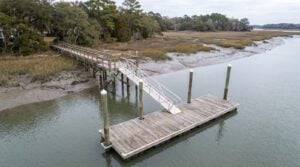
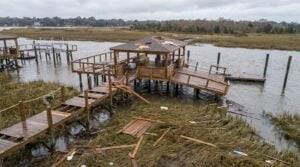
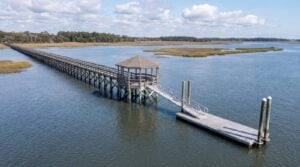
On most Lowcountry lots, the water is a considerable distance from dry land across protected salt marsh. That produces the four-part structure that has become the regional standard:
- A fixed walkway crossing the marsh on driven pilings, from the high-ground bulkhead or bank out to usable water.
- A fixed pierhead — the platform at the end. Benches, rails, a ladder, a cleaning station, often a roof.
- An aluminium gangway hinged at the pierhead, riding on the float below.
- A floating dock that holds the boat at a constant boarding height through the tidal swing, usually with a lift alongside.
Not every property needs all four. On shallow northern creeks a well-built fixed pierhead is the honest answer and the float would spend half its life in mud. We work through that decision in fixed vs. floating docks in Lowcountry tidal water.
The three conditions every Charleston dock is built against
A five-to-six-foot tidal range. Deck elevation, ramp length and float position are all calculations made against both the spring high and the winter low, not the pleasant middle you see on a site visit.
Pluff mud. The surface layer in these creeks carries almost no load. Pilings have to be driven past it into competent sand or firm clay, and the depth to that layer varies across a single lot. It is the largest single variable in what a dock costs.
Brackish salt water. Twenty to thirty parts per thousand, twice a day, for the life of the structure. It governs lumber treatment, fastener metallurgy and hardware selection, and it is unforgiving of shortcuts.
How we build
Pilings are driven, not jetted or augered. A driven pile sets by friction into undisturbed soil and holds. A jetted pile sits in ground that has been washed loose around it, and it will move. This is the difference you cannot see from the deck and cannot fix later without rebuilding. Our marine pile driving guide explains the methods and where each belongs.
Framing is sized for coastal loading. Marine-grade pressure-treated southern yellow pine, retention-rated for saltwater immersion below the waterline and ground contact above it. Joist spacing and stringer sizing set for the deck load and the span, not for the minimum that passes.
Fasteners are hot-dip galvanised at minimum, 316 stainless in the splash zone. Every connection below the deck and anywhere spray reaches. Zinc-plated hardware from a home centre will bleed rust down the pilings within a season and lose section within a decade.
Decking is specified to the property. Treated pine where budget leads. Ipe where the owner wants a hardwood that silvers beautifully and lasts forty years. Composite where the priority is a barefoot surface with no annual maintenance. We cover the trade-offs in the best decking and lumber for Charleston docks and in aluminium vs. wood docks.
Deck elevation is set for surge, not convenience. A dock deck set too low is a dock that gets lifted off its pilings in a storm. We build to the elevation the structure needs and design the approach around it.
What a residential dock costs in Charleston
| Element | Typical installed range | Principal cost driver |
|---|---|---|
| Marsh walkway | $110 – $190 per linear foot | Length, pile depth, barge vs. land access |
| Fixed pierhead | $60 – $110 per square foot | Size, rails, benches, finish level |
| Covered pierhead | + $28,000 – $75,000 | Span, roof material, ceiling finish, added pile work |
| Aluminium ramp + float | $18,000 – $40,000 | Ramp length, float size, mooring type |
| Boat lift | $9,000 – $30,000+ | Capacity, lift type, whether new pilings are needed |
| Power, lighting and water | $6,000 – $18,000 | Distance from panel, service size, lift circuit |
| Survey and permitting | $3,500 – $9,000 | Agency review depth, HOA, surveys required |
A short pier on deep water with a modest pierhead sits near the bottom of that stack. A long marsh crossing to a covered pierhead with ramp, float and lift sits well above it. The walkway length moves the total more than any other single decision. Our detailed breakdown is in how much a boat dock really costs.
Permitting and timeline
Every private dock in the Charleston area needs a critical area permit from the state’s coastal management programme, and most need concurrent authorisation from the U.S. Army Corps of Engineers. Many neighbourhoods add an architectural review of their own.
Realistically, plan on nine to fifteen months from first conversation to finished dock, of which six to twelve months is permitting and design and four to ten weeks is construction. We set the whole schedule out month by month in how long it takes to build a dock in Charleston, and the agency process itself in our guide to OCRM and DHEC permitting. Current forms and rules are published by the South Carolina Department of Environmental Services.
We handle the applications, the surveys, the agency correspondence and the HOA submissions as part of the project. Owners should not be chasing agencies.
Where we build
We work across the Charleston metro and the wider Lowcountry coast. Several submarkets have conditions specific enough to warrant their own guides:
- Mount Pleasant — Shem Creek, the Wando, Copahee Sound
- Kiawah Island — critical zone building and POA standards
- Seabrook Island — salt marsh, OCRM setbacks, POA review
- Sullivan’s Island — historic barrier island constraints
- Isle of Palms — Wild Dunes and the Connector
- Beaufort and Hilton Head — the lower SC coast
Choosing between builders
There are good marine contractors in this market and there are people with a barge. The questions that separate them are specific, and we set them out in full in our guide to choosing a dock builder in Charleston. The short version:
- Ask whether pilings are driven or jetted, and get the answer in writing.
- Ask what fastener specification is quoted — hot-dip galvanised and 316 stainless, or zinc plated.
- Ask who prepares and files the permit, and whether the fee is in the quote.
- Ask to see docks the builder finished eight to ten years ago, not eight months ago. Salt water tells the truth on that timescale.
- Confirm marine general liability and workers’ compensation cover, and that the contractor is licensed in South Carolina.
Frequently asked questions
How much does a private dock cost in Charleston?
Most residential docks in the Charleston area land between $45,000 and $180,000 installed. Short piers on deep water sit at the lower end; long marsh crossings with a covered pierhead, float and lift sit at the upper end.
How long will a well-built dock last?
Driven pilings and properly specified framing should give 25 to 40 years. Decking is normally the first element replaced, at 15 to 20 years for treated pine and considerably longer for hardwood or composite. Float units and hardware run 15 to 25 years.
Can you repair my existing dock instead of replacing it?
Very often, and it is usually better value — an existing permitted footprint is worth preserving. Where the pilings are sound, re-framing and re-decking costs a fraction of a new structure. See our guide to dock piling repair and replacement.
Do I need a boat lift?
If a boat lives at the dock, a lift extends hull, running gear and bottom-paint life substantially and removes the risk of a boat sinking on its lines. On rivers with current and wake, like the Wando and the Ashley, it is close to essential. See our boat lift guide.
What size dock can I build?
State rules cap walkway width and limit pierhead size relative to the width of the waterway, so a narrow creek constrains more than a broad river. Our dock dimensions guide covers the standard sizes.
What happens to a dock in a hurricane?
A dock built to the right deck elevation with adequate pile embedment and through-flow decking generally survives. Ones that fail usually fail because surge lifted a deck set too low. Our hurricane preparation guide covers the pre-season checklist.
Starting a project
Every dock we design starts with a walk of the property at low tide — depth at the mooring point, distance from high ground, creek width, and where the critical-area line falls. Those four measurements decide the design and most of the cost, and no honest number can be given before they are taken.
If you own waterfront in the Charleston area and are thinking about a dock, get in touch. Finished work across the Lowcountry is in our project gallery, and our full residential capability is set out on our residential page.